Federal Defence Contracts in Canada: What 28,938 Awards Show About Who Wins
ARTICLE SUMMARY
Federal departments awarded $75.6 billion in aerospace, defence and marine contracts from 2020 through 2025, across 28,938 contracts and 1,618 vendors.
- For
- Vendors, buyers, and readers following Canadian procurement
- Main topic
- Defence Procurement
- Why it matters
- The article's argument is summarized up front so people and agents can grasp the point before reading the full body.
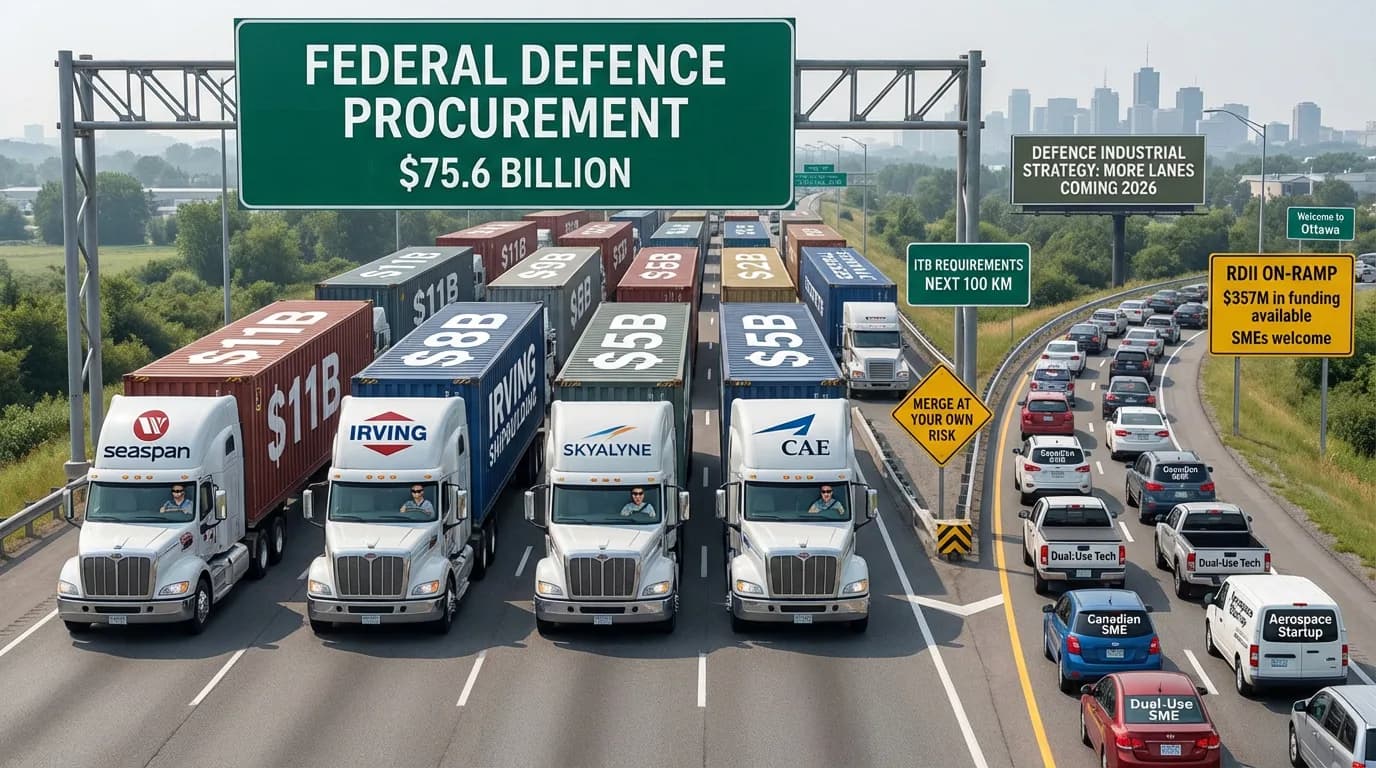
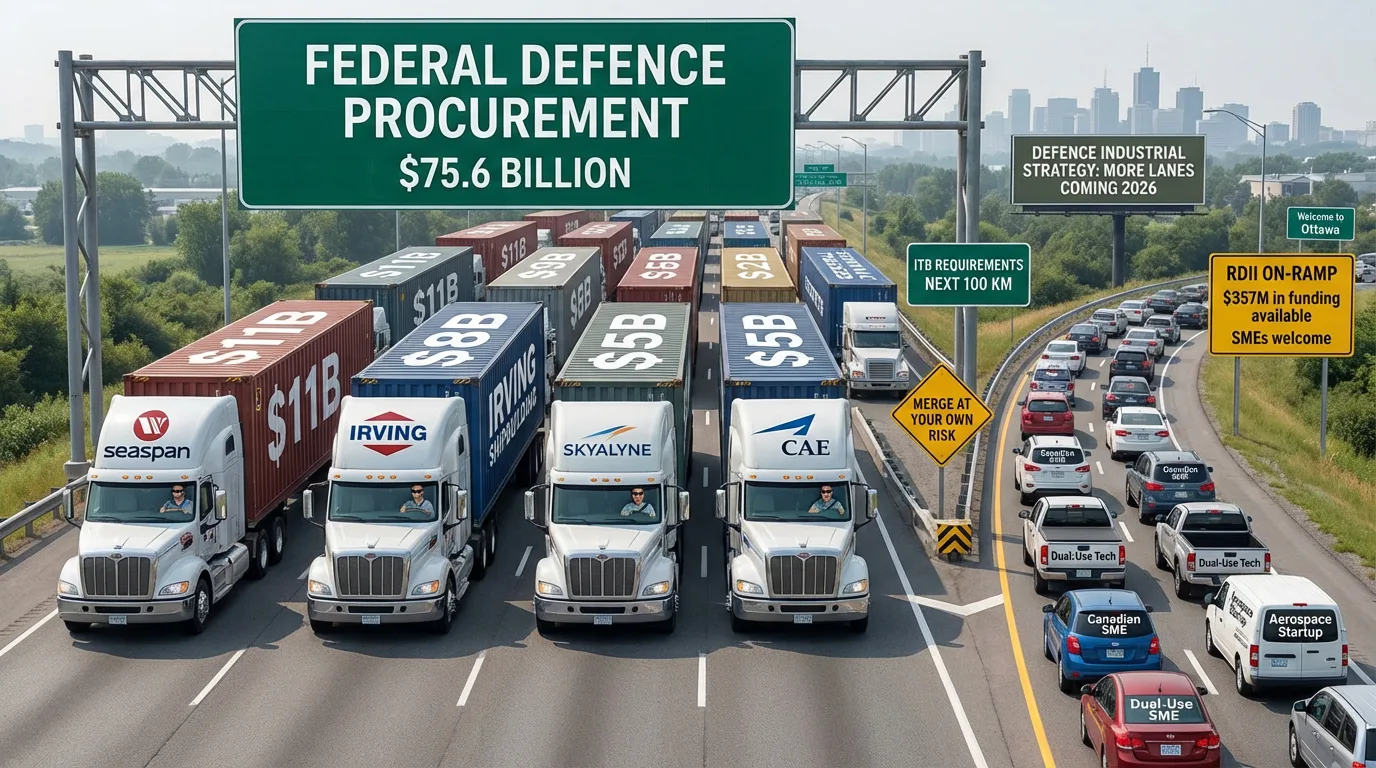
Federal departments awarded $75.6 billion in aerospace, defence and marine contracts from 2020 through 2025, across 28,938 contracts and 1,618 vendors. Annual awards grew 565 percent between 2021 and 2024, and five contractors hold 53 percent of the dollars. National Defence is the buyer behind three of every four of those dollars. This page breaks down who buys, who wins, why a few mega-contracts decide the market, and where smaller Canadian suppliers can get in (original GovCon Weekly analysis).
How fast have federal defence contract awards grown since 2020?
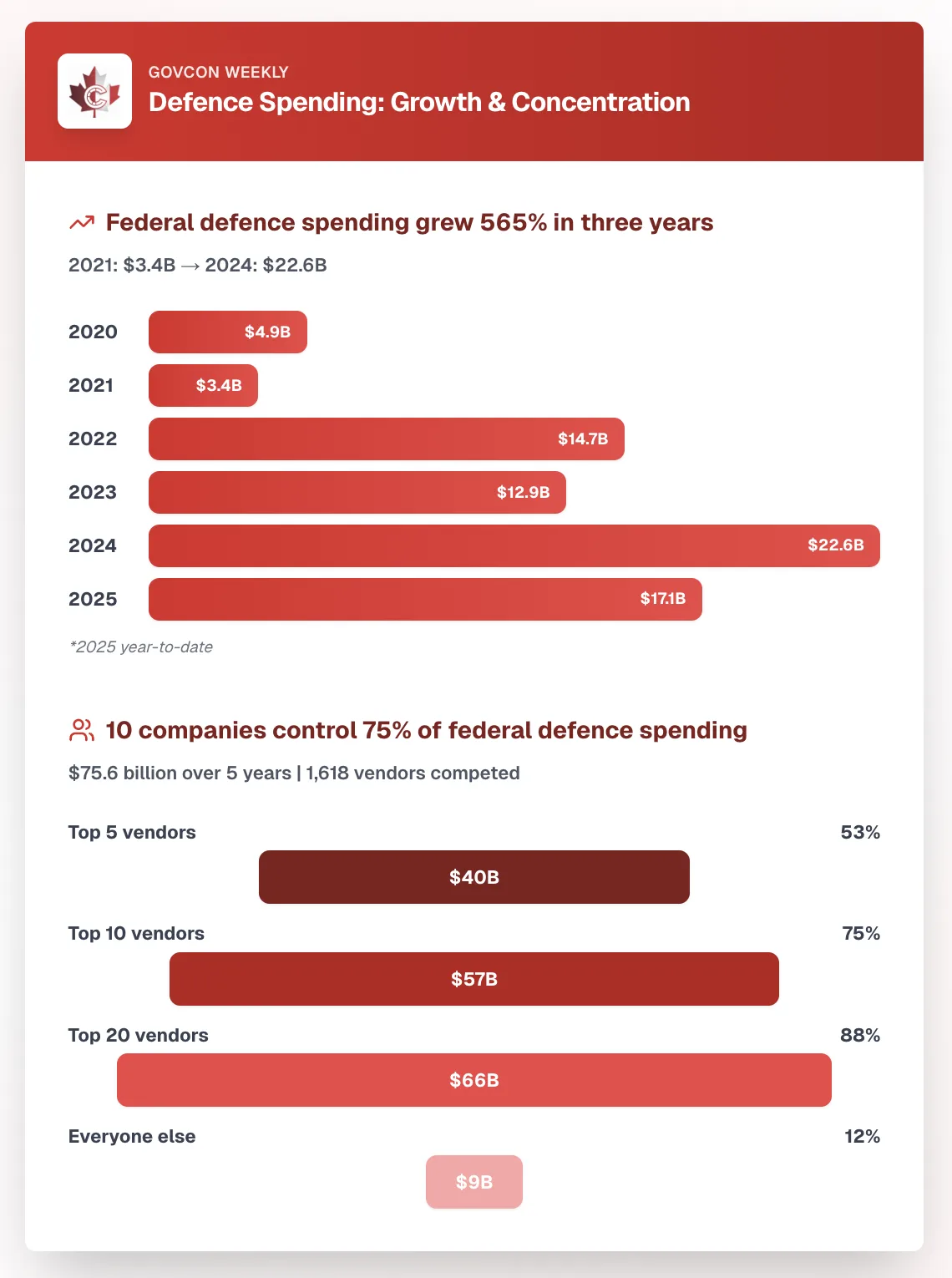
Annual awards went from $3.4 billion in 2021 to $22.6 billion in 2024, a 565 percent increase in three years. The market operates nothing like IT services: it is shaped by shipbuilding mega-contracts, a small club of prime contractors, and growth that is accelerating faster than any other federal category. With 2025 not yet complete when the data was pulled, it had already reached $17.1 billion (year-by-year figures).
| Year | Defence, aerospace and marine contracts awarded |
|---|---|
| 2020 | $4.9B |
| 2021 | $3.4B |
| 2022 | $14.7B |
| 2023 | $12.9B |
| 2024 | $22.6B |
| 2025 (year to date) | $17.1B |
| Total | $75.6B |
Source: Publicus analysis of 28,938 federal aerospace, defence and marine contracts, 2020 to 2025 (2025 year to date), first published in GovCon Weekly.
Contracts are also getting bigger, not just more numerous. The average contract value rose from $782,000 in 2021 to $4.4 million in 2025. The government is consolidating its defence buying into larger, more complex procurements, which changes who can realistically compete for prime work (contract size analysis).
Which federal departments award defence and marine contracts?
National Defence awards 76 percent of the sector's contract value, $57.2 billion. The Canadian Coast Guard and Fisheries and Oceans take 18 percent ($13.3 billion), and the Canadian Space Agency 3 percent ($2.5 billion). In practice this is a two-customer market, and for most contractors DND is the only one that really matters (buyer breakdown).
| Buyer | Contracts awarded | Share |
|---|---|---|
| National Defence | $57.2B | 76% |
| Canadian Coast Guard / Fisheries and Oceans | $13.3B | 18% |
| Canadian Space Agency | $2.5B | 3% |
Source: Publicus analysis of 28,938 federal aerospace, defence and marine contracts, 2020 to 2025 (2025 year to date), first published in GovCon Weekly.
Who wins the most federal defence contracts?
Three shipyards account for $23.3 billion: Seaspan ($11.0 billion), Halifax Shipyard/Irving ($8.4 billion) and Davie ($3.8 billion). Add SkyAlyne's $11.2 billion Future Aircrew Training (FAcT) contract and CAE's $5.0 billion, and five vendors hold about half of the entire market (vendor rankings).
| Vendor | Contracts awarded |
|---|---|
| SkyAlyne (FAcT training) | $11.2B |
| Seaspan | $11.0B |
| Halifax Shipyard / Irving | $8.4B |
| CAE | $5.0B |
| Davie | $3.8B |
Source: Publicus analysis of 28,938 federal aerospace, defence and marine contracts, 2020 to 2025 (2025 year to date), first published in GovCon Weekly.
The concentration goes deeper than the top five. Those five vendors capture 53 percent of contract value, the top ten 75 percent, and the top twenty 88 percent. For comparison, the top twenty vendors in federal IT services hold 58 percent. Everyone else shares the last 12 percent, about $9 billion (concentration analysis).
| Vendor group | Contracts awarded | Share of $75.6B |
|---|---|---|
| Top 5 vendors | $40B | 53% |
| Top 10 vendors | $57B | 75% |
| Top 20 vendors | $66B | 88% |
| Everyone else | $9B | 12% |
Source: Publicus analysis of 28,938 federal aerospace, defence and marine contracts, 2020 to 2025 (2025 year to date), first published in GovCon Weekly.
On the textbook measure, the Herfindahl-Hirschman Index, the market scores 761, which classifies it as "unconcentrated." That is absurd when ten vendors control three-quarters of the dollars. Federal defence procurement is a closed ecosystem with very high barriers to entry (GovCon Weekly).
Why do a few mega-contracts decide the defence market?
This is the number that defines the market: 46 contracts worth $100 million or more represent 84 percent of all sector contract value. That is about $63 billion flowing through fewer than 50 procurement vehicles. Another 78 contracts in the $25 million to $100 million range add just 5 percent more (contract size bands).
| Contract size | Number of contracts | Share of contract value |
|---|---|---|
| $100M or more | 46 | 84% |
| $25M to $100M | 78 | 5% |
| Under $25M | The rest of the 28,938 | About 11% |
Source: Publicus analysis of 28,938 federal aerospace, defence and marine contracts, 2020 to 2025 (2025 year to date), first published in GovCon Weekly.
The overwhelming majority of the 28,938 contracts in the dataset compete for roughly 11 percent of the available dollars. The National Shipbuilding Strategy and major platform acquisitions such as the F-35, the Future Fighter and the surface combatants are what drive that consolidation. If a Canadian prime is not already positioned on these programs, its window is closing (GovCon Weekly).
What do Buy Canadian, RDII and SAFE change for defence suppliers?
Ottawa knows the concentration is a problem, and three late-2025 measures are its answer. Incumbents will keep winning the major platforms, but the government is building on-ramps for everyone else.
- Buy Canadian at $25 million: the Treasury Board Secretariat confirmed that all federal contracts over $25 million must prioritize Canadian materials, including steel, aluminum and wood, with the same threshold for grants and contributions. Officials projected over $1 billion in new demand for Canadian steel. Expect Canadian content plans, certifications and material origin documentation in large RFPs.
- Regional Defence Investment Initiative (RDII): a $357.7 million program delivered through the regional development agencies to expand defence industrial capacity. Southern Ontario alone receives nearly $200 million ($94.7 million through RDII plus $106 million in additional FedDev Ontario resources). It targets small and mid-sized firms and dual-use businesses moving into defence supply chains, with streams for Atlantic Canada, Quebec, Ontario, the Prairies, B.C. and the North.
- EU SAFE: Canada became the first non-European country to join the EU's Security Action for Europe initiative, a €150 billion rearmament fund. Canadian firms can bid on SAFE-funded joint projects but must work within a 65 percent EU-origin component rule, with exemptions possible for partner countries.
Small and medium enterprises make up 92 percent of the defence industry but only 40 percent of its jobs, and RDII is designed to change that ratio. It is groundwork for the Defence Industrial Strategy, which has $6.6 billion allocated over five years: a way to build the supplier base before the larger contracts flow (National Defence announcement). The $357.7 million is the government's own acknowledgment that the current market structure excludes most Canadian businesses.
How can a smaller Canadian company win federal defence work?
Forget competing with the primes. With 46 contracts carrying 84 percent of the dollars, the route in for most firms is through the Industrial and Technological Benefits (ITB) policy, which requires Canadian investment equal to the value of major contracts over $100 million. Seaspan, Irving, CAE and the other top vendors need Canadian subcontractors to meet those commitments.
- Small and mid-sized suppliers: make yourself essential to a prime's ITB compliance, and apply for RDII funding while it is available (program details).
- Canadian primes: position on the shipbuilding and platform programs now; RDII is explicitly designed to build the supply chain capacity they need.
- Firms bidding above $25 million: get steel provenance certifications, material sourcing records and supply chain tracking in order before RFPs require them (Buy Canadian policy).
- Foreign firms: international participation is significant (Airbus, KNDS, General Atomics, Leonardo UK) but increasingly runs through Canadian subsidiaries or partnerships. Bidding without a Canadian presence is becoming untenable under ITB and Buy Canadian.
- Aerospace, cyber and drone firms: build relationships with European manufacturers. Joint ventures and consortia with EU primes will become the standard way to take part in SAFE projects.
For the supplier-level view of who sits beneath these primes, see our map of Canada's defence procurement supply chain. To follow federal award records yourself, start with Publicus procurement awards.
About the data
Figures come from a Publicus analysis of 28,938 federal contracts in the aerospace, defence and marine sectors, awarded from 2020 through 2025, totalling $75.6 billion across 1,618 vendors. Federal contract records of this kind are published through the government's Proactive Publication of Contracts dataset. The 2025 figures are year to date as of the original publication, so that year is incomplete and the growth comparison uses 2021 to 2024. This analysis first appeared in GovCon Weekly on December 9, 2025.
- defence procurement
- federal contracts
- national defence
- shipbuilding
- itb
- govcon weekly