Mapping Canada's Defence Supply Chain: $102B in Contracts, 8,536 Organizations and a Cleared Bench of 2,458
ARTICLE SUMMARY
Canada's defence supply chain is far wider than its prime contractor list. Across 8,536 organizations , Publicus counts about $102 billion in observed defence procurement over roughly ten years, plus $6.7 billion in...
- For
- Vendors, buyers, and readers following Canadian procurement
- Main topic
- Defence Procurement
- Why it matters
- The article's argument is summarized up front so people and agents can grasp the point before reading the full body.

Canada's defence supply chain is far wider than its prime contractor list. Across 8,536 organizations, Publicus counts about $102 billion in observed defence procurement over roughly ten years, plus $6.7 billion in defence-relevant grants, drawn from federal contract disclosure and grants records. The more useful number sits underneath: 2,880 organizations hold Controlled Goods Program registration, and 2,458 of them have no observed prime contract. That is a cleared, defence-ready bench sitting one teaming agreement away from the work.

The map below links every participant Publicus could find: who owns them, which contracts they have won, which grants they have received and what they make. It is built to show where the supply chain is thin, where it is crowded, and where the openings are (original GovCon Weekly analysis).
Which defence categories carry the most contract value?
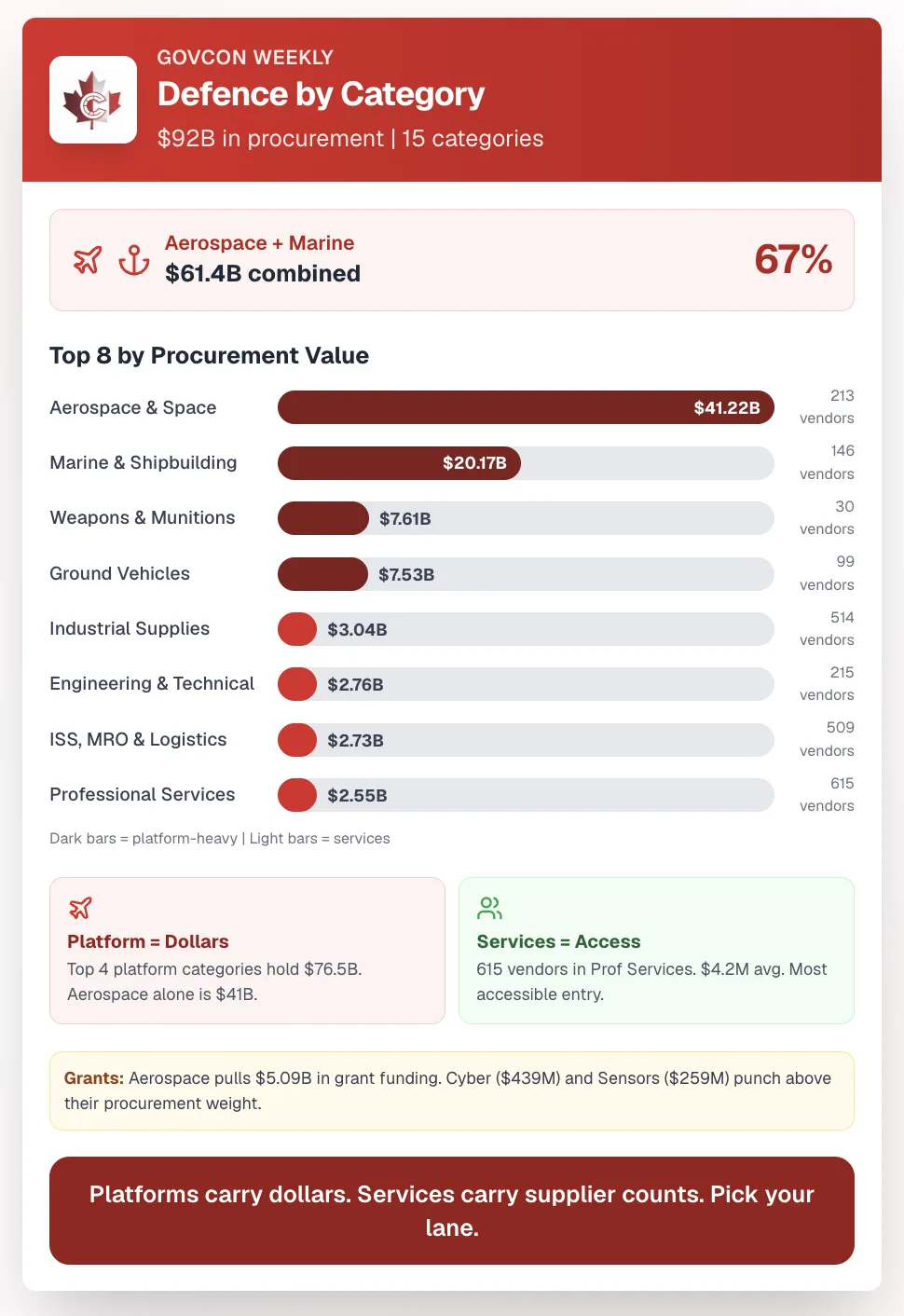
Aerospace and marine dominate. Together they account for $61.4 billion in observed procurement, about 67 percent of the $92 billion that falls into the fifteen categories below and more than every other category combined (contract disclosure). Platform-heavy categories carry the dollars. Services and sustainment categories carry the supplier counts.
| Category | Vendors with contracts | Procurement | Grants |
|---|---|---|---|
| Aerospace and Space Systems | 213 | $41.22B | $5.09B |
| Marine and Shipbuilding | 146 | $20.17B | $37.9M |
| Weapons, Munitions and Effects | 30 | $7.61B | $6.5M |
| Ground Vehicles and Mobility | 99 | $7.53B | $88.3M |
| Industrial and Commercial Supplies | 514 | $3.04B | $4.3M |
| Defence Engineering and Technical Services | 215 | $2.76B | $175.3M |
| In-Service Support, MRO and Logistics | 509 | $2.73B | $5.1M |
| Professional, Business and Specialised Services | 615 | $2.55B | $81.8M |
| Cyber and Information Security | 79 | $1.29B | $438.6M |
| AI, Software and Data Systems | 191 | $1.27B | $59.4M |
| C4ISR and Communications | 119 | $939.5M | $165.8M |
| Soldier Systems and Protection | 88 | $500.4M | $3.3M |
| Sensors, EO/IR, Radar and Sonar | 95 | $424.8M | $258.5M |
| Training, Simulation and Wargaming | 120 | $377.3M | $228.0M |
| Advanced Materials and Manufacturing | 74 | $184.8M | $28.9M |
Source: federal proactive contract disclosure and grants and contributions records, about ten years cumulative, analysed by Publicus.
Three patterns stand out. Professional services is the broadest competitive field: 615 vendors sharing $2.55 billion, under $4.2 million each on average, which makes it the most accessible category for a new entrant without a platform anchor. In-service support and MRO is a sleeper: 509 vendors and $2.73 billion, nearly matching engineering services on both counts, yet fleet life-cycle work gets almost no policy attention next to platform buys. Industrial supplies has the lowest dollars per vendor, about $5.9 million each across 514 firms, against roughly $193 million per vendor in aerospace and $138 million in marine (category analysis).
How much defence procurement goes to foreign-owned firms?
This is where the numbers stop lining up with the political conversation. Foreign-owned firms are about 17 percent of the supplier base and hold around 55 percent of observed procurement value. Canadian-owned firms hold the bench instead: 6,704 companies against 1,459, three times the grant capture, and six times the Controlled Goods registrations (registration data).
| Ownership | Companies | Procurement | Grants | Controlled Goods registrations |
|---|---|---|---|---|
| Foreign-owned | 1,459 | $55.90B | $1.63B | 395 |
| Canadian-owned | 6,704 | $45.33B | $5.04B | 2,406 |
| Uncertain | 373 | $775.7M | $25.3M | 79 |
Source: Controlled Goods Program registrations matched to federal contract disclosure, analysed by Publicus.
The two populations convert their presence into different things. Foreign-owned firms turn it into contracts; Canadian-owned firms turn it into grants and clearances. One distinction matters before anyone draws a policy conclusion: many foreign-owned firms here run substantial Canadian facilities and Canadian workforces. They are foreign-owned, not foreign-located, and they deliver real industrial benefit in Canada. That nuance belongs in any debate about Canadian content thresholds, and in any pitch a contractor makes to a prime about offset value under the Industrial and Technological Benefits policy.
How concentrated are Canada's defence markets?
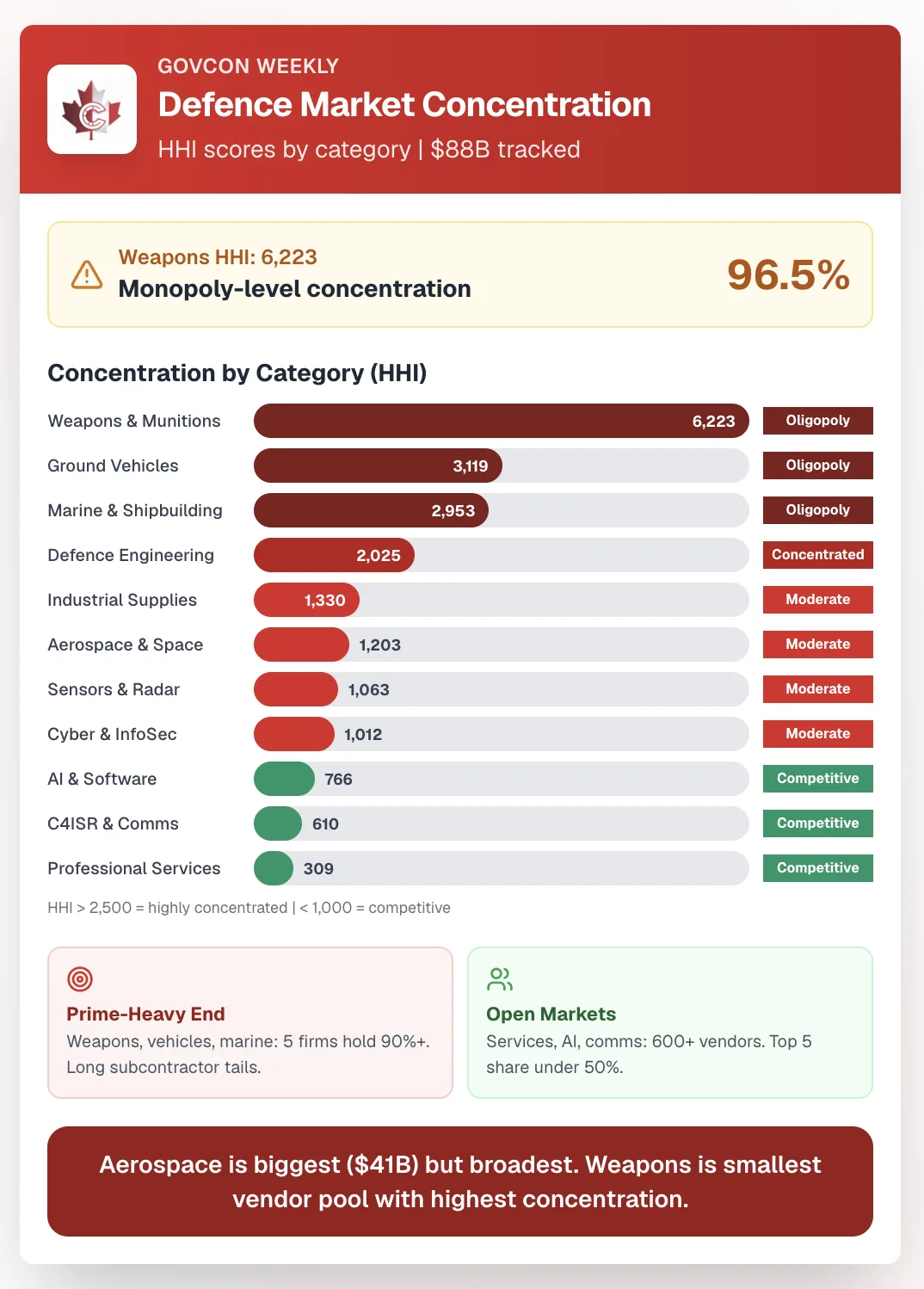
Weapons and ground vehicles are the most concentrated strategic categories. Aerospace, despite carrying the largest dollar total, is meaningfully broader. The table uses the Herfindahl-Hirschman Index (HHI), the measure competition regulators use, where scores above 2,500 indicate a highly concentrated market and scores under 1,000 a competitive one.
| Category | Vendors | Procurement | Top 5 share | HHI |
|---|---|---|---|---|
| Weapons, Munitions and Effects | 30 | $7.61B | 96.5% | 6,223 |
| Ground Vehicles and Mobility | 99 | $7.53B | 93.7% | 3,119 |
| Marine and Shipbuilding | 146 | $20.17B | 89.9% | 2,953 |
| Defence Engineering and Technical Services | 215 | $2.76B | 76.5% | 2,025 |
| Industrial and Commercial Supplies | 514 | $3.04B | 53.0% | 1,330 |
| Aerospace and Space Systems | 213 | $41.22B | 62.8% | 1,203 |
| Sensors, EO/IR, Radar and Sonar | 95 | $424.8M | 57.8% | 1,063 |
| Cyber and Information Security | 79 | $1.29B | 59.8% | 1,012 |
| AI, Software and Data Systems | 191 | $1.27B | 47.4% | 766 |
| C4ISR and Communications | 119 | $939.5M | 48.0% | 610 |
| Professional and Business Services | 615 | $2.55B | 33.6% | 309 |
Source: federal proactive contract disclosure and grants and contributions records, about ten years cumulative, analysed by Publicus.
Read it from both ends. At the prime-heavy end, weapons runs at an HHI of 6,223, the kind of number regulators associate with monopoly conversations, and five firms hold 96.5 percent of observed value. Ground vehicles and marine are not far behind: a small handful of integrators with a long subcontractor tail. At the competitive end, professional services sits at 309 with 615 active vendors, and AI and software, C4ISR and cyber are all in the moderately competitive range. Those are the categories where new entrants still have room (concentration analysis).
How many Canadian firms are cleared for defence work but have never won a prime contract?
The Controlled Goods Program register is one of the better proxies for defence-ready industrial capacity, because it captures every organization cleared to handle controlled technical data and components. Of the 2,880 registered organizations in the data, 2,458 have not won an observed prime contract. The Canadian-owned share of the register is 84 percent (contract records).
| Category | Controlled Goods firms | Canadian-owned | Procurement |
|---|---|---|---|
| Defence Engineering and Technical Services | 463 | 424 | $2.05B |
| Aerospace and Space Systems | 381 | 293 | $25.45B |
| Professional and Business Services | 329 | 302 | $227.8M |
| In-Service Support, MRO and Logistics | 328 | 257 | $1.66B |
| AI, Software and Data Systems | 230 | 180 | $773.3M |
| Marine and Shipbuilding | 125 | 92 | $4.14B |
| Cyber and Information Security | 123 | 97 | $464.2M |
| C4ISR and Communications | 87 | 63 | $283.2M |
| Construction and Facilities Operations | 55 | 53 | $2.03B |
| Weapons, Munitions and Effects | 29 | 22 | $310.5M |
Source: Controlled Goods Program registrations matched to federal contract disclosure, analysed by Publicus.
- For primes building ITB commitments: this is the long list of potential Canadian content partners. The categories with the largest cleared rosters and the smallest procurement totals hold the most underused capacity (ITB policy).
- For SMEs without a prime relationship: this is the peer set worth knowing. Engineering and technical services shows 463 cleared firms against $2.05 billion in observed procurement, a wide supplier pool that has not consolidated (cleared-firm analysis).
- For policy teams: the industrial base policy is trying to protect is mostly already cleared, mostly Canadian-owned, and mostly not winning prime contracts.
Which federal grant programs fund defence-relevant companies?
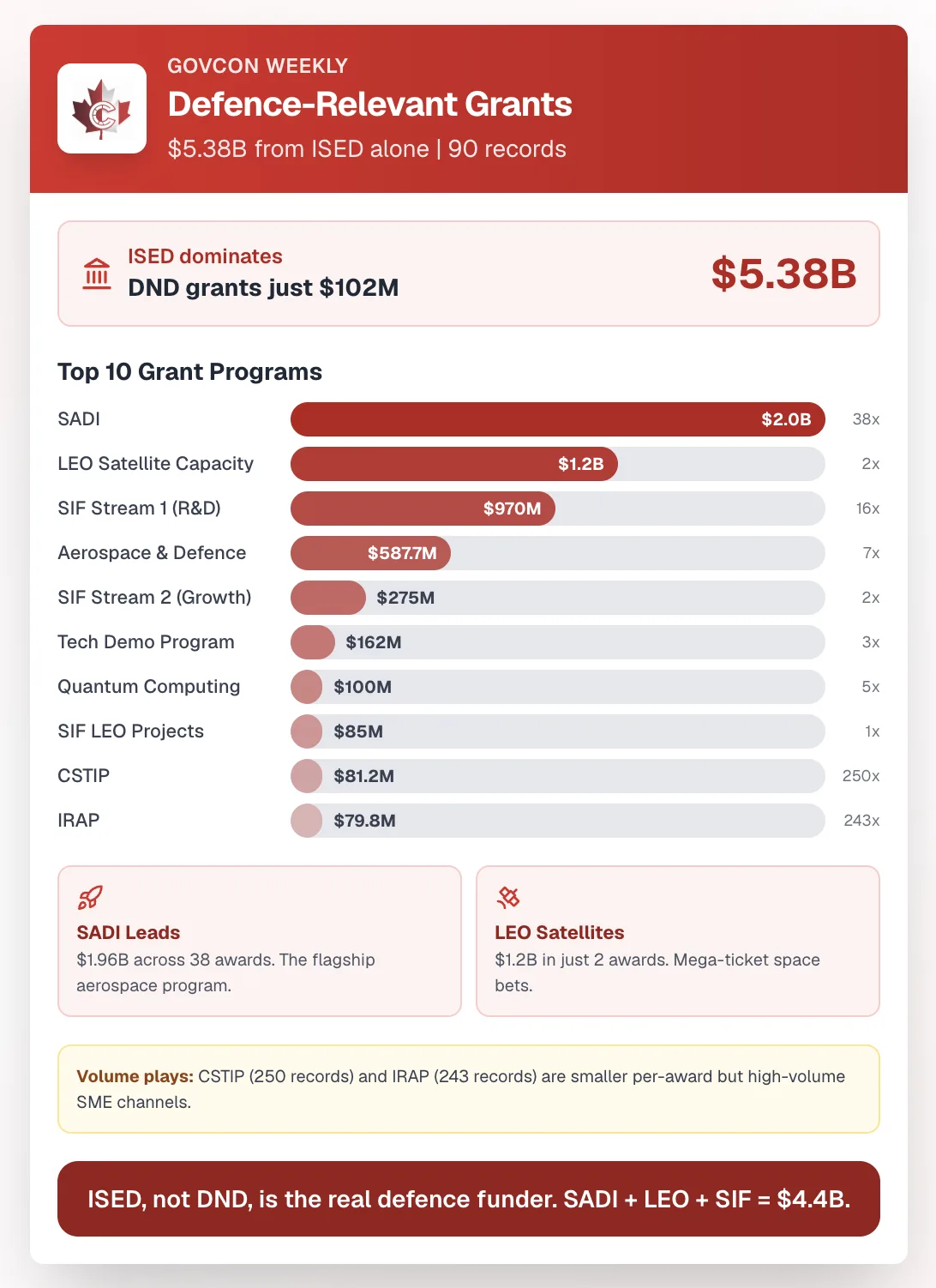
Innovation, Science and Economic Development Canada is the dominant funder by a wide margin, with $5.38 billion across 90 defence-relevant grant records. National Defence's own grant programs total $102.4 million, and the rest is spread across the National Research Council, Public Safety, Global Affairs and the regional development agencies (grants disclosure). In short, ISED, not DND, is the real defence funder.
| Grant program | Value | Records |
|---|---|---|
| Strategic Aerospace and Defence Initiative (SADI) | $1.96B | 38 |
| Low Earth Orbit Satellite Capacity Agreement | $1.20B | 2 |
| Strategic Innovation Fund, Stream 1 (R&D) | $970.0M | 16 |
| Aerospace & Defence | $587.7M | 7 |
| Strategic Innovation Fund, Stream 2 (Growth) | $275.0M | 2 |
| Technology Demonstration Program | $162.0M | 3 |
| Institute for Quantum Computing | $100.0M | 5 |
| SIF, Low Earth Orbit Satellite Projects | $85.0M | 1 |
| Collaborative Science, Technology and Innovation Program | $81.2M | 250 |
| Industrial Research Assistance Program | $79.8M | 243 |
Source: federal grants and contributions disclosure, defence-relevant records, analysed by Publicus.
- SADI: the workhorse repayable contributions program for aerospace and defence, and the main federal vehicle for major Canadian aerospace players for more than a decade, with 38 records totalling nearly $2 billion (records).
- Strategic Innovation Fund: newer and broader than SADI. Stream 1 funds R&D and Stream 2 funds growth and scale-up; together they have placed more than $1.2 billion in defence-relevant work (records).
- Technology Demonstration Program: smaller at $162 million, aimed at industry and government collaboration on emerging defence capabilities. Three records, three big bets (records).
- Institute for Quantum Computing: $100 million across five records, a national bet on quantum capability anchored at the University of Waterloo (records).
- IRAP and the Collaborative Science program: the high-volume, lower-dollar end, with 243 and 250 records respectively, doing the work of seeding small-firm capability (NRC IRAP).
- LEO Satellite Capacity Agreement: the outlier. Two records, $1.2 billion: a national capability commitment structured as a grant (records).
Do defence grants turn into government contracts?
Matching grant recipients against contract winners shows which categories work as a pipeline. Conversion here is the share of grant-receiving organizations in a category that also appear as procurement vendors, and converted procurement is what those firms have since won (contract records).
| Category | Grant orgs | Also vendors | Conversion | Converted procurement |
|---|---|---|---|---|
| Construction and Facilities Operations | 3 | 3 | 100.0% | $788K |
| Training, Simulation and Wargaming | 2 | 2 | 100.0% | $6.64M |
| Professional and Business Services | 16 | 14 | 87.5% | $45.9M |
| Soldier Systems and Protection | 6 | 5 | 83.3% | $27.75M |
| Marine and Shipbuilding | 20 | 15 | 75.0% | $416.4M |
| In-Service Support, MRO and Logistics | 3 | 2 | 66.7% | $629K |
| Defence Engineering and Technical Services | 22 | 14 | 63.6% | $1.05B |
| Sensors, EO/IR, Radar and Sonar | 23 | 13 | 56.5% | $135.7M |
| C4ISR and Communications | 15 | 8 | 53.3% | $49.9M |
| Cyber and Information Security | 11 | 5 | 45.5% | $16.2M |
| Ground Vehicles and Mobility | 7 | 3 | 42.9% | $13.4M |
| AI, Software and Data Systems | 26 | 11 | 42.3% | $17.5M |
| Aerospace and Space Systems | 115 | 43 | 37.4% | $4.49B |
| Advanced Materials and Manufacturing | 15 | 2 | 13.3% | $5.48M |
Source: federal grants and contributions disclosure, defence-relevant records, analysed by Publicus.
Marine is the standout in absolute terms: $37.9 million in grants associated with firms now holding $416 million in defence procurement, which reflects the National Shipbuilding Strategy's deliberate use of grants to build the supplier base ahead of major builds. Aerospace converts at a lower rate but at far greater scale, with 43 of 115 grant recipients now vendors holding $4.49 billion. Cyber, AI and C4ISR all sit between 40 and 55 percent, reasonable given how recently they became defence priorities; treat those as early indicators, not steady state. Advanced materials lags at 13.3 percent, either because the category is earlier in its development or because domestic production feeds non-defence buyers more readily than DND (conversion analysis).
Which dual-use Canadian companies are next in line for defence contracts?
The clearest signal of where the next wave of Canadian defence vendors comes from is firms that hold meaningful grants, sit on the Controlled Goods register, and have little or no procurement yet. The data turns up more than 40 of them across sensors, C4ISR, cyber, AI, advanced materials and training. A handful stand out (grant records):
- Cohere Inc.: Toronto foundation model company. $240 million in grants, $0 in observed defence procurement, CADSI member, Controlled Goods registered, Canadian-owned. The largest grant footprint on the watchlist and the clearest Canadian AI capability bet in the data. (records)
- BlackBerry Limited: $43.9 million in grants, $0 in observed defence procurement, CADSI member, Controlled Goods registered, Canadian-owned. Long positioned as a Canadian cyber and secure communications asset; its procurement footprint has not caught up with its grant footprint. (records)
- Wescam Inc.: $225 million in grants against $4.4 million in observed prime procurement. Owned by L3Harris, so foreign-owned. The gap reflects its role as a sub-tier supplier of EO/IR sensors to aircraft integrators rather than a prime. (records)
- WOLF Advanced Technology Canada: Toronto-area maker of rugged compute and graphics hardware for defence platforms. $14 million in grants, no observed prime procurement, Canadian-owned. A textbook sub-tier supplier feeding integrators. (records)
- LARUS Technologies: Ottawa C4ISR firm with $4 million in grants and $3 million in procurement already booked. The cleanest example of active grant-to-contract conversion on the list. (records)
- D-TA Systems: Ottawa sensors company with $2.4 million in grants and $3.6 million in procurement, mid-pipeline. (records)
- GSTS (Global Spatial Technology Solutions): Halifax C4ISR firm with $2.5 million in grants and $4.3 million in procurement. An Atlantic Canada dual-use story. (records)
- Bluedrop Training & Simulation: Newfoundland training and simulation provider with $492,000 in grants and $6.7 million in procurement. Already converted, and arguably the model the rest of the watchlist is following. (records)
- GasTOPS: Ottawa-area specialist in machinery health monitoring for naval and aerospace platforms, with $1.4 million in grants and $4.5 million in procurement. (records)
- ATCO Frontec: Alberta facilities and remote operations provider with $130,000 in grants and $119 million in observed procurement. The outlier, included because the dual-use signal is strong, though it is already deep in the prime ecosystem. (records)
- École de technologie supérieure: Montreal university with $13.8 million in C4ISR grants, the only academic entity on the immediate watchlist. (records)
All of the companies above are Canadian-owned except Wescam (watchlist).
Why is Canada's defence supply chain so hard to see?
The real story is how disconnected the supply chain is. There is no directory linking every participant, from a small dual-use company that has received government funding to a prime holding billion-dollar contracts. The ITB managers we have spoken with run their partner lists from spreadsheets, and defence primes search the web like everyone else to find Canadian suppliers. Every one of these organizations, from Pomerleau supporting Defence Construction Canada to Levio supporting Defence Research and Development Canada, plays a part in the industrial base. Joining the contract, grant and clearance records into one view of about 8,500 companies is a first step toward making that base usable for the primes, SMEs and public servants who are already building it (how Publicus builds this).
About the data
Figures are cumulative, not annual: they reflect observed values across about ten years of federal procurement disclosure, grants and contributions records and Controlled Goods Program registrations, with ownership and category classified by Publicus. Classified contracts, foreign military sales and call-ups against standing offers are undercounted, so treat this as a directional market map, not a financial statement. It is published government data, with the usual flaws such as misclassified contracts and duplicate vendors; Publicus mitigates them but cannot remove them all. Category tables cover the $92 billion that could be assigned to a category, out of $102 billion overall. This analysis first appeared in GovCon Weekly on May 27, 2026.
- defence procurement
- supply chain
- controlled goods
- defence grants
- market map
- govcon weekly