Halifax Procurement: Who Wins the City's $600M in Contracts and What It Buys Next
ARTICLE SUMMARY
Halifax Regional Municipality awarded $600.3 million across 855 contracts from 2023 through early 2026, and one firm, Dexter Construction, won about 21 percent of it.
- For
- Vendors, buyers, and readers following Canadian procurement
- Main topic
- Market Maps
- Why it matters
- The article's argument is summarized up front so people and agents can grasp the point before reading the full body.
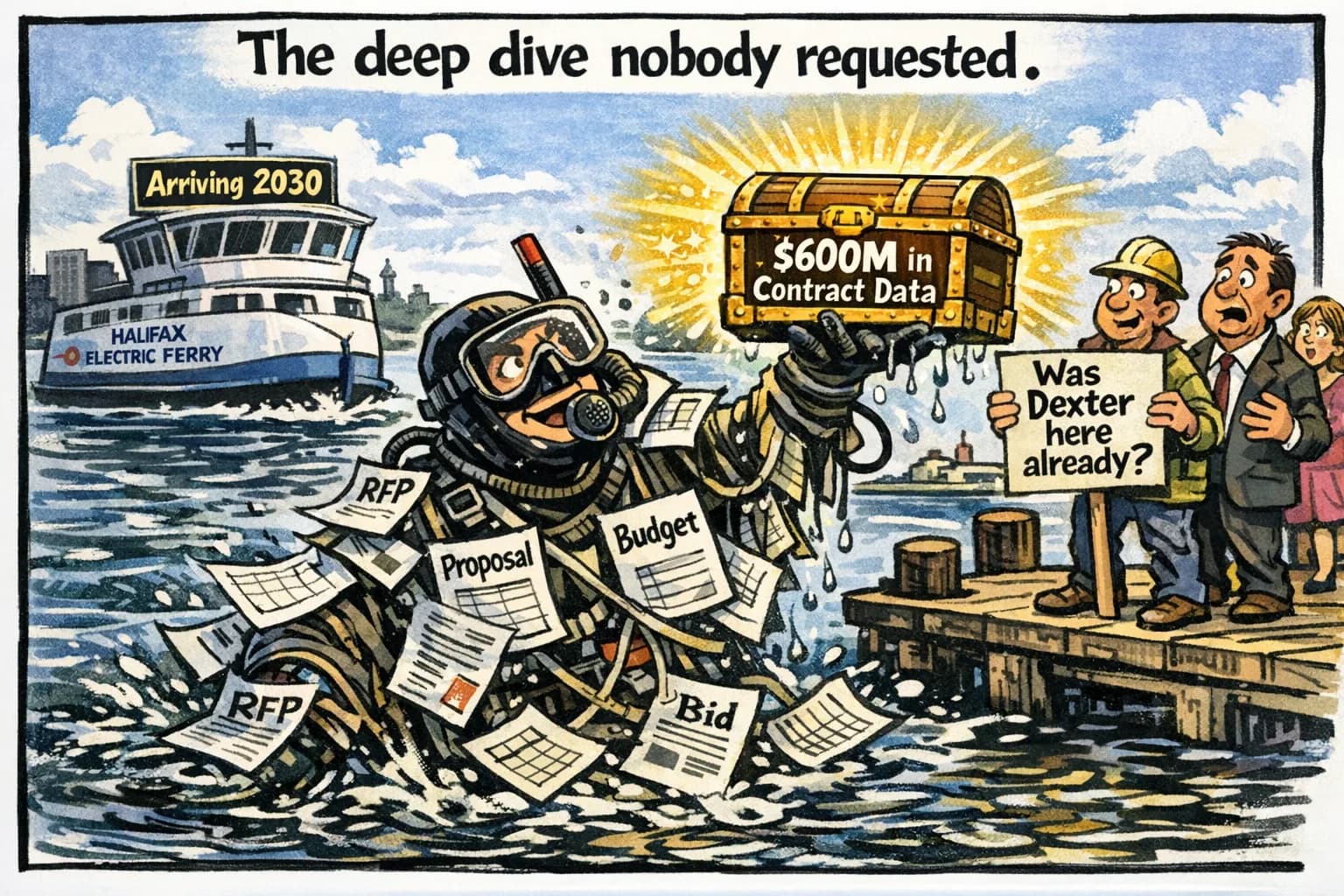
Halifax Regional Municipality awarded $600.3 million across 855 contracts from 2023 through early 2026, and one firm, Dexter Construction, won about 21 percent of it. Construction and paving dominate the money, professional services dominate the contract count, and the large consulting firms are almost absent. The current pipeline is planning work, transit electrification and fleet, which points to a bigger capital cycle in 2026 and 2027 (HRM buyer profile).
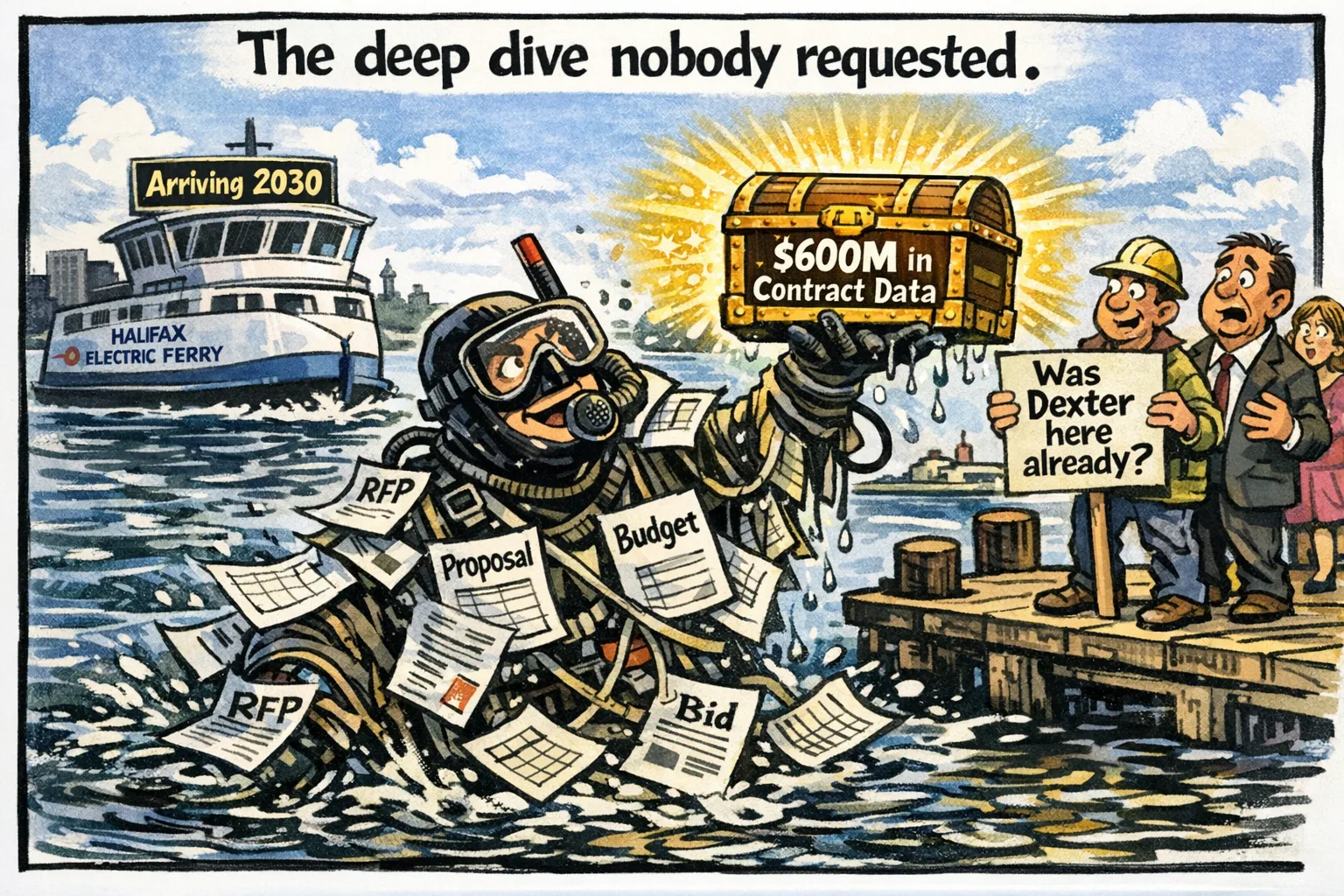
How much does Halifax Regional Municipality award each year?
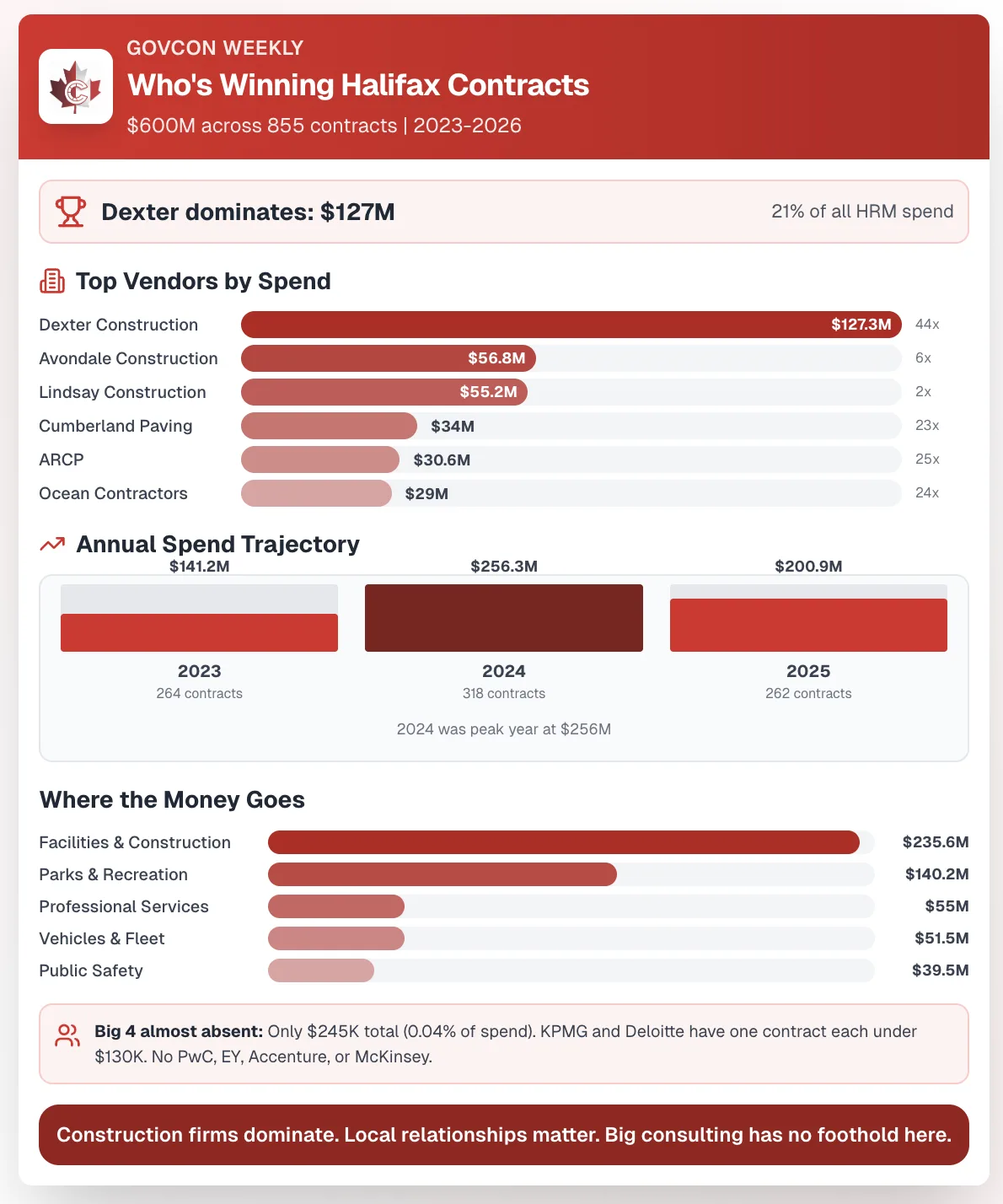
Awarded value went from $141.2 million in 2023 to a peak of $256.3 million in 2024, then eased to $200.9 million in 2025. Contract counts moved far less than dollars: 264, 318 and 262 (full GovCon Weekly analysis).
| Year | Awarded value | Contracts |
|---|---|---|
| 2023 | $141.2M | 264 |
| 2024 | $256.3M | 318 |
| 2025 | $200.9M | 262 |
Source: Halifax Regional Municipality award records, 2023 to early 2026, analysed by Publicus (GovCon Weekly).
Facilities and construction is the largest category by value, and parks and recreation is a strong second. Professional services is third-largest in dollars at $55.0 million but has the most contracts of any category, 231, which makes it the easiest place for a smaller firm to get a first award (award data).
| Category | Awarded | Contracts |
|---|---|---|
| Facilities and construction | $235.6M | 217 |
| Parks and recreation | $140.2M | 124 |
| Professional services | $55.0M | 231 |
| Vehicles and fleet | $51.5M | 77 |
| Public safety | $39.5M | 19 |
| Traffic and transportation | $33.3M | 42 |
| Goods and supplies | $30.8M | 95 |
| Transit and ferry | $11.8M | 23 |
Source: Halifax Regional Municipality award records, 2023 to early 2026, analysed by Publicus (GovCon Weekly).
Who wins Halifax municipal contracts?
Dexter Construction has won $127.3 million across 44 contracts, about 21 percent of everything HRM awarded in the period and more than the next two vendors combined. The rest of the top ten is almost all construction and paving. Some of it is lumpy: Lindsay Construction's $55.2 million came from two contracts and Brycon Construction's $17.0 million from one (vendor rankings).
| Vendor | Awarded | Contracts |
|---|---|---|
| Dexter Construction | $127.3M | 44 |
| Avondale Construction | $56.8M | 6 |
| Lindsay Construction | $55.2M | 2 |
| Cumberland Paving | $34.0M | 23 |
| ARCP | $30.6M | 25 |
| Ocean Contractors | $29.0M | 24 |
| Brycon Construction | $17.0M | 1 |
| Basin Contracting | $11.6M | 14 |
| Atlantica Mechanical | $9.1M | 3 |
| Imperial Cleaners | $6.7M | 5 |
Source: Halifax Regional Municipality award records, 2023 to early 2026, analysed by Publicus (GovCon Weekly).
Construction is a concentrated market. Breaking in usually means subcontracting to one of the established players or finding a specialty they do not cover. Fleet is the opposite: several dealers compete across vehicle types, with MacPhee Ford at $4.3 million and Steele Ford Lincoln at $2.6 million. Fire apparatus is the exception, where Camions Carl Thibault leads at $5.9 million (supplier breakdown).
Do the big consulting firms work for Halifax?
Barely. Across three years and $600.3 million, the Big 4 won $245,000, or 0.04 percent of the total. KPMG and Deloitte have one contract each, both under $130,000 and both operational reviews: Deloitte at $129,000 on winter operations service standards and KPMG at $116,000 on a transit accessibility review. There is no PwC, no EY, and no Accenture, McKinsey or BCG (consulting analysis).
That is not because Halifax buys no advice. It buys about $2.0 million of management-consulting-type work, but it buys it from engineering firms and specialists, and it tends to fold strategy into engineering scopes rather than tender standalone consulting. Parsons ($423,000, Ragged Lake analysis) and Dillon Consulting ($400,000, solid waste strategy review) lead, followed by Diamond Head Consulting on the urban forest master plan and CIRQL Ferries on a ferry operations review (HRM award records).
The wider planning and engineering bench looks the same. Parsons totals $2.9 million (Ragged Lake, Main Street design, Windmill Road), Colliers Project Leaders $2.5 million (zero-emission bus project management), Canadian Maritime Engineering $1.9 million (ferry refits), Architecture49 $1.8 million and Adesso Project Management $1.5 million, the last for phase two of an HR system rollout (consultant table). A municipality awarding $600 million over three years with almost no Big 4 work is not doing organizational transformation yet. When back-office modernization starts, it will be an opening for a new entrant.
How much technology does Halifax buy?
Not much, and most of it is tied to a building. Renovations at the Scotiabank Centre drove $2.1 million to Daktronics Canada for LED displays and $1.1 million to Applied Electronics for an IPTV network. Core municipal IT, such as Eastlink's $1.6 million in WAN and internet services and smaller recreation-software and scheduling projects, totals under $3 million (IT vendor list).
What technology Halifax does buy clusters around transit and traffic: zero-emission bus charging software on standing offer with Evenergi and INIT Innovations, traffic detection systems, dynamic speed display signs and school beacons, and a standardized video management platform for security. The charging software is foundational to fleet electrification, not a standalone purchase, and those standing offers will turn into real contract value as the electric bus fleet grows. What is missing is enterprise software. Operational technology is being bought; back-office systems are holding steady, and a municipality scaling up capital delivery will eventually need them to match.
What is Halifax buying now?
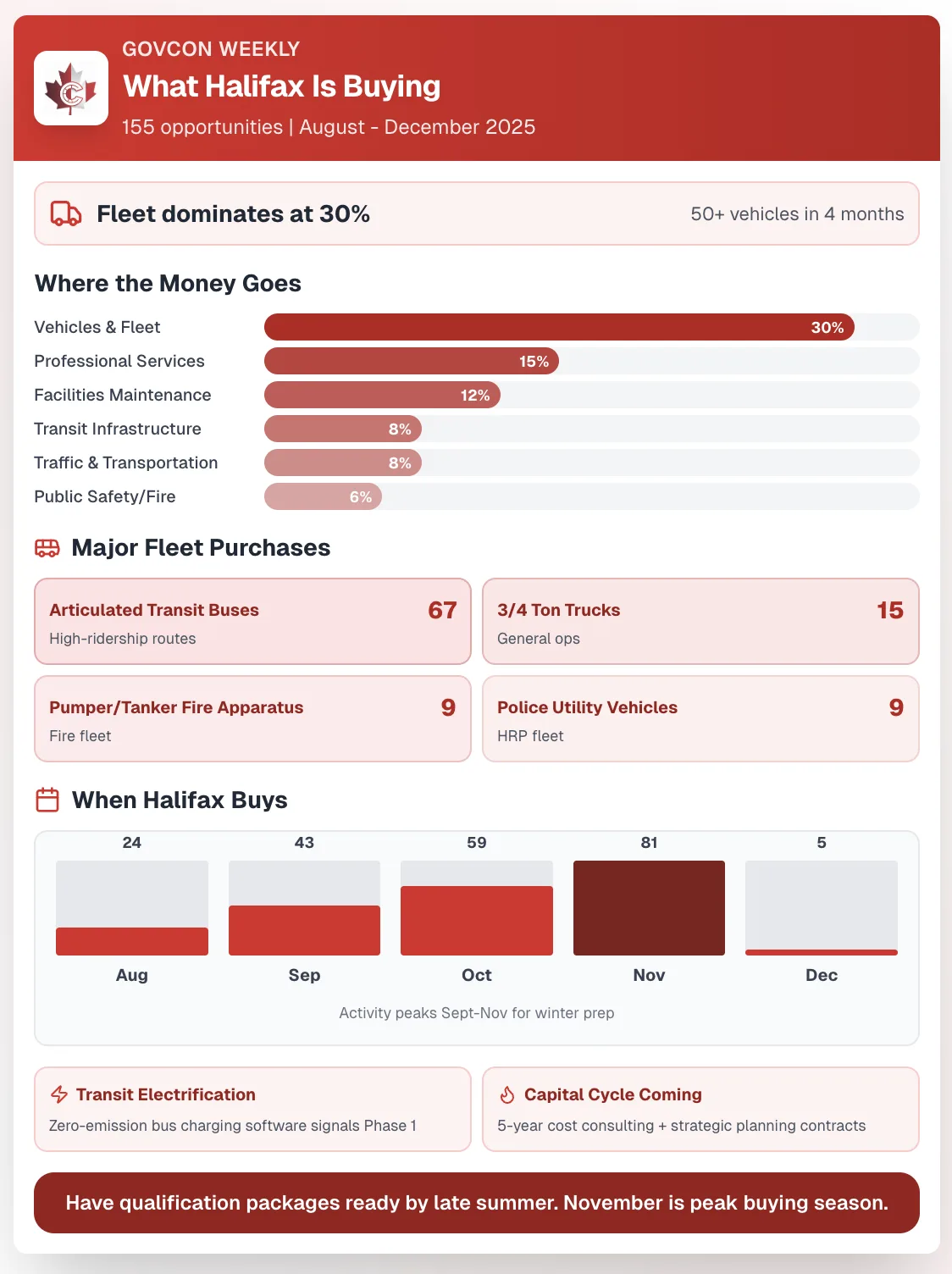
A review of 155 HRM bid opportunities from the second half of 2025 shows vehicles and fleet as the largest group, about 30 percent, followed by professional services and facilities maintenance (HRM procurement).
| Category | Opportunities | Share |
|---|---|---|
| Vehicles and fleet | 45 to 50 | ~30% |
| Professional services and consulting | 20 to 25 | ~15% |
| Facilities maintenance | 15 to 20 | ~12% |
| Transit infrastructure | 10 to 15 | ~8% |
| Traffic and transportation | 10 to 15 | ~8% |
| Public safety and fire | 8 to 10 | ~6% |
| Parks and recreation | 8 to 10 | ~6% |
| Technology and IT | 8 to 10 | ~6% |
| Ferry and marine | 5 to 6 | ~4% |
| Environmental and waste | 5 to 6 | ~4% |
Source: 155 Halifax Regional Municipality bid opportunities from the second half of 2025, analysed by Publicus. Counts and shares are approximate ranges.
The fleet list alone ran past 50 vehicles in four months: 15 three-quarter-ton trucks, 9 police-package utility vehicles, 7 cargo vans, 5 one-ton plow trucks, 5 dump trucks, 4 tandem dump trucks with plows, 5 compact sedans, 4 passenger vans and 4 electric ice resurfacers. On top of that sit 8 to 9 pumper/tanker fire trucks and a five-year contract for up to 67 articulated transit buses, 47 guaranteed and 20 optional, the largest single procurement in the set.
The services list is the more interesting signal. Halifax is buying planning capacity: a Strategic Growth and Infrastructure Priorities Plan, a housing strategy scope, an integrated infrastructure servicing plan for the province's special planning areas, Mill Cove land use planning, pre-design for a new Halifax Regional Police headquarters, and a five-year cost consulting contract for the Major Projects Office. That is a municipality building the internal capacity to manage growth before the construction dollars flow (pipeline analysis). Consultants who get in on the planning side now will be better placed when implementation contracts follow.
Halifax also keeps standing offers for predictable needs: automotive batteries, glass and windows, janitorial, locksmith hardware, marine services, painting, pool chemicals, road salt haulage, septic services, sign hardware and streetlight maintenance. They are small, but they recur.
When does Halifax put work out to bid?
Activity climbs steeply in the fall as HRM works through its budget and gets ready for winter. In the period reviewed, opportunity counts went from 43 in September to 59 in October and 81 in November, then fell to 5 in December. Firms targeting Halifax should have qualification packages ready by late summer, because November is the peak.
Which big Halifax projects are coming?
The Mill Cove ferry expansion has confirmed funding of $260.7 million from all three governments: $155.7 million federal, $65 million provincial and about $40 million municipal. It covers five electric ferries, two net-zero terminals and a maintenance facility, with completion now expected in 2030 and projected ridership of 908,000 a year (Halifax ferry service). Expect several procurement packages needing marine electrical, terminal construction and charging infrastructure. A 2030 finish means bidders should build price escalation into proposals, and tri-government money brings heavier reporting and stricter change control.
Offshore, Nova Scotia's deputy minister has indicated a call for development bids on the Wind West offshore project, valued at $60 billion, could come as early as summer 2026. The province is targeting 80 percent renewable energy by 2030, with five onshore wind farms (480 MW) expected by the end of 2026 and close to 1,000 MW by the end of 2028. Expect developer qualification requirements on financial capacity, Indigenous and local benefits and long-horizon permitting, and steady demand for renewables construction, marine engineering and grid interconnection work.
Where can a new supplier break in?
- Construction firms: Dexter alone takes 21 percent of the money. Subcontract to the established players or find a specialty niche.
- Vehicle and equipment dealers: fleet is fragmented and bought in volume every fall. Fire apparatus is the exception.
- Consultants and smaller service firms: professional services has the most contracts of any category, and the planning work now underway will lead to implementation contracts.
- Software and systems firms: the opening is back-office modernization, which has not started yet. Watch for it as capital delivery scales up (how Publicus tracks buyers like HRM).
- Transit and energy suppliers: transit electrification, the ferries and offshore wind are the throughlines for Halifax over the rest of the decade.
About the data
Award figures cover 855 Halifax Regional Municipality contracts worth $600.3 million from 2023 through early 2026, by awarded value. The pipeline view covers 155 HRM bid opportunities from the second half of 2025; category counts are approximate ranges, and the monthly counts show timing rather than adding up to that total. Standing offers are listed by vendor and do not represent confirmed purchases. Ferry and offshore wind figures come from public reporting in early 2026. This analysis first appeared in GovCon Weekly on February 3, 2026. For how the municipality buys and its thresholds, see Halifax procurement services.
- halifax
- nova scotia
- municipal procurement
- market map
- govcon weekly