Federal IT Standing Offers: Where Government IT Contracts Actually Flow
ARTICLE SUMMARY
Most federal IT and professional services work is not bought through open tenders. It is bought through a handful of pre-qualified vehicles.
- For
- Vendors, buyers, and readers following Canadian procurement
- Main topic
- Market Maps
- Why it matters
- The article's argument is summarized up front so people and agents can grasp the point before reading the full body.
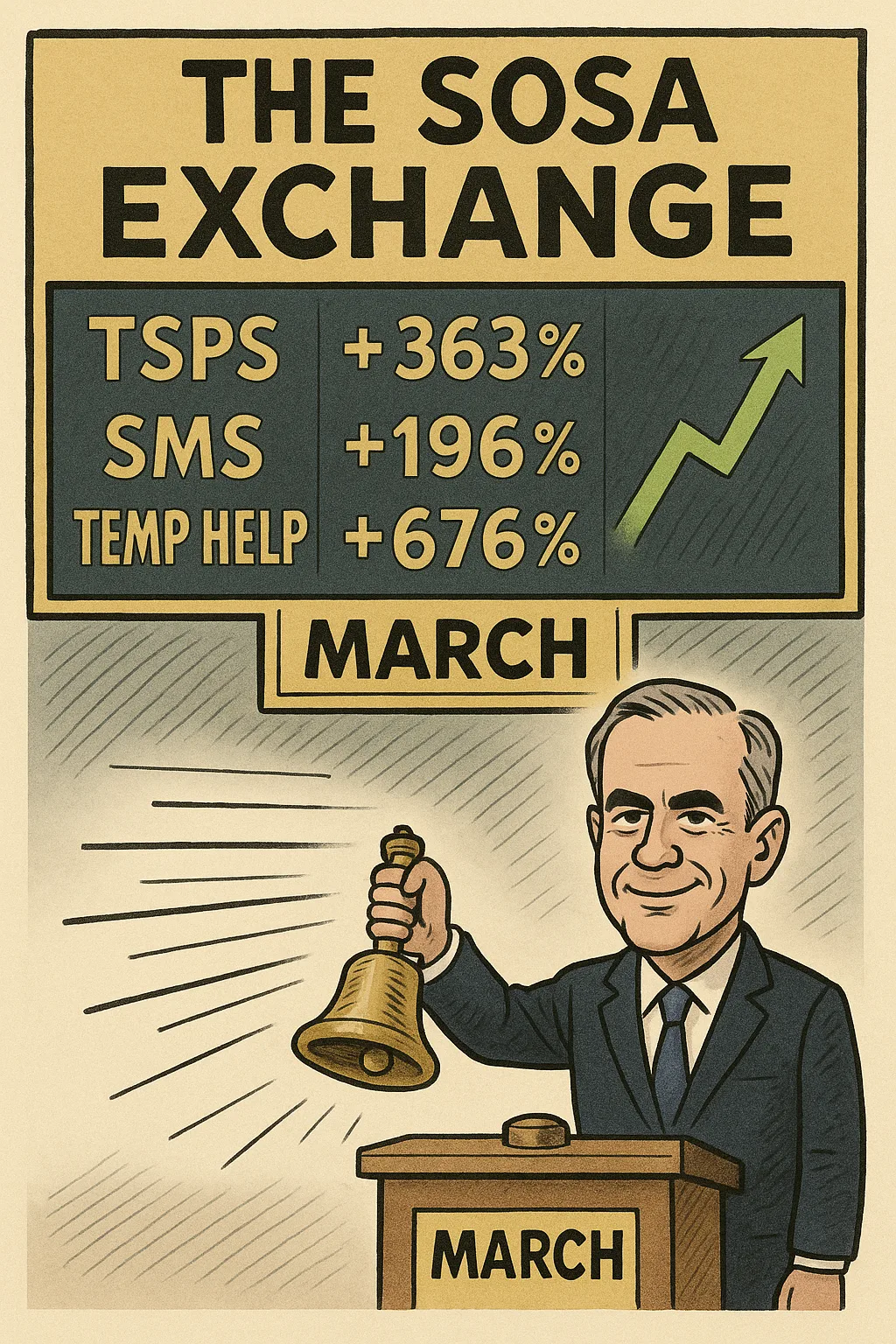
Most federal IT and professional services work is not bought through open tenders. It is bought through a handful of pre-qualified vehicles. Over the first nine months of 2025, TBIPS carried $598 million in disclosed contract value, SMS $85 million, TSPS $80 million, Temporary Help Services $17 million and PSPC Cloud $8 million (proactive disclosure data). Two departments dominate the largest vehicle, and March decides much of the rest.
What are federal IT standing offers, and how much flows through them?
A standing offer, or its close cousin the supply arrangement, lets suppliers qualify once and then compete for, or receive, individual call-ups and task authorizations as departments need work done. Public Services and Procurement Canada runs the main IT and professional services vehicles, listed on CanadaBuys as standing offers and supply arrangements (SOSA). The five tracked here are task-based informatics professional services (TBIPS), task and solutions professional services (TSPS), software licensing (SMS), temporary help and PSPC Cloud.
| Vehicle | What it buys | Disclosed value, Jan to Sep 2025 | Defining pattern |
|---|---|---|---|
| TBIPS | IT professionals by task | $598M | Two departments, two separate markets |
| SMS | Software licences and maintenance | $85M | March peak of $34M |
| TSPS | Consulting and solutions work | $80M | March peak of $43.1M |
| Temporary Help Services | Short-term staff | $17M | One $7.5M contract |
| PSPC Cloud | Cloud and SaaS subscriptions | $8M | Resellers and small subscriptions |
Source: federal proactive disclosure of contracts under PSPC standing offers and supply arrangements, January to September 2025, cleaned and analysed by Publicus (GovCon Weekly).
The data comes with a caveat. Departments enter these records by hand, and while Publicus uses an AI system to clean and standardize them, the government's reporting process guarantees some errors survive. Treat every figure below as a close reading of what was disclosed, not an audit (method notes).
Who buys under TBIPS, and why are there two markets?
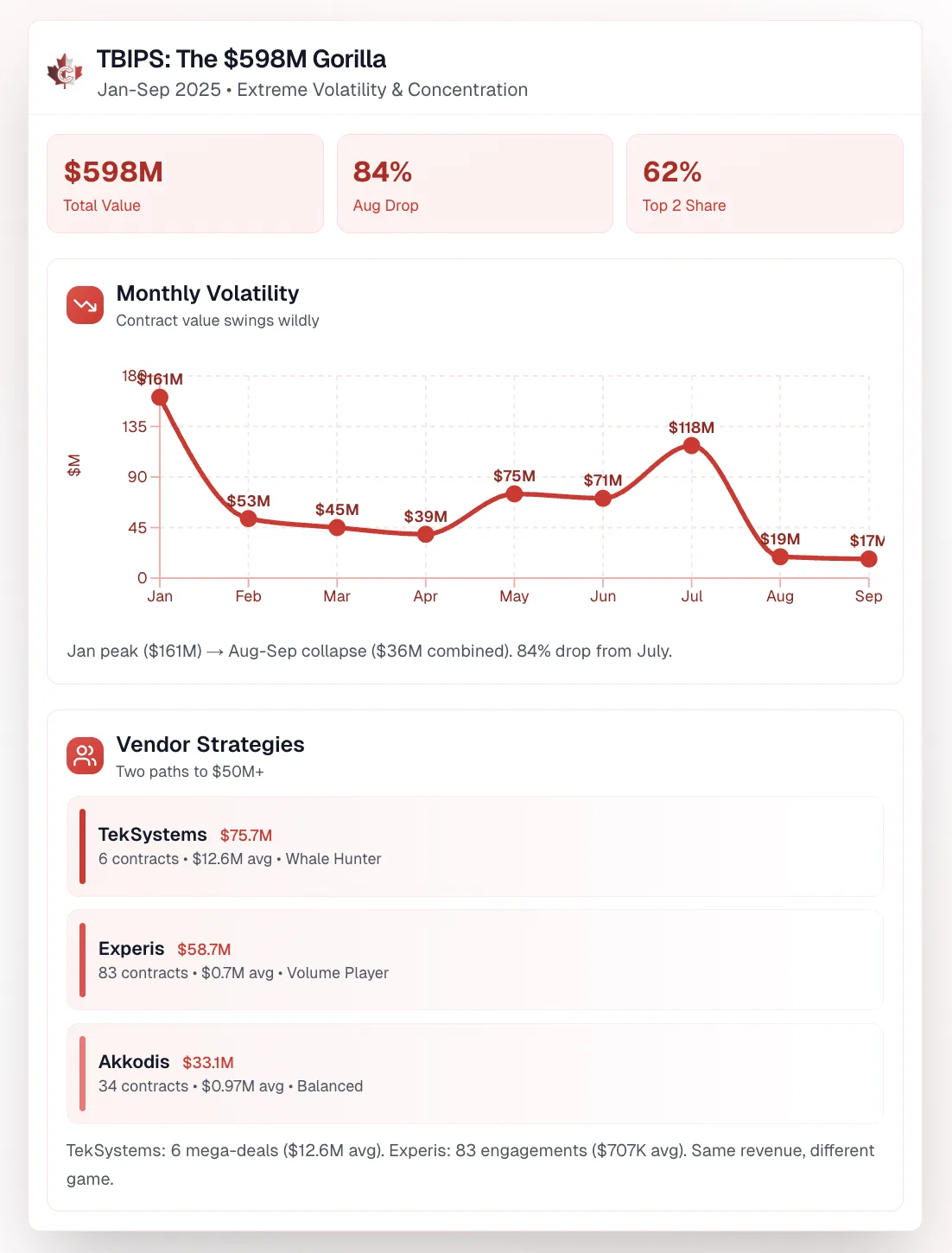
TBIPS is the largest vehicle by a wide margin, and its monthly totals swing hard. January hit $161 million, April fell to $39 million, July jumped back to $118 million, then August and September collapsed to $19 million and $17 million (disclosure records). That is not steady demand. It is fiscal calendar pressure plus a few very large task authorizations distorting the monthly totals.
| Month (2025) | TBIPS | SMS |
|---|---|---|
| January | $161M | $9.7M |
| February | $53M | $11.5M |
| March | $45M | $34M |
| April | $39M | $8.8M |
| May | $75M | $3.9M |
| June | $71M | $3.5M |
| July | $118M | $8.2M |
| August | $19M | $1.7M |
| September | $17M | $3.7M |
Source: federal proactive disclosure of contracts under PSPC standing offers and supply arrangements, January to September 2025, cleaned and analysed by Publicus (GovCon Weekly).
Shared Services Canada and National Defence account for $392.6 million of TBIPS between them (source). Shared Services averages $9.6 million per contract across 27 deals: infrastructure-scale engagements such as cloud migrations, enterprise system implementations and multi-year IT transformation. National Defence spreads $132 million across 49 contracts, a $2.7 million average and a middle ground between mega-projects and volume work.
Then there is a cliff. Employment and Social Development Canada posted 228 TBIPS contracts but averaged only $183,000 each, and Immigration, Refugees and Citizenship Canada and Global Affairs Canada show the same high-volume, low-value pattern (buyer breakdown). In practice these are two separate markets with different sales cycles, different competitors and different margins. A firm without relationships at Shared Services or National Defence is competing for what is left, split across dozens of buyers.
Which vendors win the most TBIPS work?
Two firms reached similar totals by opposite routes. TekSystems won 6 contracts worth $75.7 million, a $12.6 million average: whale hunting. Experis won 83 contracts worth $58.7 million, a $707,000 average, which takes consistent proposal quality and delivery on every one of them (award records). TekSystems needs executive relationships and large delivery capacity; Experis needs the operational efficiency to win ten or more times a year.
| Vendor | TBIPS value | Contracts | Average | Model |
|---|---|---|---|---|
| TekSystems | $75.7M | 6 | $12.6M | Mega-deals |
| Experis | $58.7M | 83 | $707K | Volume |
| Akkodis | $33M | 34 | $972K | Volume |
| iFathom (solo) | $25M | Mega-deal | ||
| A large IT infrastructure services firm | $21.6M | 1 | $21.6M | Mega-deal |
| SKYFLY, iFathom and EPI-USE joint venture | $16.3M | Partnership | ||
| Adirondack Information Management | $16M | 29 | $554K | Volume |
Source: federal proactive disclosure of contracts under PSPC standing offers and supply arrangements, January to September 2025, cleaned and analysed by Publicus (GovCon Weekly).
The joint venture is worth noticing. iFathom appears twice, once on its own at $25 million and once inside the SKYFLY and EPI-USE partnership at $16.3 million, for more than $41 million in related work (vendor analysis). Partnering is a real route to the large end of TBIPS. The practical lesson is to pick a lane and commit: build executive relationships to compete for $5 million-plus deals at Shared Services and National Defence, or build the machinery to win 20 or more smaller contracts with volume buyers. The middle ground barely exists.
Who wins TSPS consulting work?
TSPS produced the single biggest monthly anomaly of any vehicle tracked. March reached $43.1 million, up 363 percent from February's $9.3 million, before monthly totals fell back to the $3 million to $7 million range (disclosure records). The return to normal shows March was an outlier, but it also shows that consulting volumes follow the fiscal year-end, not only project needs.
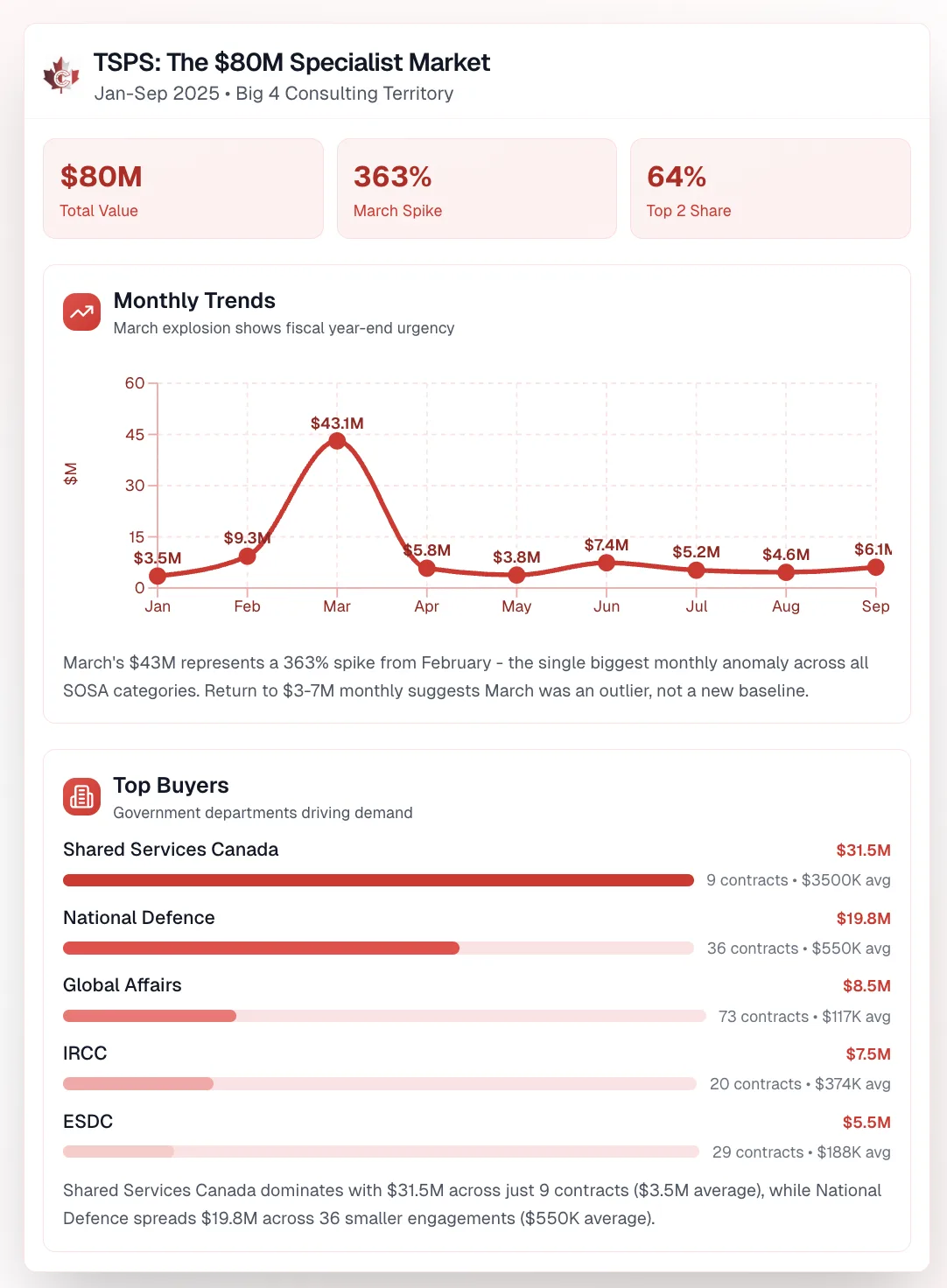
| Buyer | TSPS value | Contracts | Average |
|---|---|---|---|
| Shared Services Canada | $31.5M | 9 | $3.5M |
| National Defence | $19.8M | 36 | $550K |
| Global Affairs Canada | $8.5M | 73 | $117K |
| Immigration, Refugees and Citizenship Canada | $7.5M | 20 | $374K |
| Employment and Social Development Canada | $5.5M | 29 | $188K |
Source: federal proactive disclosure of contracts under PSPC standing offers and supply arrangements, January to September 2025, cleaned and analysed by Publicus (GovCon Weekly).
The top of the vendor list is the establishment. PwC, S.I. Systems and Accenture lead with average contracts of $4 million to $5 million. PwC's 3 contracts total $14.9 million, which suggests strategic work for Shared Services, and S.I. Systems sits at the same tier with $14.4 million across 3 contracts (vendor rankings). Below the top three, averages fall under $700,000.
TSPS is not where an emerging consultancy breaks in without deep specialization. The sub-$1 million market exists, but it is contested by volume players tuned for $100,000 to $500,000 contracts. A boutique firm does better aiming at Global Affairs, IRCC and ESDC, where specialist expertise wins work without Big 4 scale (browse federal awards).
Why do software licences under SMS peak in March?
SMS shows the same March surge: up 196 percent to $34 million, against a normal month of $3 million to $11 million (disclosure records). Licence renewals and maintenance agreements are recurring costs, yet they cluster at fiscal year-end. Shared Services Canada and National Defence again lead, but less heavily than in TBIPS, because every department needs productivity tools, security software and specialized applications.
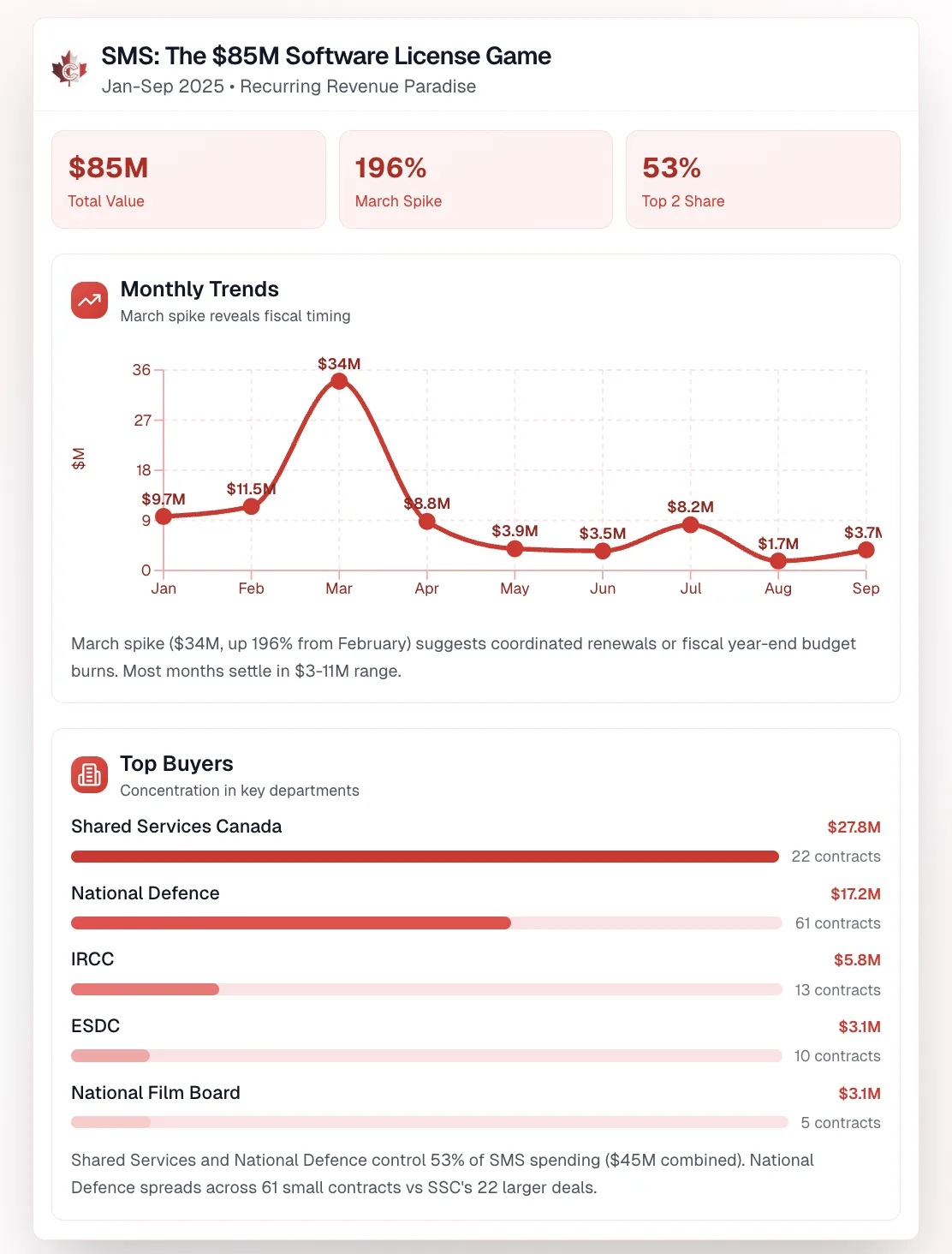
The surprise buyer is the National Film Board: $3.1 million across just 5 software contracts, a $613,000 average that ranks third among all SMS buyers (source). Specialized media and production software has little competition, and niche software commands premium pricing when there is only one viable vendor.
| Vendor | SMS value | Contracts | What it shows |
|---|---|---|---|
| PureLogic IT Solutions | $21.1M | 22 | Recurring renewals, expansions and upsells |
| Advanced Chippewa Technologies | $9.7M | 31 | One department, then adjacent tools, then other departments |
| ESRI Canada | $5.6M | 26 | GIS software that nearly every department needs |
Source: federal proactive disclosure of contracts under PSPC standing offers and supply arrangements, January to September 2025, cleaned and analysed by Publicus (GovCon Weekly).
The licence business is a relationship business. PureLogic's 22 contracts are not 22 products; they are renewals and expansions. ESRI Canada's 26 contracts most likely reflect different departments each renewing annually (SMS analysis). For a new vendor the entry strategy is to avoid productivity and GIS software entirely, find an underserved specialized category, and become its leader. The National Film Board's $3.1 million shows niches pay.
How does the Temporary Help Services market work?
Temporary help is small and lumpy. March jumped 676 percent to $8.7 million, driven by one contract: CACHE Computer Consulting's $7.5 million deal with Fisheries and Oceans Canada, about 43 percent of the category's value across all nine months (disclosure records). It is most likely a multi-year staff augmentation agreement for specialized roles. Strip it out and the category runs $500,000 to $2.6 million a month.
National Defence ($5.7 million across 34 contracts, a $167,000 average) and Global Affairs ($3.6 million across 20 contracts, a $182,000 average) show what temporary help normally looks like: $150,000 to $200,000 contracts for specialized staff on 3 to 12 month assignments. Tiree Facilities ($2.1 million across 10 contracts) and MAXSYS ($1.5 million across 9) win repeatedly at that size (temporary help analysis). Most vendors in this category depend on a single department for all of their temporary help revenue; only the largest are diversified.
Is PSPC Cloud a real market?
Not yet, by contract value. Most months saw under $400,000. January peaked at $3.9 million, then fell 94 percent to $242,000 in February (disclosure records). Innovation, Science and Economic Development Canada placed $3.6 million through just 2 contracts, the largest share of a category worth about $8 million, and no other buyer reached $800,000 over the nine months.
The leading vendor, Carahsoft Canada at $4 million, is a software reseller rather than a cloud provider, acting as a procurement intermediary for SaaS products. VIDCRUITER's 12 contracts at a $69,000 average show the subscription model: small annual contracts with high retention (cloud analysis). With SMS roughly ten times larger, most federal cloud purchasing likely runs through software licensing instead. PSPC Cloud is an accessible entry point for smaller SaaS vendors to get onto a government vehicle, not where enterprise cloud infrastructure is bought.
Which vendors win across several standing offers?
Only a handful of vendors compete successfully across more than one vehicle (source).
| Vendor | TBIPS | TSPS | SMS | Temporary Help | PSPC Cloud | Total |
|---|---|---|---|---|---|---|
| S.I. Systems | $14.6M | $14.4M | $277K | $29M+ across 11 contracts | ||
| Orangutech | $18.7M | $2.6M | $1.3M | $22.6M | ||
| Carahsoft | $1.8M | $4M |
Source: federal proactive disclosure of contracts under PSPC standing offers and supply arrangements, January to September 2025, cleaned and analysed by Publicus (GovCon Weekly).
S.I. Systems is the quiet giant, with relationships spanning IT services, consulting and staffing. Orangutech has positioned itself as a full-stack IT provider, and Carahsoft dominates software reselling (cross-category analysis). Most vendors stay in one lane and miss the diversification.
How should a contractor choose a standing offer strategy?
- Software licences beat cloud subscriptions. SMS ($85 million) is about ten times PSPC Cloud ($8 million), so most federal software money flows through SMS (source).
- Volume and value both work. TekSystems (6 contracts, $75.7 million) and Experis (83 contracts, $58.7 million) succeeded with opposite approaches. Pick one and commit (vendor data).
- Recurring relationships beat one-offs. Vendors with 10 or more contracts in a single vehicle, such as Experis, PureLogic, Advanced Chippewa and ESRI Canada, show the value of becoming the default supplier for a specific need.
- Plan around March. TSPS, SMS and temporary help all peaked in March. Proposals, renewals and relationships should be ready before the fiscal year-end, not during it (how Publicus tracks the calendar).
Standing offers are not the exception in federal IT buying; they are the rule. Knowing which vehicle, which department and which deal size fits your firm decides where business development time is worth investing (search federal contracts).
About the data
Figures cover contracts reported under five PSPC standing offers and supply arrangements from January to September 2025, drawn from federal proactive disclosure and cleaned and standardized by Publicus. Departments enter these records manually, so errors and inconsistencies remain; values are disclosed contract values, and a single large task authorization can dominate a month or a category. This analysis first appeared in GovCon Weekly on November 18, 2025.
- standing offers
- tbips
- tsps
- federal it procurement
- market map
- govcon weekly