Canada's $100 Million Club: A Decade of Mega Procurements and the New $5 Million Line
ARTICLE SUMMARY
Canada's $100 million club is small. Over the past decade, disclosed public awards at $100 million and above came to roughly 19 construction contracts a year and about 1.6 defence contracts a year ( GovCon Weekly...
- For
- Vendors, buyers, and readers following Canadian procurement
- Main topic
- Market Maps
- Why it matters
- The article's argument is summarized up front so people and agents can grasp the point before reading the full body.
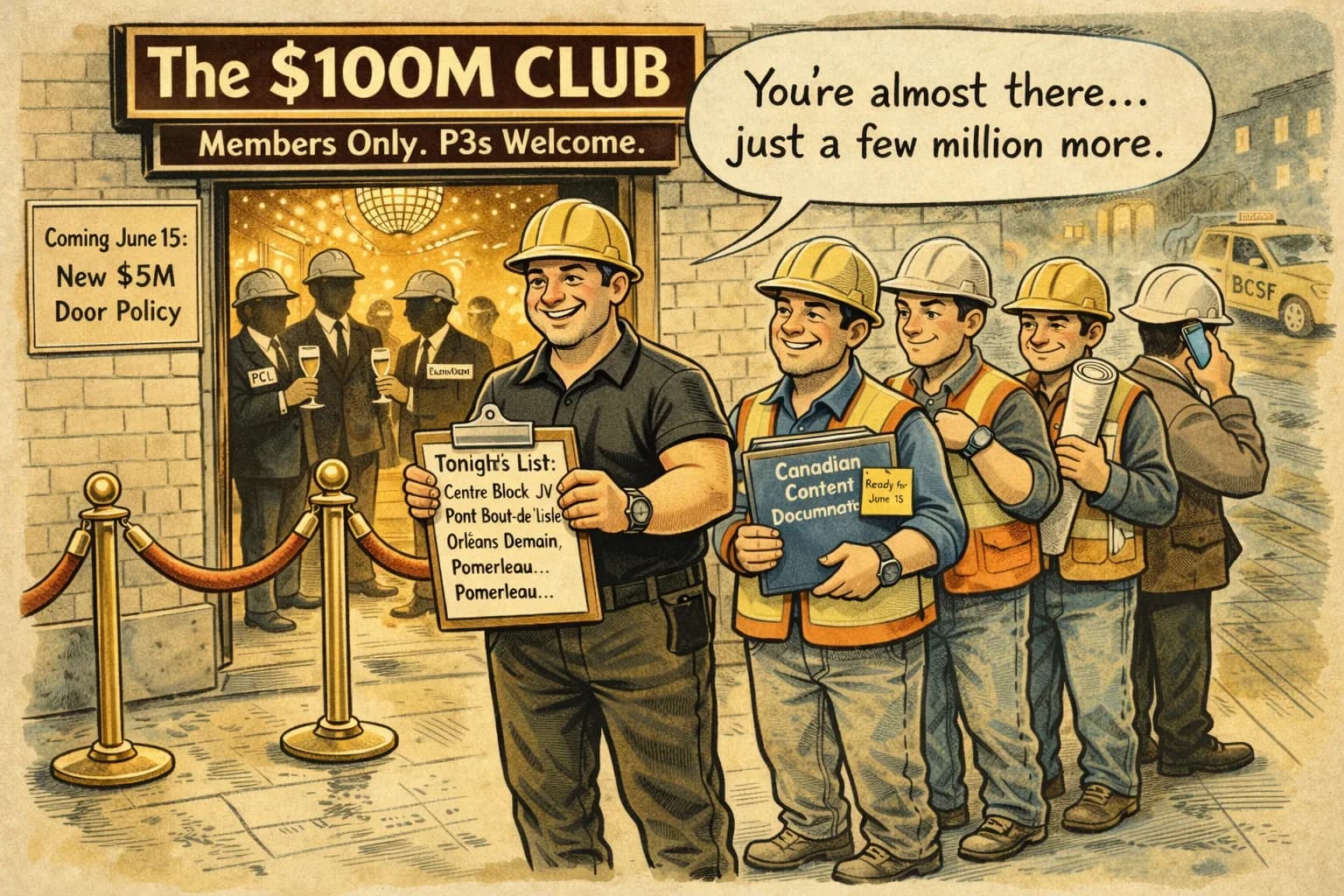
Canada's $100 million club is small. Over the past decade, disclosed public awards at $100 million and above came to roughly 19 construction contracts a year and about 1.6 defence contracts a year (GovCon Weekly analysis). Most of the construction slots are held by single-project companies, most of the defence value goes to a short list of primes, and the rules that matter for most suppliers now start much lower: at $5 million, where Buy Canadian evaluation took effect on June 15, 2026.
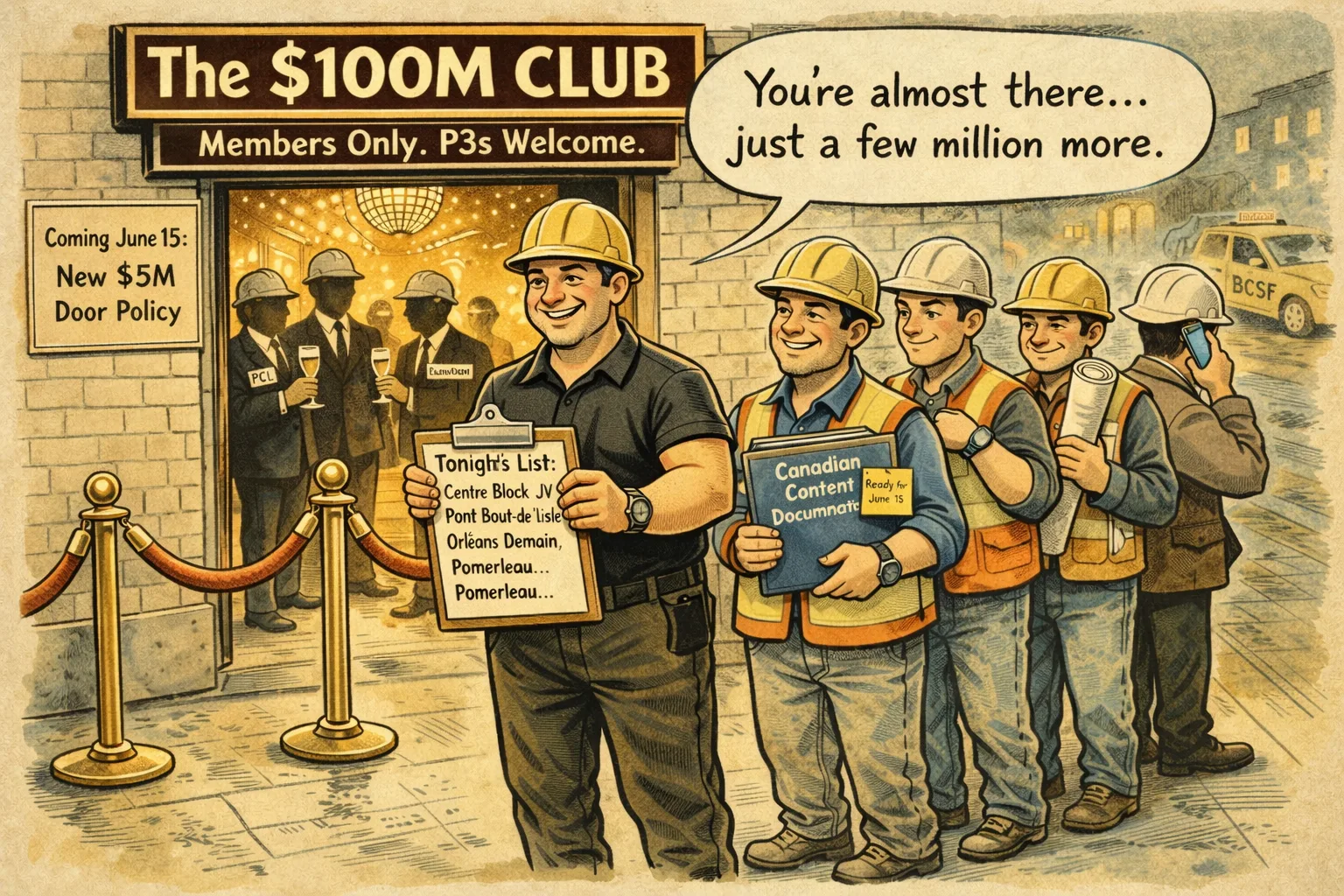
What changed at the $5 million line?
The federal Policy on Prioritizing Canadian Suppliers and Canadian Content applied from December 2025 to contracts over $25 million. On June 15, 2026 it expanded to every federal contract at $5 million and up (Treasury Board Secretariat, Contracting Policy Notice 2025-7). Canadian suppliers receive a 10% reduction applied to their financial proposal at evaluation, and Canadian content is scored as part of the bid assessment.
- The evaluation math. A Canadian firm's $11 million bid evaluates as equivalent to a non-Canadian firm's $10 million bid, which changes the competitive picture on hundreds of procurements a year (policy notice).
- The size of the band. Roughly 1,351 contracts a year, worth $15.4 billion, fall between $5 million and $25 million, and all of them now require Canadian content documentation (GovCon Weekly estimate).
- No token presence. Foreign-headquartered firms need demonstrable Canadian manufacturing, R&D or economic activity on file. A sales office in Mississauga will not clear the bar.
The $25 million threshold captured the marquee procurements. The $5 million threshold captures the workhorse contracts where most Canadian SMEs actually compete: mid-size IT services engagements, regional construction projects and professional services retainers. Firms with a documented Canadian content methodology have a real edge over the ones still working out what "Canadian" means (policy requirements).
Where do $100 million construction contracts go by province?
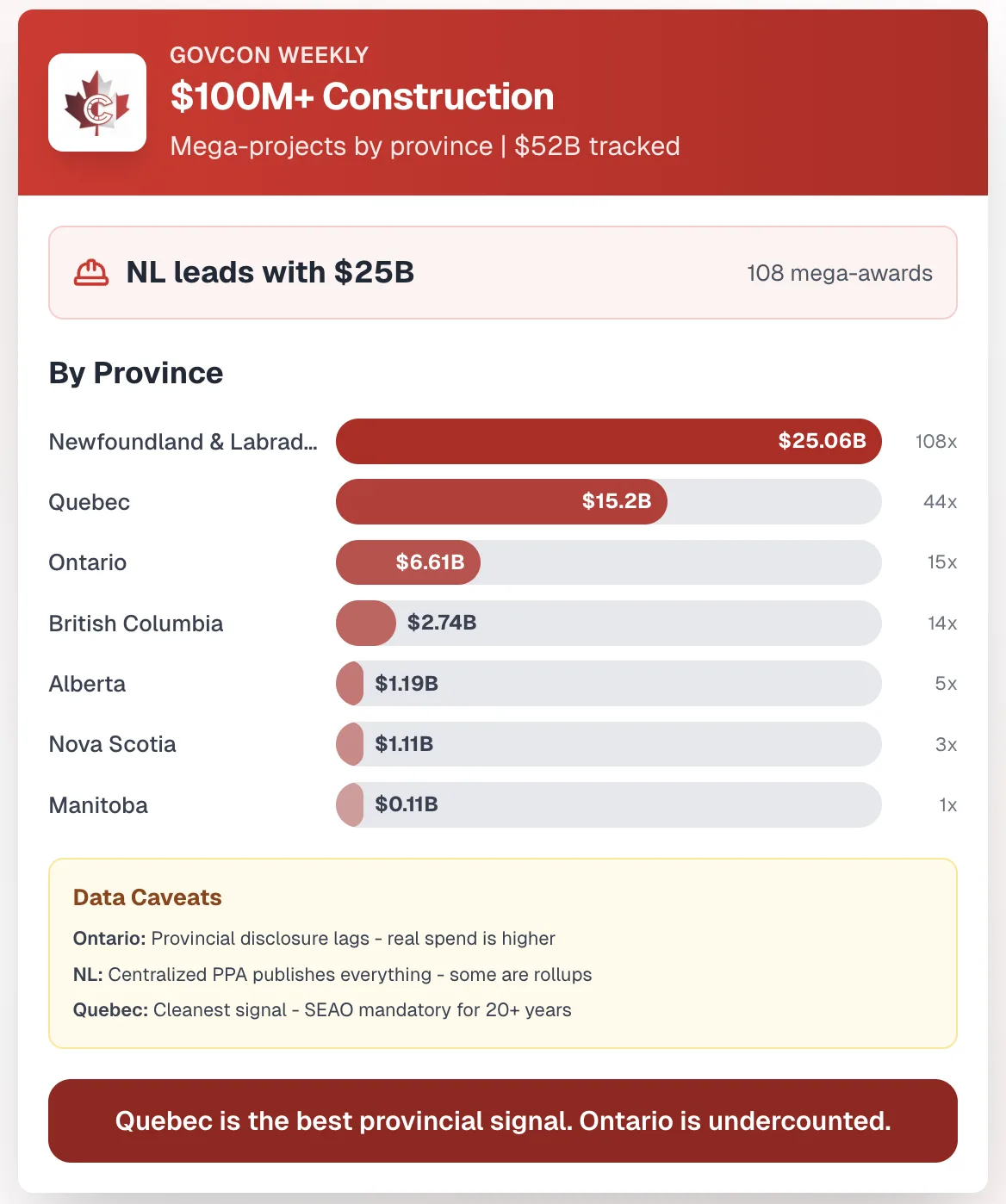
Ten years of disclosed construction awards at $100 million and above add up to about $52 billion across 190 awards. Newfoundland and Labrador leads with $25.06 billion across 108 awards, ahead of Quebec at $15.20 billion (full provincial breakdown).
| Province | Value of $100M+ construction awards | Awards |
|---|---|---|
| Newfoundland and Labrador | $25.06B | 108 |
| Quebec | $15.20B | 44 |
| Ontario | $6.61B | 15 |
| British Columbia | $2.74B | 14 |
| Alberta | $1.19B | 5 |
| Nova Scotia | $1.11B | 3 |
| Manitoba | $0.11B | 1 |
Source: disclosed public awards of $100 million and above over ten years, including SEAO and NL Public Procurement Agency records, analysed by Publicus (GovCon Weekly).
This table measures disclosure as much as building. Ontario's $6.61 billion is artificially low because provincial disclosure at this tier lags the rest of the country, so a large share of real Ontario contracting never surfaces in the data. Newfoundland runs a centralized Public Procurement Agency that publishes everything, which inflates its position, and a few of its awards appear to be program-level rollups. Quebec is the cleanest provincial signal: SEAO has run mandatory disclosure across agencies, Crown corporations and municipalities for two decades.
Who actually holds Canada's largest construction contracts?
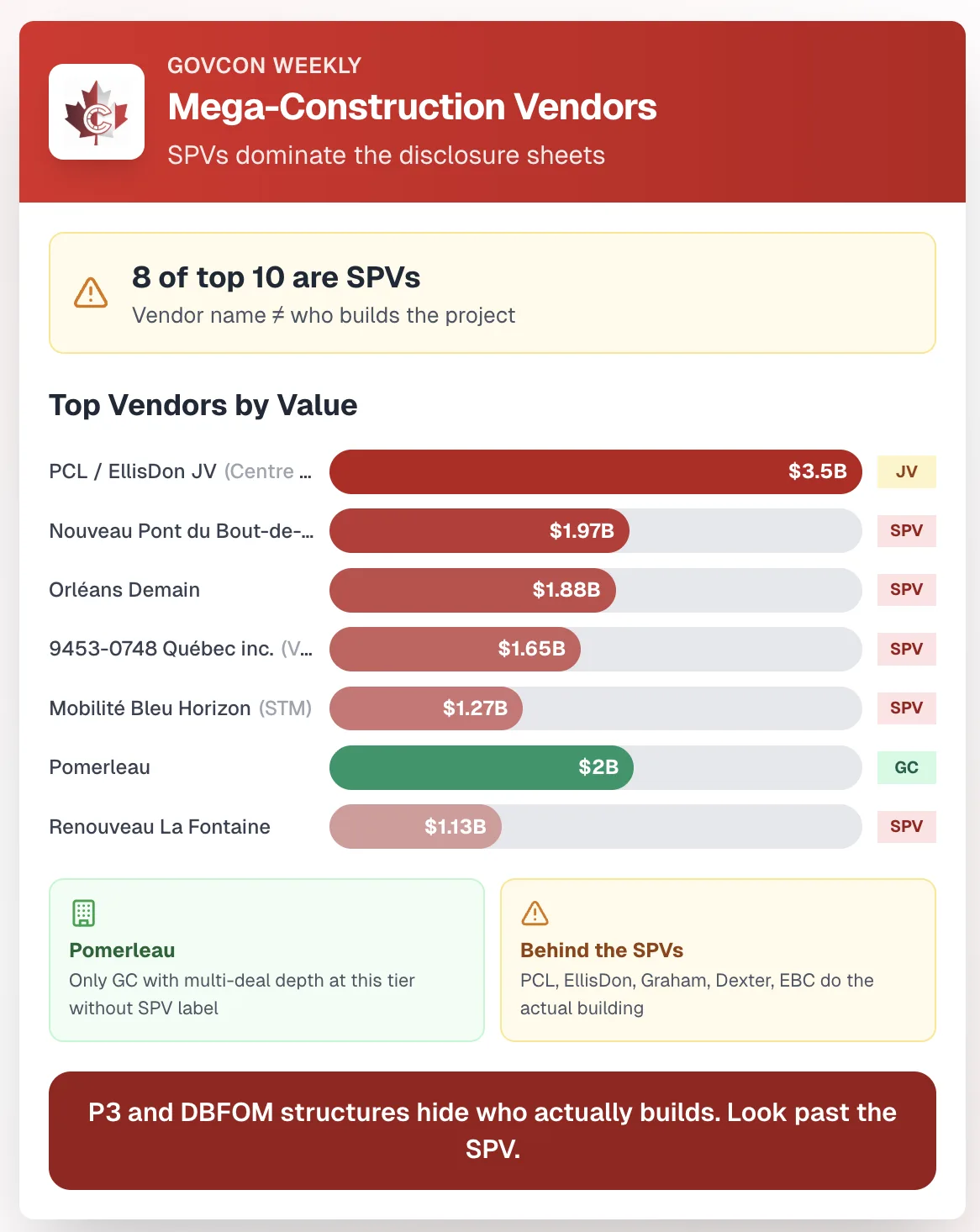
Mostly special purpose vehicles, not contractors. Five of the seven largest construction contract holders shown below are single-project entities. Most Canadian mega-construction is delivered through P3 and DBFOM structures, where a purpose-built company holds the contract on behalf of general contractors such as PCL, EllisDon, Pomerleau, Graham, Dexter and EBC (vendor analysis). The vendor name on the disclosure sheet does not tell you who builds the thing.
| Vendor | Value | Structure |
|---|---|---|
| PCL / EllisDon JV (Centre Block) | $3.50B | Joint venture |
| Pomerleau | ~$2.0B | General contractor |
| Nouveau Pont du Bout-de-l'Isle | $1.97B | SPV |
| Orléans Demain | $1.88B | SPV |
| 9453-0748 Québec inc. (Vaudreuil) | $1.65B | SPV |
| Mobilité Bleu Horizon (STM) | $1.27B | SPV |
| Renouveau La Fontaine | $1.13B | SPV |
Source: disclosed public awards of $100 million and above over ten years, including SEAO and NL Public Procurement Agency records, analysed by Publicus (GovCon Weekly).
Pomerleau is the only general contractor with organic, multi-deal depth at this tier without an SPV label in front of it. For subcontractors, the practical lesson is to look past the entity name: Mobilité Bleu Horizon, for example, holds a $1.27 billion contract for the Société de transport de Montréal, and the firms behind it are the ones hiring trades and suppliers.
Who wins Canada's $100 million defence contracts?
Every defence award of $100 million or more over the past decade went through Public Services and Procurement Canada, and $25.6 billion was awarded at this tier (GovCon Weekly defence breakdown). One contract shapes the whole picture: SkyAlyne Canada, the CAE and KF Aerospace venture delivering Future Aircrew Training, holds $11.2 billion, or 44% of the mega-tier. Most analysis of Canadian defence contracting misses it entirely.
| Vendor | Value | Origin | Program |
|---|---|---|---|
| SkyAlyne Canada (CAE + KF Aerospace) | $11.20B | Canada | Future Aircrew Training (FAcT) |
| Bell Textron Canada | $3.08B | US parent | CH146 Griffon in-service support, helicopters |
| General Atomics Aeronautical | $1.80B | US | MQ-9B remotely piloted aircraft |
| A French defence electronics firm (Canadian arm + JV) | $1.44B | France | AOPS/JSS, MWAV IV |
| Leonardo UK | $1.17B | UK | Rotary wing (likely Cormorant) |
| GDLS Canada | $0.94B | US parent | Halifax-class combat systems |
| US AFSAC (Foreign Military Sales) | $0.82B | US | Multiple |
| Bombardier | $0.75B | Canada | Airlift Capability Project |
| KNDS Deutschland | $0.65B | Germany | Leopard 2 sustainment |
| Weir Canada | $0.64B | UK parent | NETE |
Source: disclosed federal defence awards of $100 million and above over ten years, analysed by Publicus (GovCon Weekly). Origin is the parent company's home country.
By headquarters, 53.8% of mega-tier defence value went to Canadian-headquartered firms. Counting foreign-owned companies with Canadian operations, such as Bell Textron Canada and GDLS Canada, the figure rises to 80.7%, leaving 19.3% to suppliers abroad. The Foreign Military Sales channel through US government accounts carried $820 million across four contracts, real but under 4% of the total (ownership split).
Volume is the other story. About 1.6 defence awards a year clear $100 million, against roughly 19 in construction, so large single programs such as remotely piloted aircraft, Arctic and Offshore Patrol Ships, the Maritime Helicopter Project and the Armoured Combat Support Vehicle dominate in cycles (award records). Outside SkyAlyne and Bombardier, the top of the list is foreign primes and their Canadian subsidiaries, which is why Buy Canadian evaluation and new domestic industrial programs have room to move the numbers.
What new federal programs feed the mid-market?
Two April 2026 announcements point at the band below the $100 million club. The Build Communities Strong Fund is a ten-year, $51 billion program for roads, bridges, water systems, transit, hospitals, recreation centres and post-secondary facilities, launched with 13 named projects and $300 million in federal funding. Provinces are to add nearly $17 billion in co-investment, about $0.33 for every federal dollar (Prime Minister's announcement). Community centres, water plants and local transit typically run $5 million to $50 million, which makes regional contractors, not national primes, the target. Canadian content priority and materials requirements for steel, aluminum and wood apply above threshold.
On the defence side, the federal government announced $1.4 billion to expand domestic ammunition production. Two contribution agreements are confirmed through the Canadian Defence Industry Resilience Program: $355.7 million to General Dynamics Ordnance and Tactical Systems in Valleyfield, Quebec for a nitrocellulose facility, and up to $305.4 million to IMT Precision in Ingersoll, Ontario for 155mm artillery shell manufacturing (Department of National Defence). Both plants must be built before they produce a round, which gives contractors in explosives handling, chemical processing and precision machining a multi-year pipeline.
How should suppliers below the $100 million tier respond?
- Formalize a Canadian content methodology. If you bid between $5 million and $25 million, document ownership, employment, manufacturing location and supply chain percentages before the next bid, not during it (policy notice).
- Register and watch both channels. Federal infrastructure work posts on CanadaBuys, but the provincial matching money flows through provincial procurement systems.
- Learn the Canadian Defence Industry Resilience Program. Ammunition, propellant and energetics suppliers should understand its intake ahead of the Valleyfield and Ingersoll construction phases.
- Look behind the SPV. The vendor on a mega-contract disclosure is usually a P3 entity. Know which builders sit behind it before chasing subcontracts (how Publicus tracks award records).
Most firms will not make it into the $100 million club this decade, and that is fine. The club has a cover charge measured in P3 financing arrangements and a dress code that requires a joint venture. What the mid-market gets instead is a 10% evaluation advantage, a $51 billion community infrastructure pipeline, and a government visibly looking for domestic suppliers (program details). The bouncer at the velvet rope is not the only interesting character in this story. The line forming outside it is.
About the data
Figures cover disclosed public awards of $100 million and above over the ten years to April 2026, drawn from federal and provincial award disclosures, including SEAO in Quebec and the NL Public Procurement Agency, and analysed by Publicus. Only disclosed awards are counted, so totals reflect each jurisdiction's disclosure as much as its contracting: Ontario is undercounted, Newfoundland and Labrador includes some program-level rollups, and the Pomerleau total is approximate. Contract values are award values, not amounts paid. Infrastructure and defence awards were already running well above the historical pattern in 2025-26, so the decade averages here describe the past rather than the next few years. This analysis first appeared in GovCon Weekly on April 15, 2026.
- mega procurements
- p3
- defence procurement
- buy canadian
- govcon weekly