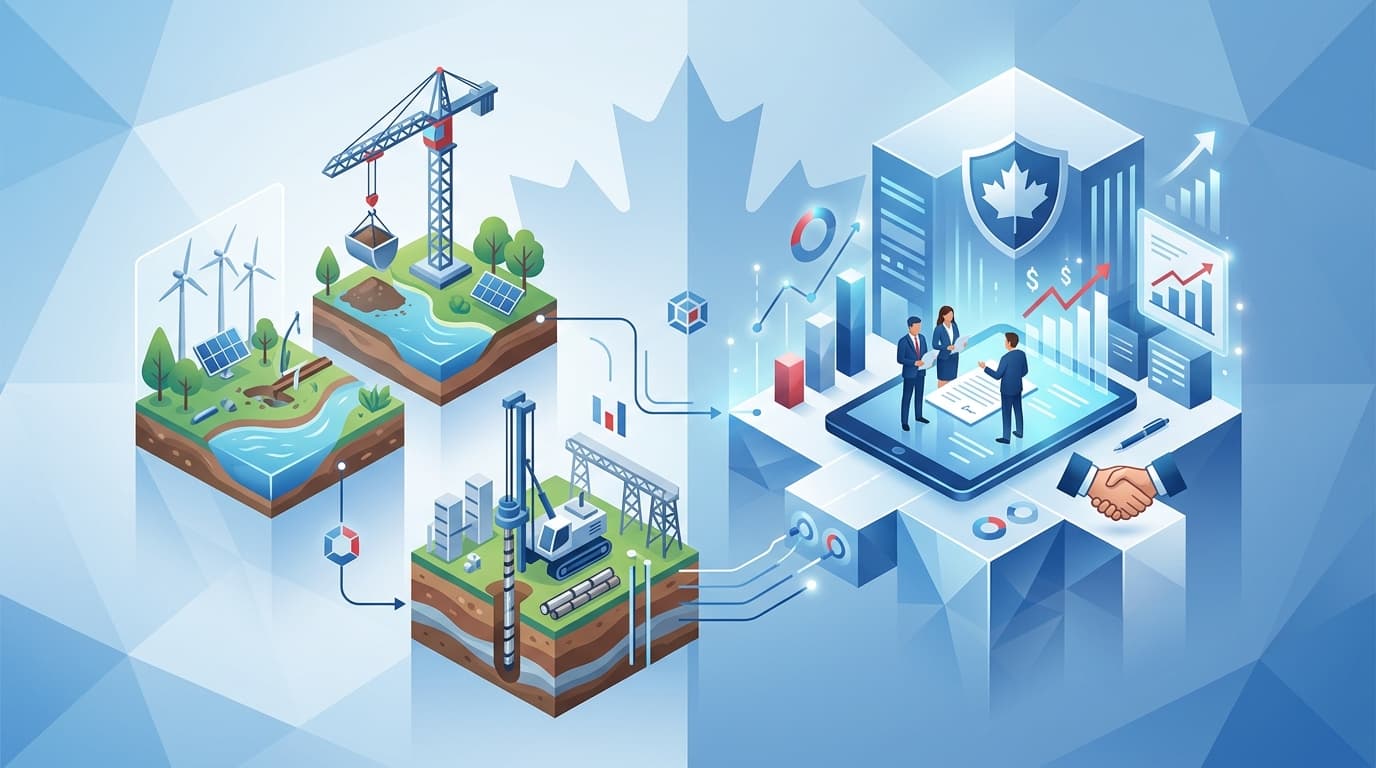
Winning $42M+ Federal Environmental Remediation & Geotechnical Mandates via SBIPS and Tier 2 Supply Arrangements
At a Glance
- Large federal remediation and geotechnical mandates are almost exclusively awarded through pre-qualified supply arrangements and standing offers.
- Tier 2 vehicles are reserved for high-value, complex projects, while SBIPS covers the critical data, IT, and monitoring systems required for massive cleanups.
- Integrating green remediation strategies and strict compliance frameworks is mandatory under current federal directives.
- Publicus helps contractors find, qualify, and manage these complex bidding opportunities without wasting hundreds of hours.
This article breaks down exactly how Canadian firms secure high-value federal environmental remediation and geotechnical projects by mastering Tier 2 supply arrangements, standing offers, and specialized procurement vehicles like SBIPS.
Getting your foot in the door for massive Government Contracts isn't about submitting the best resume; it's about being on the right list. If you want to know How to Win Government Contracts Canada, especially those massive $42M+ environmental remediation and geotechnical mandates, you have to understand the pre-qualification game. Navigating any standard Government RFP Process Guide shows that federal buyers rely heavily on Supply Arrangements (SAs) and Standing Offers (SOs) to manage risk. For the complex data and systems supporting these physical cleanups, they often turn to vehicles like SBIPS. Searching through endless portals to Find Government Contracts Canada is exhausting and prone to error. That's exactly why smart firms use RFP Automation Canada tools to Save Time on Government Proposals and Simplify Government Bidding Process. The right strategy mixed with the right technology is what separates the winners from the firms that just waste money on bid preparation.
The Regulatory Reality of High-Value Mandates
You cannot simply wake up one morning, spot a $45 million federal cleanup project, and submit a proposal. The Treasury Board of Canada Secretariat sets strict rules through its Directive on the Management of Procurement. This framework dictates that federal departments must use established procurement instruments, like standing offers and supply arrangements, whenever they provide the best value [4]. For large environmental remediation or geotechnical mandates, Public Services and Procurement Canada (PSPC) typically acts as the common service provider.
Here's the thing: PSPC evaluates more than just your technical engineering capability. You have to pass the Integrity Regime. Governed by the Ineligibility and Suspension Policy, this regime is brutally strict [3]. If your firm, or an affiliate, has a history of environmental offences, fraud, or labour code violations, you can be suspended from federal contracting for up to ten years. The Registrar of Ineligibility and Suspension holds the power here. You are essentially guilty until proven reliable. Before you spend a dime chasing a massive contract, your internal compliance house must be in order.
Large projects also trigger intense scrutiny under the Government Contracts Regulations. These regulations define exactly when competitive processes are required. Non-competitive contracts are exceptionally rare for standard geotechnical or environmental work, meaning you will face fierce competition at the Tier 2 call-up stage. You need to be prepared for this.
Deciphering SBIPS and Tier 2 Supply Arrangements
Federal procurement loves acronyms. Let's talk about SBIPS—Solutions-Based Informatics Professional Services. At first glance, you might wonder what an IT supply arrangement has to do with digging up contaminated soil or stabilizing a slope. What most don't realize: massive environmental programs are data programs.
A $42M remediation portfolio requires complex geospatial intelligence systems, 3D groundwater modelling, and real-time environmental monitoring dashboards. When federal departments like National Defence or Environment and Climate Change Canada need end-to-end IT solutions to support contaminated sites management, they issue RFPs against the SBIPS vehicle. SBIPS is a multi-supplier, multi-tier arrangement. Tier 1 handles the small stuff. Tier 2 is where the serious money lives.
Tier 2 is used for higher-complexity, higher-dollar requirements. If you are an environmental engineering firm, you either need to hold a spot on SBIPS for your technical consulting divisions, or you need to partner with an SBIPS holder to provide the software and data infrastructure for your remediation bids.
Physical Remediation Vehicles
For the actual physical dirt-moving, site assessment, and geotechnical engineering, PSPC uses regional and national environmental services supply arrangements. The structure directly mirrors SBIPS. Firms pre-qualify by proving financial capacity, safety records, and past performance. Once on the list, you compete in "second-stage" mini-competitions.
Academic research on European and Canadian public sector framework agreements shows that these Tier 2 mini-competitions often suffer from incumbent lock-in. If a contracting authority knows and trusts three firms on the list, they will subtly shape the evaluation criteria to favor those firms. Your goal is to disrupt that bias by bringing undeniable innovation to your proposals.
The Greening Government Overlay
You cannot win a major federal project today without addressing climate impact. The Treasury Board's Greening Government Strategy mandates that federal custodians manage contaminated sites in a way that supports sustainable practices and net-zero emissions by 2050 [9]. Furthermore, PSPC's own Departmental Sustainable Development Strategy explicitly commits to integrating environmental performance into procurement decisions [6].
How does this look in practice? It looks like Green Remediation Best Management Practices (BMPs). While originally popularized by the US EPA for Superfund sites, these BMPs have become the de facto standard in Canadian federal contracting [10][11]. Evaluators want to see how you will reduce total energy use on site. They want to see commitments to clean diesel equipment, strict idling reductions, and the reuse of soil and concrete.
Consider a massive groundwater pump-and-treat operation. If your proposal includes conventional diesel generators, you will lose points. If your competitor proposes a solar-powered containment system with optimized vapor extraction footprints, they will win the technical rating. You have to tie these green BMPs directly to life-cycle costs, proving to the Crown that your sustainable approach is actually cheaper over a ten-year operational period.
Winning Tactics for Tier 2 Call-Ups
Getting onto a Supply Arrangement is a milestone, but it is not a contract. It is merely a hunting license. The firms actually capturing $40M+ portfolios treat the Tier 2 vehicle as a strategic ecosystem.
First, position your service catalogue aggressively. If you are on an environmental SA, your listed labour categories and NAICS codes must scream competence in hazardous waste, hydrogeology, and risk assessment. Top performers pre-design their solution architectures. When a call-up is published on CanadaBuys, they don't start from scratch. They pull pre-approved geotechnical details, template health and safety plans, and standard traffic models.
Second, master integrated delivery. The Crown hates managing five different contractors on one site. Offer an integrated "Investigation-Design-Build-Operate" model. Present a single Program Management Office (PMO) with standardized governance. Use cloud-based project controls to give the federal technical authority real-time visibility into the cleanup.
Third, embed Indigenous participation deeply into your delivery model. Federal departments like Indigenous Services Canada and PSPC require meaningful Indigenous procurement targets [8]. Do not treat this as a last-minute checklist item. The winners establish early Memorandums of Understanding with local Indigenous communities for field labour, site security, and environmental monitoring well before the RFP drops.
How Publicus Changes the Game
Managing this level of complexity manually is a losing battle. Federal supply arrangements generate a massive volume of data, amendments, and hidden call-ups. Missing a single mandatory requirement buried on page 87 of an RFP can disqualify months of work.
Publicus is an AI platform specifically designed for Canadian government contracting. Instead of paying a bid coordinator to refresh CanadaBuys ten times a day, Publicus aggregates RFPs from various sources automatically. The system uses AI to qualify opportunities, matching complex requirements against your firm's specific capabilities and supply arrangement standing.
By parsing massive federal documents in seconds, Publicus helps your team save time on proposals. It extracts the mandatory criteria, flags the specific environmental and safety standards required, and allows your senior engineers to focus on designing the remedial solution rather than fighting with administrative paperwork. In the high-stakes world of Tier 2 federal contracting, time is your most expensive resource. Publicus gives it back to you.
Preparing for the Future of Federal Geotech
The scale of federal environmental liability in Canada is massive. Custodian departments are under immense pressure to accelerate cleanups, reduce long-term monitoring costs, and implement climate-resilient infrastructure. The procurement mechanisms will only become more heavily weighted toward innovation and sustainability.
To dominate this space, you must secure your spots on the relevant supply arrangements, perfect your green remediation delivery, and leverage AI tools to outpace your competitors during the chaotic RFP response windows. The $42M mandates are out there. The federal government has already budgeted for them. Now you just need to execute the strategy to win them.
Frequently Asked Questions
What exactly is a Tier 2 Supply Arrangement?
A Tier 2 Supply Arrangement is a pre-qualified list of vendors approved by PSPC to bid on federal contracts that exceed a certain dollar threshold or complexity level. While Tier 1 is for smaller, routine tasks, Tier 2 requires extensive proof of financial stability and past performance on massive, high-risk projects.
Does SBIPS cover physical construction and excavation?
No. SBIPS (Solutions-Based Informatics Professional Services) is strictly an IT and data services vehicle. However, large environmental projects use SBIPS to procure the complex 3D modeling, geospatial tracking, and data management systems required to support the physical remediation work.
How do federal green policies impact standard geotechnical bids?
The Greening Government Strategy requires evaluators to consider carbon footprints and life-cycle costs. A standard geotech bid for slope stabilization must now account for the embodied carbon in the concrete, fuel emissions from heavy machinery, and the long-term climate resilience of the design.
Can Publicus help me get onto a Supply Arrangement?
Publicus helps by tracking the refresh cycles and solicitations for these standing offers and supply arrangements. It uses AI to parse the massive qualification documents, ensuring you understand exactly what mandatory criteria your firm needs to meet to get on the list.
Sources
- [1] tradecouncil.org
- [2] globalefficiencyintel.com
- [3] mcmillan.ca
- [4] gost.tpsgc-pwgsc.gc.ca
- [5] geds-sage.gc.ca
- [6] canada.ca
- [7] publications.gc.ca
- [8] sac-isc.gc.ca
- [9] canada.ca
- [10] clu-in.org
- [11] epa.gov
- [12] pa.gov
- [13] 19january2021snapshot.epa.gov
- [14] ibisworld.com
- [15] enviro.wiki
- [16] dart.deloitte.com
- [17] hazmatmag.com
- [18] nsf.gov
- [19] nepis.epa.gov
- [20] pmc.ncbi.nlm.nih.gov
- [21] escholarship.org
- [22] superfund.oregonstate.edu
- [23] abpsoil.com
- [24] ebionline.org
- [25] bls.gov