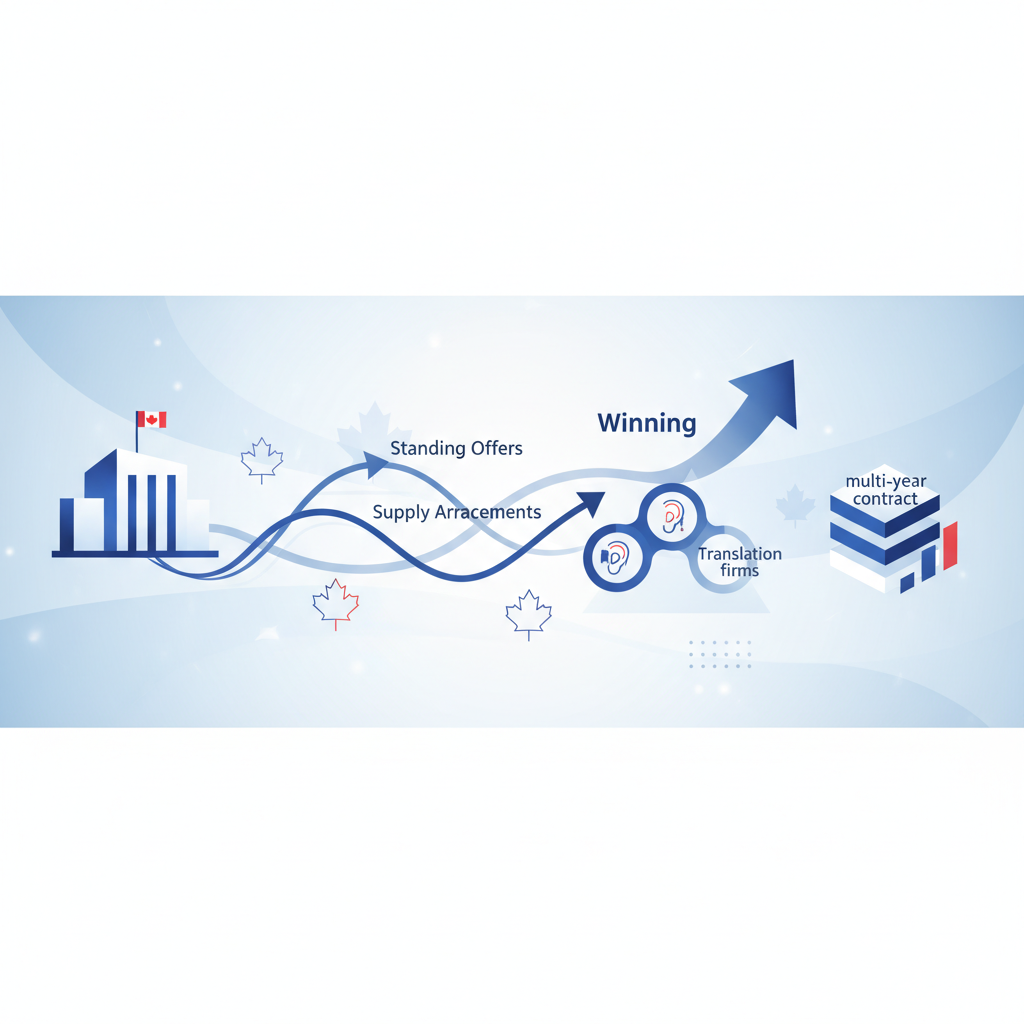
How Translation Firms Win Multi-Year Government Contracts Through Standing Offers & Provincial Supply Arrangements
If you've been chasing government RFPs one contract at a time, you're doing it wrong. Translation firms that crack the code on government procurement don't win projects—they win multi-year access to work. The mechanism? Standing Offers and provincial supply arrangements that put your firm on pre-qualified lists where departments can call on you repeatedly, sometimes for years.
Understanding how to win government contracts Canada in the translation sector requires a fundamental shift in thinking. Instead of responding to individual government RFPs for each project, successful translation firms invest upfront effort to secure positions on Standing Offers managed by Public Services and Procurement Canada (PSPC) and provincial procurement bodies. These arrangements operate on an "as and when requested" basis, dramatically simplifying the government bidding process once you're qualified.[2][3]
The Canadian government contracting guide for translation services looks nothing like traditional competitive procurement. Through platforms that help find government contracts Canada like CanadaBuys, firms discover Requests for Standing Offers (RFSOs) rather than standard RFPs. Getting onto these lists represents the single most effective way to save time on government proposals while building predictable revenue streams. Tools that offer RFP automation Canada, like Publicus, aggregate these opportunities from various sources and use AI to qualify which standing offer competitions actually match your firm's capabilities, helping you focus energy where it counts.
The government procurement landscape for translation services centers on official bilingualism requirements under the Official Languages Act. What most don't realize: federal departments can't just hire any translation firm they want. They must select from existing Standing Offer holders—sometimes as few as 11 firms for English-French work in specific regions.[3]
The Standing Offer Framework: How the System Actually Works
Standing Offers function as pre-negotiated agreements between PSPC and qualified translation suppliers. Think of them as membership in an exclusive club where government departments shop for language services. The Treasury Board Directive on the Management of Procurement, effective May 13, 2021, governs how federal departments acquire these services, emphasizing value for money and streamlined processes.[3]
Here's how the government RFP process guide plays out in practice. PSPC publishes an RFSO on CanadaBuys for translation services in specific regions. For instance, GSIN R109D covers the Ontario region for technical and non-technical English-French translation and editing services.[2][3] Qualified firms submit comprehensive proposals demonstrating credentials, capacity, security clearances, and pricing structures. PSPC evaluates submissions and establishes a standing offer with a ranked list of pre-qualified suppliers. From that point forward, departments issue call-ups directly to these suppliers without running new competitive processes for every translation need.[3]
The operational requirements are specific. Regular translation work must be completed within 3 working days, while urgent translation requires 24-hour turnaround from receipt.[2] These timelines are non-negotiable, which means firms need established capacity before applying. Standing Offers run to specific expiry dates with ongoing work throughout the period. Parks Canada Agency's National Individual Standing Offers for translation services, for example, run for two years (September 1, 2025 to August 31, 2027), with the possibility to extend by up to three additional one-year periods under identical terms and conditions.[6]
The catch? You can't simply respond to individual translation needs. Departments contact Standing Offer holders with a Statement of Work, and suppliers submit proposals, work samples, and resource résumés—often within tight timelines that test organizational readiness.[3]
Accreditation: The Non-Negotiable Barrier to Entry
For interpretation services, suppliers must already be accredited by the Translation Bureau to even participate in standing offer competitions.[4] This represents a significant barrier to entry that protects incumbent suppliers while creating frustration for newcomers.
The Translation Bureau conducts accreditation examinations periodically. In October 2025, PSPC published a request for standing offers for interpretation services on CanadaBuys, with an initial closing date of November 24, 2025, explicitly open only to suppliers already accredited by the Translation Bureau.[4] The procurement notice referenced November 2025 examination sessions for suppliers seeking accreditation, creating a phased approach where firms completing exams could participate in later closing dates.[4]
This pre-qualification process fundamentally changes your business development strategy. Rather than marketing directly to departments or responding opportunistically to RFPs, translation firms must invest months—sometimes over a year—preparing for and obtaining accreditation before they can compete. The professional standards cover language profiles, regional coverage, and demonstrated expertise in technical versus non-technical translation.[3]
What changed recently? PSPC's October 2024 updates to interpretation procurement shifted back to daily rates, added explicit recognition of health and safety obligations, and introduced service quality expectations with procedures for managing breaches of these expectations.[4] These modifications signal ongoing refinement of standing offer terms, meaning firms need to monitor policy changes even after achieving accreditation.
Understanding Call-Up Thresholds and Competition Levels
Not all standing offer work involves the same level of competition. The dollar value of each call-up determines how departments select suppliers from the pre-qualified list.
Under $25,000, call-ups often go directly to any qualified supplier on the standing offer without further competition.[7] This represents the most accessible work once you're on the list—departments may rotate through suppliers or select based on availability and past performance without formal evaluation.
Between $25,000 and $75,000, departments typically request quotes from multiple pre-qualified suppliers. Awards go to the best combination of price and other factors like demonstrated subject matter expertise or faster delivery timelines.[3][7] The Ontario Region Translation Services standing offer (GSIN R109D) allows departments to issue call-ups up to $75,000 for technical and non-technical translation and editing services, with pre-negotiated per-word pricing and delivery timelines.[7]
Above $100,000, competitive processes apply even among standing offer holders. Departments develop more formal evaluation criteria, potentially longer timelines, and detailed scoring matrices. Ontario's Broader Public Sector Procurement Directive requires open competition for services exceeding $100,000, aligning with Canadian Free Trade Agreement thresholds.[7] At this level, you're competing against the same small group of pre-qualified firms, but with more rigorous proposal requirements.
The procurement officer for Ontario Region Translation Services (GSIN R109D) is Andrew Denbeigh, reachable at 613-536-4994 or [email protected].[2] Building relationships with procurement officers doesn't hurt—they manage the standing offer agreements and can clarify technical requirements during RFSO competitions.
Pricing Strategy: How Rate Structures Determine Work Allocation
PSPC shifted from random supplier selection to rate-based allocation several years ago, fundamentally changing competitive dynamics. Among accredited suppliers meeting quality standards, departments now prioritize lowest-rate qualified holders for call-ups.[6]
This creates tension between maximizing margins and maximizing volume. Firms pricing aggressively low can capture disproportionate shares of call-up work, building revenue through volume rather than per-project margins. However, unsustainably low rates create operational problems when urgent 24-hour turnarounds stretch capacity or specialized technical content requires expensive subject matter expertise.
Standing offer submissions require detailed pricing structures: per-word rates for translation, hourly rates for editing, rush fees for urgent work, and rates for different language pairs and specializations. These rates remain locked for the standing offer period—potentially two years with three additional one-year extensions—so pricing strategy must account for inflation, wage increases, and market changes over up to five years.[6]
Performance evaluations under professional standards also influence work allocation. Excel in delivery quality, timeliness, and responsiveness, and you'll see more call-ups even if you're not the absolute lowest bidder. Demonstrate problems with quality or miss deadlines, and departments will shift work to other standing offer holders without notice.
Provincial Variations: Ontario, BC, and Regional Frameworks
While PSPC manages federal standing offers, provincial governments operate parallel frameworks with distinct rules. Ontario's regional Standing Offers mirror federal PSPC models, focusing on English-French technical and non-technical translation.[3] Supply Ontario operates as the central procurement hub, similar to how CanadaBuys works federally, but with separate posting requirements and timelines.[7]
Below $100,000, Ontario allows direct awards and standing arrangements without full competitive processes, creating opportunities for pre-qualified suppliers.[7] British Columbia operates Provincial Language Services frameworks with different structures, and Quebec obviously has its own extensive French-language service requirements.
Translation firms pursuing multi-provincial coverage need separate accreditations and standing offer positions for each jurisdiction. A federal PSPC standing offer doesn't automatically qualify you for Ontario provincial work, despite covering the same Ontario region geographically. This multiplies the upfront investment but also multiplies revenue opportunities across federal, provincial, and municipal clients.
Practical Steps: Getting on the List and Winning Call-Ups
Start by monitoring CanadaBuys for Requests for Standing Offers rather than individual project RFPs. Platforms like Publicus aggregate these opportunities from various government sources and use AI to identify which standing offer competitions match your accreditation, regional coverage, and service capabilities. This saves substantial time compared to manually checking multiple procurement portals.
Pursue Translation Bureau accreditation immediately if you don't have it. The examination process takes months, and you cannot compete for standing offers without it. Recent interpretation standing offers opened phased closings—November 24, 2025 initial deadline, with mid-December dates for firms completing new accreditation exams—showing PSPC's willingness to accommodate newly accredited suppliers.[4]
When responding to RFSOs, emphasize government track record over commercial client success. Evaluators want evidence you understand government deliverable requirements: formatted translations matching source documents, glossaries, style guides, quality assurance reports, and security protocols. Highlight ISO certifications, ATA memberships, and any existing security clearances your translators hold.[6]
Build capacity for standardized workflows before applying. Government work demands consistency across projects and translators. If you operate as a boutique firm with artisanal approaches to each project, you'll struggle with the volume and timeline requirements once call-ups start arriving. Standing offers reward scalable operations that can handle multiple simultaneous three-day turnarounds.
Once on the standing offer, respond to Statements of Work with samples, translator résumés, and competitive rates within specified deadlines. Even small call-ups like $8,700 each add up—two such projects total $17,400, and steady work throughout a two-year standing offer period generates substantial cumulative revenue.[6]
Looking Forward: Market Trends and Emerging Opportunities
Federal and provincial emphasis on the Official Languages Act continues driving steady English-French translation demand. The shift to rate-based allocation enhances competitiveness for cost leaders among accredited suppliers, moving from random distribution to prioritized selection based on price and performance.[6]
Growing accreditation windows signal potential expansion. The new PSPC interpretation standing offers launched in October 2025 open to Translation Bureau-accredited firms or those qualifying through upcoming examinations, suggesting PSPC recognizes capacity constraints in current supplier pools.[4] More accredited suppliers could mean more standing offer positions, though also increased competition.
No fixed revenue thresholds exist for standing offer work, but ongoing call-ups build substantial value over multi-year periods. Track record on initial small call-ups influences allocation of larger projects, so treat every $15,000 assignment as an audition for $100,000+ opportunities.
The bottom line? Translation firms should invest in PSPC accreditation and rate optimization now. Pre-qualified status unlocks years of call-ups rather than one-off project wins. Target upcoming standing offer competitions on CanadaBuys—like the 2025 interpretation framework—to establish positions before competitors. The firms winning multi-year government translation revenue aren't chasing individual RFPs. They secured standing offer positions years ago and now receive steady call-ups while unaccredited competitors remain locked out of the system entirely.
Sources
- [1] publicus.ai
- [2] canada.ca
- [3] publicus.ai
- [4] canada.ca
- [5] opo-boa.gc.ca
- [6] merx.com
- [7] publicus.ai
- [8] tenderimpulse.com
- [9] search.open.canada.ca
- [10] iq.govwin.com
- [11] globaltenders.com
- [12] inventive.ai
- [13] usfcr.com
- [14] highergov.com
- [15] tendersinfo.com
- [16] alsglobal.net
- [17] state.gov
- [18] milengo.com
- [19] marstranslation.com
- [20] buy.gsa.gov