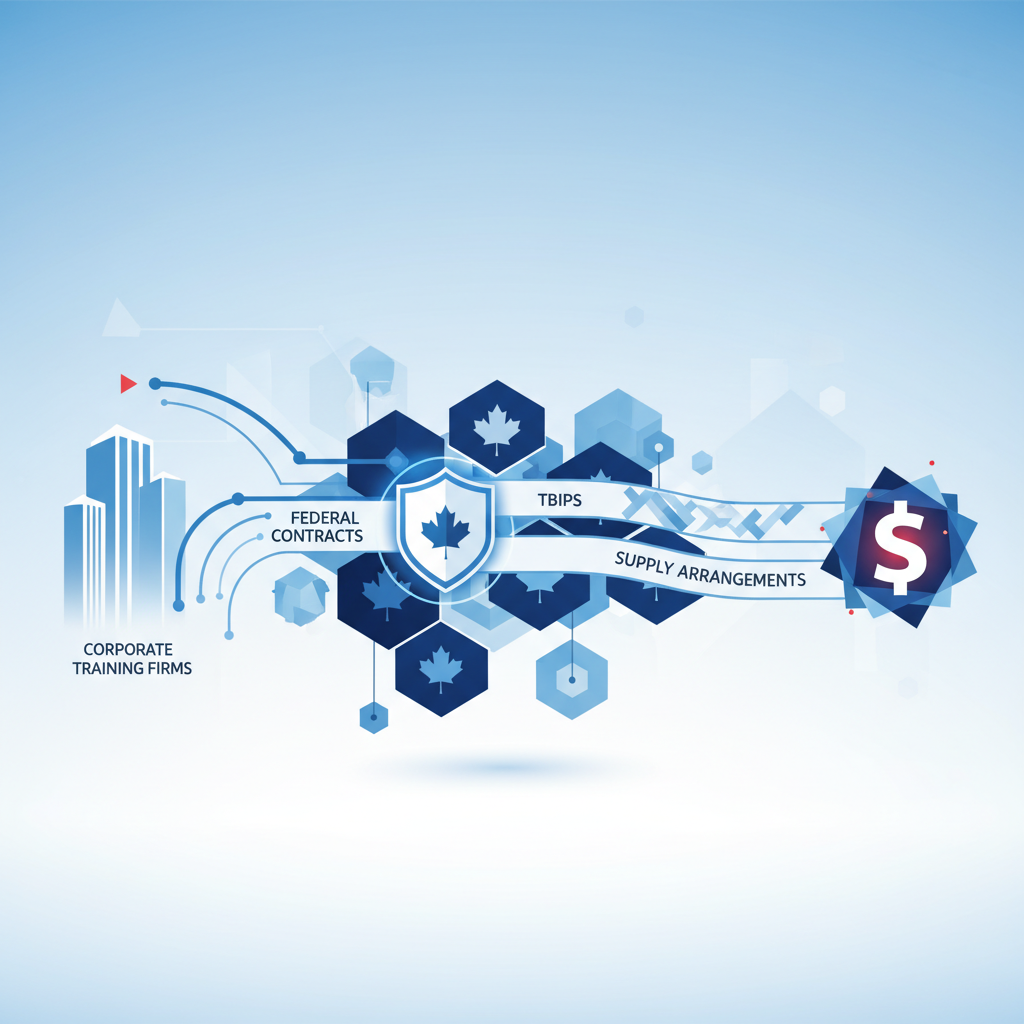
How Corporate Training Firms Win $12M+ Federal Contracts Through TBIPS & Supply Arrangements
A privacy consultancy in Ottawa lands a $4.2 million contract. Six months later, the same firm secures another $3.8 million task authorization. By year's end, they've stacked a third engagement worth $5.1 million. Total value? Just over $13 million—all through the same procurement vehicle.
This isn't an anomaly. Corporate training firms specializing in informatics professional development are quietly building eight-figure revenue streams through Task-Based Informatics Professional Services Supply Arrangements. While most businesses chase individual government RFPs one at a time, sophisticated training providers understand how to navigate the Canadian government contracting landscape through pre-qualified mechanisms that fundamentally change how government procurement works.
The Task-Based Informatics Professional Services framework operates as the mandatory method of supply for discrete IT consulting assignments across federal departments. This means if a government entity needs specialized training in cybersecurity, project management methodologies, or business systems implementation, they must use TBIPS Supply Arrangements.[3] For training firms, this creates a repeatable path to government contracts that bypasses traditional competitive bidding for every single engagement.
Here's the thing: winning these contracts requires understanding a system that wasn't designed with training providers in mind. TBIPS targets informatics professional services—IT consultants, systems analysts, project managers. But corporate training firms fit squarely within several of its seven service streams, particularly business services and project management, where knowledge transfer and capability development constitute core deliverables.[3] The government RFP process guide for TBIPS reveals opportunities most training companies never discover.
Getting pre-qualified means your firm becomes one of the go-to suppliers departments can task directly, dramatically simplifying the government bidding process. Instead of responding to endless open competitions, you receive invitations for specific task authorizations. This is how to win government contracts Canada at scale—through strategic positioning rather than volume bidding. Platforms like Publicus, an AI system that aggregates government RFPs and uses artificial intelligence to qualify opportunities, help firms find government contracts Canada-wide by tracking these TBIPS task authorizations alongside traditional solicitations, helping save time on government proposals by focusing only on relevant matches.
The Two-Tier Structure That Enables $12M+ Engagements
TBIPS operates through a tiered architecture that determines both procurement authority and contract ceiling values. Understanding these tiers is essential because they define the pathway to high-value engagements.
Tier 1 covers task authorizations between $100,000 and $3.75 million. Individual departments manage these directly after signing a Master Level User Agreement with Public Services and Procurement Canada. They identify needs, issue task-specific requests from pre-qualified suppliers, and award contracts without PSPC's direct involvement.[3] Think of Tier 1 as the departmental self-service tier—faster, more flexible, but capped.
Tier 2 handles everything above $3.75 million per requirement. These flow through centralized PSPC oversight, ensuring high-value contracts receive additional scrutiny and competitive rigor among pre-qualified suppliers.[1] The catch? Individual task authorizations max out at $1.5 million unless the departmental Chief Information Officer grants specific approval to exceed this limit.[3]
So how do training firms reach $12 million or beyond? Three primary methods emerge from the structure itself. First, firms stack multiple Tier 1 task authorizations across different departments or fiscal years. A supplier qualified under business services might simultaneously deliver change management training to Immigration, Refugees and Citizenship Canada, project management certification programs to National Defence, and leadership development to the Canada Revenue Agency. Each represents a separate task authorization, potentially worth millions individually.
Second, suppliers secure Tier 2 contracts with approved increases beyond the standard $1.5 million task ceiling. A comprehensive three-year training program transformation for a large department could easily justify a $6 million single engagement with proper CIO authorization.[3] These require stronger justification but offer revenue concentration and relationship depth.
Third—and this is what most don't realize—firms combine TBIPS engagements with complementary procurement vehicles. A training company might hold both TBIPS qualification for IT-focused professional development and separate standing offers for general management training, effectively covering multiple angles into the same client departments.
The Qualification Gauntlet: Security, Insurance, and Demonstrated Capability
Pre-qualification separates window shoppers from serious contenders. The requirements aren't insurmountable, but they demand upfront investment and organizational maturity that many training firms lack.
Security clearance starts with Designated Organization Screening at Reliability Status level. Your organization must undergo background verification processes, establish security protocols, and maintain compliance standards that satisfy federal requirements.[1] For training firms accustomed to commercial clients, this represents new territory—policies around personnel screening, facility security, and information handling that extend beyond typical corporate practice.
Insurance requirements escalate with contract value. Tier 2 Supply Arrangements mandate minimum $2 million liability coverage maintained throughout the arrangement's duration.[3] This isn't project-specific insurance you obtain per contract; it's continuous coverage reflecting your capacity to handle high-value federal engagements. Smaller training providers often carry $1 million policies sufficient for commercial work but inadequate for federal Tier 2 qualification.
Demonstrated capability matters more than marketing promises. TBIPS qualification requires documented experience in specific service streams and categories. A firm claiming expertise in project management training must provide client references, project examples, and evidence of successful delivery at comparable scale and complexity.[3] Generic training credentials don't suffice—evaluators want proof you've delivered informatics professional development specifically, ideally with government or large institutional clients.
Resource supervision requirements add another dimension. TBIPS contracts typically require that supplied training professionals work under appropriate oversight aligned to each Statement of Work's standards.[2] Your firm must demonstrate quality control mechanisms, professional development frameworks, and management capacity to ensure consistent delivery across multiple concurrent engagements.
The quarterly refresh cycle offers strategic entry points. TBIPS accepts new supplier applications at the end of March, June, September, and December.[3] This prevents market saturation while allowing qualified firms regular access. Existing suppliers can add capabilities during these refreshes without full re-qualification—a significant advantage for established providers expanding service offerings.
Registration and Administrative Prerequisites
Beyond qualifications, administrative compliance creates barriers to entry that favor organized, process-oriented firms. ARIBA registration provides the procurement platform interface for federal transactions. Suppliers submit bids, track task authorizations, and manage contract documentation through this system.[4] The learning curve is real, particularly for training companies without dedicated proposal teams.
Treasury Board contracting policies mandate specific business conduct standards, including conflict of interest protocols and ethical procurement practices.[4] Training firms must implement compliance frameworks addressing these requirements—policies many commercial providers have never formalized.
Seven Service Streams and Where Training Firms Fit
TBIPS divides informatics professional services into seven distinct streams, each containing multiple categories. Training providers most commonly qualify under two streams, though strategic firms pursue broader coverage.
Business services encompass business process engineering, organizational change management, and strategic planning—all areas where corporate training intersects with consulting.[3] A firm delivering change management training during ERP implementations fits squarely here. So does a provider offering strategic planning facilitation and leadership development for digital transformation initiatives. The key is positioning training as integrated business consulting, not standalone course delivery.
Project management services include methodology implementation, PMO establishment, and project controls—natural fits for training firms specializing in project management professional development.[3] Think beyond certification prep courses. A comprehensive program that embeds project management capability into a department through training, coaching, tools implementation, and ongoing support qualifies as informatics professional services under TBIPS.
Some training firms also qualify under information management and cybersecurity streams when their offerings address data governance, privacy training, or security awareness programs. As federal departments intensify focus on cyber protection, training providers with specialized capabilities in these areas find growing demand.[1]
What makes the difference between acceptance and rejection? Scope definition. Training delivered as a component of broader informatics consulting—capability development integral to IT projects, business transformation, or technology adoption—aligns with TBIPS intent. Generic soft skills training or off-the-shelf course delivery doesn't. Frame your offerings as specialized informatics professional development supporting discrete departmental initiatives.
The Procurement Process: From MLUA to Task Authorization
Once qualified, the actual contracting process follows a defined sequence that differs significantly from open competition RFPs. Departments begin by signing a Master Level User Agreement with PSPC, granting authority to issue task authorizations to pre-qualified TBIPS suppliers.[2] This administrative step is invisible to suppliers but essential for departmental access.
When a need arises—say, a department requires cybersecurity awareness training for 500 employees with specialized modules for system administrators—the procurement team issues a task-specific solicitation. For Tier 1 requirements, they use PSPC's mandatory RFP template available through CanadaBuys, including standardized bid elements covering insurance confirmation, security compliance, and technical approach.[3]
Here's where pre-qualification pays off: only suppliers already holding TBIPS Supply Arrangements in relevant categories receive invitations. Instead of competing against every training provider in Canada, you're bidding within a pre-screened pool—often fewer than 50 firms for specialized categories.
Evaluation criteria balance technical merit, resource qualifications, and pricing. Departments assess your proposed approach, the experience and credentials of assigned training professionals, past performance on similar engagements, and cost competitiveness. Unlike open competitions where unknown firms sometimes win on price alone, TBIPS evaluations heavily weight demonstrated capability and resource quality—advantages for established suppliers.
Timeline compression represents another major benefit. Traditional RFPs require 15-25 days for solicitation periods per Government Contracts Regulations.[7] TBIPS task authorizations often move faster because pre-qualification has already validated basic supplier capability. Departments can issue abbreviated solicitations, accelerate evaluation, and award within weeks rather than months. For training firms, this means shorter sales cycles and faster revenue realization.
Strategic Approaches That Separate Winners from Participants
Holding TBIPS qualification doesn't guarantee contracts. Successful training firms employ deliberate strategies that maximize their pre-qualified status.
Relationship development at the departmental level matters enormously. TBIPS gives you access, but specific task authorizations flow from actual needs identified by program managers and IT directors. Sophisticated suppliers invest in understanding departmental priorities, building relationships with potential end-users, and positioning their capabilities before formal solicitations emerge. When a department drafts a Statement of Work for training services, the best suppliers have already influenced the requirement definition through earlier conversations.
Category diversification within TBIPS streams expands opportunity surface area. Rather than qualifying in a single narrow category, strategic firms pursue multiple related categories across streams. A provider might hold qualifications in business services (change management, process improvement) and project management services (methodology implementation, PMO support), doubling their addressable task authorizations.
Teaming arrangements extend capability beyond internal capacity. Winning a $4 million task authorization might require 15 specialized trainers with specific security clearances and technical certifications. Few training firms maintain that bench internally. Successful suppliers develop subcontractor networks—specialists they can mobilize for specific tasks while maintaining prime contractor relationships and margins.
Regional coverage affects opportunity access. TBIPS historically organized suppliers across zones including National Capital Region, Ontario, Quebec, Atlantic, Western, and Pacific.[6] While current arrangements show less rigid regional restriction, maintaining delivery capability across major federal employment centers—particularly NCR where most departments headquarter—increases task authorization invitations substantially.
Compliance monitoring prevents disqualification. TBIPS requires ongoing insurance maintenance, security clearance updates, and administrative compliance. Firms that let Designated Organization Screening lapse or allow insurance to drop below required minimums face suspension or removal. Winners treat qualification maintenance as operational priority, not administrative afterthought.
Navigating Common Obstacles
Even qualified suppliers encounter challenges that limit success. Understanding these pain points helps develop mitigation strategies.
Opportunity fragmentation across systems creates visibility gaps. While CanadaBuys serves as the official federal tender publication platform, individual departments sometimes issue TBIPS task authorizations through separate channels or with limited advertising periods. Training firms miss viable opportunities simply because they didn't see the solicitation in time. This is where AI-powered platforms like Publicus provide value—aggregating opportunities from multiple sources and using artificial intelligence to flag relevant matches based on your specific TBIPS categories and past bid patterns.
Resource qualification stringency in task-specific solicitations often exceeds general TBIPS requirements. A department might require trainers with both PMP certification and active Secret clearance, plus five years' experience in agile methodology instruction for government clients. Assembling teams meeting these precise specifications within tight solicitation windows tests supplier depth and network strength.
Pricing competitiveness versus capability demonstration creates constant tension. Departments evaluate both cost and quality, but weighting varies by task. Some solicitations heavily emphasize lowest compliant bid; others prioritize technical excellence with price as secondary factor. Winning requires reading evaluation criteria carefully and calibrating proposals accordingly—sometimes competing on efficiency and value, other times differentiating on specialized capability regardless of premium pricing.
New compliance requirements add complexity. Recent Treasury Board directives around professional services procurement introduce additional evaluation considerations, including Indigenous participation and environmental sustainability measures.[8] Training firms must continuously update proposal templates and compliance frameworks to address evolving requirements.
What the Next Five Years Hold
Current TBIPS Supply Arrangements extend through 2028, providing medium-term stability for qualified suppliers.[1] This timeline signals continued federal reliance on pre-qualified vehicles for informatics professional services, including training-related capabilities.
Demand drivers suggest growing opportunity volume. Federal digital transformation initiatives, cybersecurity imperatives, and workforce modernization all require substantial capability development. Departments need training in cloud technologies, data analytics, privacy compliance, project management, and change leadership—all areas where TBIPS-qualified suppliers can engage. As baby boomer retirements accelerate, knowledge transfer and professional development become departmental priorities, further expanding training requirements.
Technology integration in procurement processes will likely accelerate. PSPC continues modernizing systems, potentially consolidating platforms and improving supplier interfaces. Training firms that invest in digital proposal development, bid automation, and opportunity tracking position themselves to capitalize on efficiency gains while competitors struggle with administrative burden.
Market consolidation may increase as smaller training providers recognize the qualification barriers and ongoing compliance costs exceed their capacity. This could drive acquisition activity, with larger firms acquiring specialized boutiques to add TBIPS-qualified capabilities and expand category coverage. Alternatively, it might spur collaborative arrangements where smaller specialists subcontract to qualified primes rather than pursuing independent qualification.
Policy evolution around training specifically remains uncertain. While TBIPS serves informatics professional services broadly, training represents a subset that departments might eventually address through dedicated procurement mechanisms. Monitoring Treasury Board policy development and PSPC consultations helps anticipate potential structural changes before they impact your qualification strategy.
For corporate training firms serious about federal revenue, TBIPS Supply Arrangements represent the most reliable path to eight-figure contracts. The qualification process demands real investment—security clearances, insurance upgrades, documented capability, administrative infrastructure. But once established, pre-qualified status fundamentally changes your competitive position. You're not chasing every RFP hoping to beat 30 unknown competitors. You're receiving direct invitations to bid on specific tasks within a vetted supplier pool, building departmental relationships across multiple engagements, and stacking task authorizations into substantial revenue streams. That's the difference between hoping for government contracts and systematically winning them.
Sources
- [1] publicus.ai
- [2] torys.com
- [3] canada.ca
- [4] opo-boa.gc.ca
- [5] gazette.gc.ca
- [6] tbs-sct.canada.ca
- [7] laws-lois.justice.gc.ca
- [8] deltek.com
- [9] tbs-sct.canada.ca
- [10] publicus.ai
- [11] energy.gov
- [12] rfpsolutions.ca
- [13] federalcompass.com
- [14] usaspending.gov
- [15] sisystems.com
- [16] canada.ca
- [17] mtec-sc.org