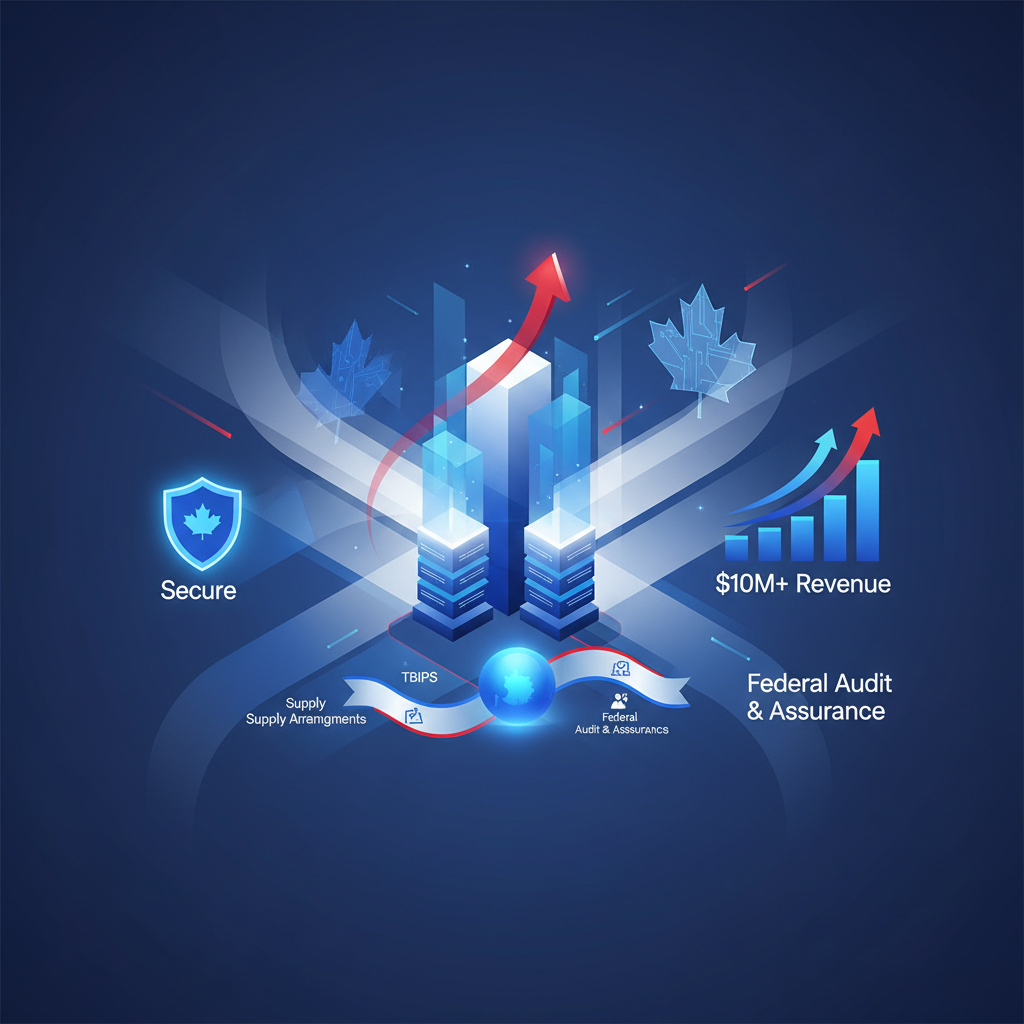
Secure $10M+ in Federal Audit & Assurance Revenue Through TBIPS & Supply Arrangements
Most audit and assurance firms treat government contracts like an afterthought—chasing one-off RFPs when a procurement manager happens to forward an opportunity. Meanwhile, a handful of firms are quietly building seven-figure revenue streams through a mechanism most accountants have never heard of: Task-Based Informatics Professional Services, or TBIPS. The federal government spends $8.6 billion annually through TBIPS and similar supply arrangements, yet firms that master this Canadian government contracting guide can bypass traditional competitive bidding almost entirely.[1][2]
Here's what makes TBIPS different from typical government procurement. Once you're pre-qualified under this supply arrangement—managed by Public Services and Procurement Canada—you compete only against 6 to 15 other approved suppliers for task authorizations worth $50,000 to $500,000 each.[1][2] Your proposal effort drops from 80-120 hours for open RFPs to just 8-15 hours per task authorization, while your win rate jumps from 15-25% to 80-90%.[2] When you understand how to win government contracts Canada through this channel, the math becomes compelling: secure 10 to 15 task authorizations annually, and you're looking at $900,000 to $1.2 million in predictable federal revenue.[2] Scale that across multiple team members or practice areas, and $10 million becomes achievable rather than aspirational.
The government RFP process guide that nobody gives audit firms explains a critical detail: TBIPS isn't just for software developers. The current supply arrangement (EN578-170432), which extends through July 2028, covers compliance informatics, risk assessment, cybersecurity audits, privacy impact assessments, and data security—exactly where modern audit and assurance work intersects with information management.[1][2][9] Platforms like Publicus help you find government contracts Canada and use AI to qualify which TBIPS opportunities match your firm's capabilities, but first you need to understand the underlying revenue model and qualification pathway.
The TBIPS Revenue Model: Why Pre-Qualification Changes Everything
The federal government's informatics spending exceeds $22 billion annually, with mandatory use of TBIPS for tasks above trade agreement thresholds.[1][2] What most firms don't realize is that this isn't a single monolithic contract—it's a framework enabling hundreds of separate task authorizations across dozens of departments. Innovation, Science and Economic Development Canada alone issued 47 task authorizations worth $18 million in a single reporting period.[2] Transport Canada, Canadian Heritage, Natural Resources Canada, and Environment and Climate Change Canada all maintain steady demand for compliance and assurance work that qualifies under TBIPS streams.
Consider the case of GC Strategies, which secured $25.3 million in 2022 through aggregated TBIPS task authorizations, or Veritaaq's $19.9 million in 2015.[1][2] These aren't Big Four firms with massive government practices—they're specialized suppliers who understood the government procurement process and positioned their services correctly. Your firm doesn't need to match those figures immediately. Start with the realistic target: 6 to 10 task authorizations in your first year post-qualification, generating $750,000 to $1.2 million.[2] That alone justifies the qualification investment for most mid-sized practices.
The catch? You're competing against informatics firms, management consultants, and other audit practices that already figured this out. A 2024 PSPC audit found that 42% of rejections stem from security clearance mismatches, not lack of technical capability.[2] The firms winning consistently have solved the clearance problem, built the reference base PSPC requires, and learned to frame traditional audit services as "informatics professional services" where they overlap with data, systems, and compliance technology.
Building Your Qualification Pathway: From Regional Contracts to TBIPS Tier 1
TBIPS operates in two tiers. Tier 1 covers department-level task authorizations up to $3.75 million, issued directly by individual federal departments. Tier 2 handles larger engagements managed centrally by PSPC.[1][2] Your pathway to $10 million runs through Tier 1 first, accumulating the references and security credentials that make Tier 2 accessible later.
Start by securing 3 to 5 federal or provincial references through regional Standing Offers or smaller contracts. Environment Canada audits at $75,000, provincial ministry compliance reviews, or Natural Resources Canada assessments all qualify as reference builders.[1] These initial engagements serve two purposes: they demonstrate your capability to deliver within government constraints (reporting templates, security protocols, bureaucratic timelines), and they establish the performance history PSPC evaluates during Stage 1 qualification review.[1][2]
Here's where strategy matters. Supply Ontario and similar provincial supply arrangements mirror TBIPS structure but require lower initial security clearances and face less competition.[1][2] Firms that secure 2 to 3 provincial wins report 47% higher federal win rates afterward—the provincial work sharpens your proposal approach while building baseline security credentials.[2] This cross-jurisdictional strategy also addresses the clearance bottleneck that kills 42% of federal bids.
TBIPS qualification follows quarterly deadlines in March, June, September, and December.[2] Your application package must demonstrate technical capability across specific service streams (Privacy and Security Assessments, Risk Management, Compliance Analytics), provide those 3 to 5 verifiable references with contact information for client verification, and prove your firm carries $2 million in professional liability and cyber insurance for higher-value tiers.[2] The evaluation isn't subjective—PSPC scores against published criteria available through their Acquisitions Program, and Publicus aggregates these requirements so you can assess readiness before investing proposal effort.
What most applicants miss: frame your audit services as informatics hybrids. Don't describe "financial statement audits"—describe "financial data integrity assessments using analytics platforms." Not "internal control reviews"—"control testing across enterprise systems with continuous monitoring protocols." This isn't dishonest rebranding; it's recognizing that modern audit work inherently involves information systems, data analytics, and technology-dependent controls.[1][2] The departments issuing task authorizations need this framing to justify TBIPS procurement over other channels.
Competing for Task Authorizations: The 8-to-15-Hour Proposal Model
Once qualified, your competition model changes completely. Traditional government RFPs require exhaustive proposals: detailed methodologies, work breakdown structures, past performance narratives, pricing schedules, and page after page of compliance matrices. A thorough response consumes 80 to 120 hours of senior staff time, and your odds of winning hover around 15% to 25%.[2] TBIPS task authorizations operate differently.
When a department issues a task authorization under TBIPS, they're selecting from a pre-qualified pool of 6 to 15 suppliers, all of whom already demonstrated basic capability.[1] The evaluation focuses on specific task fit: does your proposed team have direct experience with this department's systems? Have you conducted similar privacy impact assessments? Can you start within the required timeframe? Your proposal becomes targeted and concise—8 to 15 hours of effort rather than multi-week endeavors.[2] The win rate reflects this different competition model: 80% to 90% for firms that accurately target their qualified streams.
This efficiency fundamentally changes your business development economics. In traditional RFP pursuit, you might bid on 20 opportunities annually, invest 1,600 to 2,400 hours total, and win 3 to 5 contracts. Under TBIPS, you bid on 30 to 40 task authorizations, invest 240 to 600 hours, and win 24 to 36 of them.[2] Your business development cost per win drops by roughly 75%, while your pipeline predictability increases dramatically. Tools like Publicus that use RFP automation Canada capabilities to quickly qualify and draft initial responses amplify this advantage—you can assess more opportunities in less time, focusing senior expertise only on high-probability pursuits.
The revenue model works through volume and recurrence. A $220,000 task authorization for privacy audit services at Canadian Heritage, completed over 12 months, generates solid margin with minimal overhead.[2] But the real value emerges when you deliver successfully and position for follow-on work. Departments prefer continuity with proven suppliers. That initial $220,000 task authorization often leads to three more over the subsequent 24 months, creating a $750,000 to $900,000 relationship from a single entry point.
Scaling to $10 Million: Department Diversification and Service Productization
Reaching seven figures through TBIPS is straightforward once qualified. Reaching eight figures requires intentional scaling strategies that most firms overlook. The bottleneck isn't opportunity volume—remember, there's $8.6 billion flowing through these channels annually.[1][2] The constraint is your delivery capacity and how efficiently you can replicate expertise across multiple departments and task types.
Department diversification solves the concentration risk that plagues many government contractors. A firm generating $900,000 annually from Transport Canada task authorizations faces revenue volatility when priorities shift or budgets tighten. The same firm spreading 20 to 30 task authorizations across Transport Canada, Canadian Heritage, Innovation Science and Economic Development, Natural Resources Canada, and Environment Canada builds resilience while accessing different fiscal year cycles and funding envelopes.[2] Each department operates semi-independently with distinct budget allocations, so diversification also smooths cash flow throughout the year.
Service productization transforms task authorization pursuit from custom consulting to repeatable delivery. After conducting privacy impact assessments for three different departments, you've accumulated templates, methodology guides, common risk frameworks, and streamlined work programs. The fourth privacy assessment requires 30% less delivery time while maintaining quality—your margin improves, or you can price more competitively to increase win rate further. This productization extends beyond government: audit firms report that methodologies developed for federal cybersecurity compliance audits translate directly to private sector PIPEDA assessments, creating commercial revenue spillover from government-funded capability building.[2]
The $10 million threshold typically requires a team approach. A single senior auditor or partner can personally manage 6 to 10 task authorizations annually while maintaining quality and client relationships. Growing beyond $1.2 million means developing other team members who can lead task authorizations under your TBIPS qualification, or pursuing Tier 2 engagements above $3.75 million that require broader firm capabilities.[1][2] Some firms reach $10 million through 40 to 50 smaller task authorizations distributed across multiple leaders. Others combine 20 to 25 standard task authorizations with 2 to 3 larger Tier 2 engagements. Both models work; the choice depends on your firm's structure and risk tolerance.
Risk Mitigation and Compliance Requirements You Can't Ignore
The Policy on Internal Audit from Treasury Board Secretariat establishes that deputy heads must maintain independent internal audit functions for oversight of public resources, risk management, and governance.[1] While this policy governs departmental internal audits rather than external supplier revenue, understanding it matters because your task authorizations often support these departmental audit requirements. When Innovation, Science and Economic Development needs external expertise to assess grant program controls, they're fulfilling obligations under Treasury Board policies while accessing your specialized capability through TBIPS.[1][3]
The Directive on the Management of Procurement, recently amended to strengthen professional services accountability, requires departments to validate needs, structure contracts appropriately, and maintain ongoing control testing.[3] For your firm, this translates to rigorous contract management: detailed statements of work, clear deliverable definitions, and documented quality assurance processes. Task authorizations that go sideways—missed deadlines, scope disputes, quality issues—don't just harm that specific relationship. They jeopardize your entire TBIPS standing when departments provide performance feedback to PSPC.[2][3]
Security clearances remain the persistent obstacle. Designated Organization Screening enables your firm to handle Protected B information, the minimum for most substantive audit work.[2] Individual reliability screening covers many team members, but investigations for secret clearance take 12 to 18 months and require Canadian citizenship. The 2024 PSPC audit finding that 42% of rejections stem from clearance mismatches isn't about firms lacking technical capability—it's about not planning clearances 18 months before pursuing opportunities requiring them.[2] Provincial supply arrangements offer an entry point because they often require lower clearances initially, letting you build security credentials while generating revenue.
Professional liability insurance at $2 million minimum protects both your firm and the Crown, but cyber liability insurance increasingly matters as audit work involves accessing government systems and handling sensitive data.[2] Departments verify current insurance before issuing task authorizations, and coverage lapses can disqualify you mid-competition even if you're the technically superior bidder.
Future Outlook: TBIPS Extensions and Evolving Audit Technology Integration
The current TBIPS supply arrangement extends through July 2028, with strong indicators that PSPC will renew or replace it with similar mechanisms.[1][2][9] Federal informatics spending continues growing, driven by digital service delivery mandates, cybersecurity threats, privacy obligations, and technology modernization initiatives across departments. The $22 billion annual IT spend isn't shrinking, and the compliance and assurance components within that spend are expanding as systems become more complex and interconnected.[1][2]
Emerging trends favor firms that integrate AI and advanced analytics into audit methodologies. Departments increasingly request continuous monitoring capabilities, automated control testing, and data-driven risk assessment rather than traditional point-in-time audits. Task authorizations now specify requirements for analytics platforms, visualization dashboards, and machine learning applications to anomaly detection.[2] The firms positioning for the next wave of TBIPS revenue aren't those doing audit work exactly as they did in 2015—they're those adopting technology that makes compliance assurance faster, more comprehensive, and more actionable for departmental management.
Provincial-federal integration represents another development worth monitoring. Supply Ontario and other provincial supply arrangements increasingly align qualification criteria and service definitions with federal TBIPS, reducing duplicative qualification effort.[1][2] As provinces and federal departments collaborate more on shared services and intergovernmental programs, suppliers qualified across multiple jurisdictions gain preferential access to cross-boundary initiatives. This integration also addresses the clearance challenge: provincial work that requires moderate security handling prepares your team and processes for federal secret-level requirements.
What remains consistent is the fundamental value proposition: government needs specialized assurance expertise, audit firms need predictable revenue, and TBIPS solves the matching problem more efficiently than traditional procurement. The specific service streams will evolve, technology requirements will advance, and departments will refine how they structure task authorizations. But the supply arrangement model—pre-qualified suppliers competing for defined tasks with streamlined proposals—delivers benefits to both sides that ensure its continuation regardless of specific program names or administrative details.
Taking Action: Your 90-Day Qualification Roadmap
Building a $10 million TBIPS practice takes 18 to 36 months from initial qualification to full-scale operation. But you can launch the pathway in 90 days with focused effort. Start by auditing your current client base for projects that qualify as government references—many firms already have 1 to 2 qualifying engagements without realizing it. Municipal audits, provincial ministry compliance reviews, and Crown corporation internal control assessments all potentially count toward the 3 to 5 references PSPC requires.[1][2]
Simultaneously, pursue one or two smaller provincial or federal standing offer contracts specifically to build reference strength. Target departments with consistent but modest audit needs: Environment Canada's regional offices, smaller agencies under Canadian Heritage, or provincial ministries managing federal transfer payment programs.[1] These $75,000 to $150,000 initial engagements generate immediate revenue while establishing the performance history that makes TBIPS qualification viable.[1]
Address security clearances before they become obstacles. Designated Organization Screening applications take 6 to 12 weeks for approval; submit yours now even if you're not yet pursuing specific opportunities requiring it.[2] Identify which team members would lead federal task authorizations and initiate their individual screening processes. For those requiring secret clearance, understand the 12-to-18-month timeline and plan accordingly—your 2026 revenue depends on clearance applications you submit in 2025.
Review TBIPS service stream definitions and map your current capabilities to specific categories: Privacy and Security Assessments, Risk Management, Compliance Analytics, Data Governance, or others matching your expertise.[1][2] This mapping exercise reveals gaps you can address through training, partnerships, or selective hiring before qualification. It also clarifies which task authorizations you should pursue post-qualification versus which fall outside your realistic delivery capability.
Platforms like Publicus simplify the ongoing pipeline management once you're qualified by aggregating task authorization postings from multiple departments, using AI to qualify opportunities against your specific TBIPS streams and capabilities, and helping you save time on government proposals through automated initial draft responses. This lets your senior team focus on relationship development and delivery excellence rather than manual opportunity tracking across dozens of departmental procurement sites. The technology doesn't replace your expertise—it amplifies how efficiently you can deploy that expertise across a high-volume, fast-moving competitive environment.
The federal audit and assurance market through TBIPS isn't a secret opportunity waiting to be discovered. It's an established procurement channel that a subset of firms already exploits effectively while the majority of potential suppliers remain unaware or intimidated by the qualification process. The $8.6 billion flowing through these mechanisms annually creates ample room for firms that invest the time to understand the model, build the prerequisites, and compete consistently.[1][2] Your choice is whether to build this revenue stream intentionally over the next 24 months, or continue watching from the sidelines while competitors accumulate references, relationships, and recurring task authorizations that compound into eight-figure practices.
Sources
- [1] tbs-sct.canada.ca
- [2] cbsa-asfc.gc.ca
- [3] canada.ca
- [4] rcaanc-cirnac.gc.ca
- [5] sac-isc.gc.ca
- [6] canada.ca
- [7] tpsgc-pwgsc.gc.ca
- [8] publications.gc.ca
- [9] youtube.com
- [10] tpsgc-pwgsc.gc.ca
- [11] gdicwins.com
- [12] aicpa-cima.com
- [13] pwc.com
- [14] caaf-fcar.ca
- [15] safebooks.ai
- [16] resources.finalsite.net
- [17] canada.ca
- [18] dart.deloitte.com
- [19] opo-boa.gc.ca
- [20] berrydunn.com
- [21] publicus.ai
- [22] publicus.ai
- [23] merx.com
- [24] infra.taiyo.ai
- [25] governmentcontracts.us
- [26] tendersontime.com
- [27] dstrat.com
- [28] governmentcontracts.us
- [29] rfpsolutions.ca
- [30] merx.com