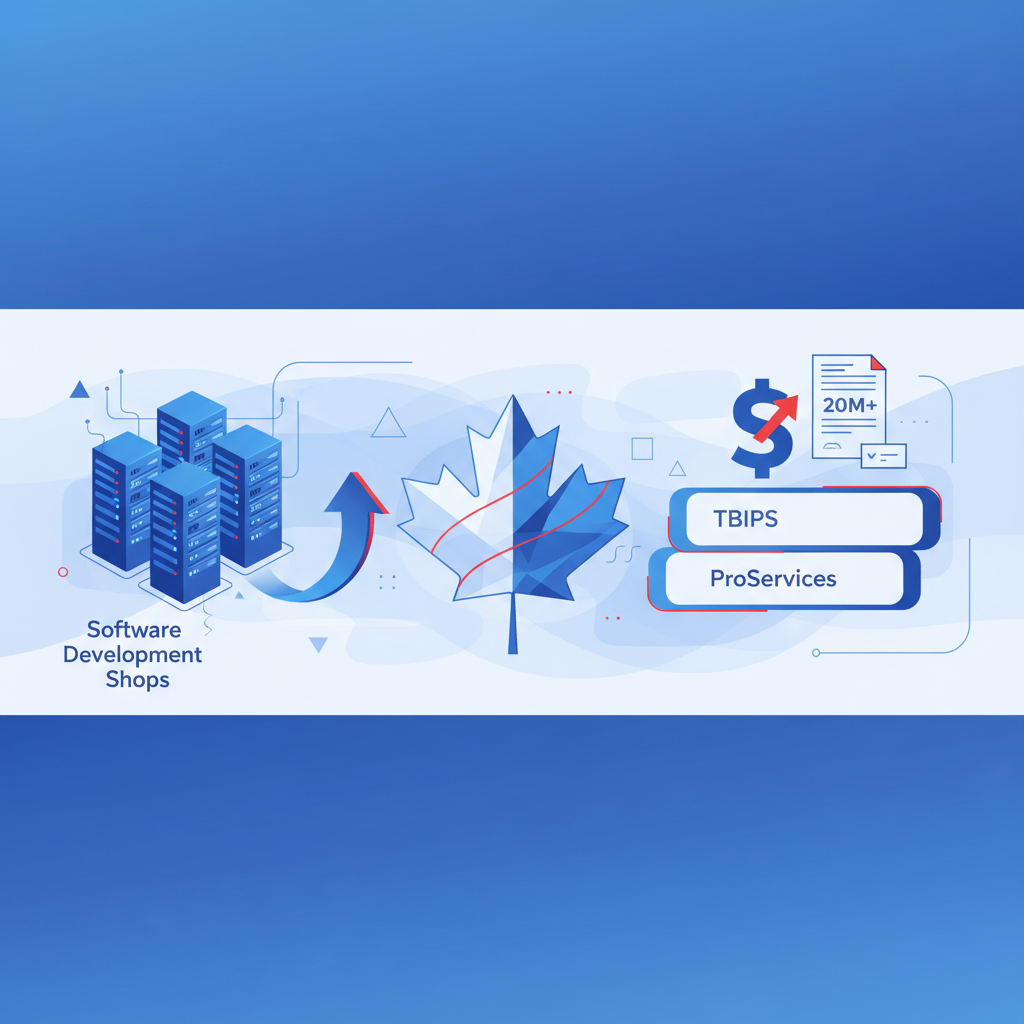
How Software Development Shops Win $20M+ Federal Contracts Through TBIPS & ProServices
A mid-sized software development shop in Ottawa landed $12.8 million in federal contracts over four years without winning a single traditional RFP. They didn't chase massive one-off competitions. Instead, they aggregated seven smaller task authorizations through pre-qualified supply arrangements. This is the hidden playbook for how software development firms actually reach eight-figure revenue with Government Contracts in Canada—not through the Government RFP Process Guide most consultants describe, but through a fundamentally different approach to Canadian Government Contracting.
Most firms trying to Find Government Contracts Canada focus on CanadaBuys listings and open competitions. That's a mistake. The real action happens through invitation-only task authorizations issued to pre-qualified suppliers on TBIPS (Task-Based Informatics Professional Services) and ProServices supply arrangements. These mechanisms govern the majority of professional services procurement and offer a path to Simplify Government Bidding Process by competing against 10-20 vetted firms instead of hundreds. Understanding How to Win Government Contracts Canada at this scale means mastering these vehicles first, traditional Government RFPs second. Tools that offer RFP Automation Canada and help Save Time on Government Proposals become valuable only after you've positioned your firm in the right procurement stream—not before.
The Mandatory Supply Arrangement System That Governs $20M+ Software Deals
Here's what most software development shops miss: the federal government doesn't typically issue single $20 million contracts for custom software development. That's not how Government Procurement works in Canada. Instead, departments use mandatory supply arrangements to issue multiple task authorizations to pre-qualified suppliers, allowing firms to compound revenue through repeat engagements with the same client over 18-48 months.
TBIPS is the mandatory method of supply for task-based informatics professional services at or above approximately $118,000 CAD under the Canada-Korea Free Trade Agreement threshold[2]. When a department needs application development, data management, cybersecurity integration, or informatics project management, they don't publish an open RFP—they search the TBIPS supplier list maintained by Public Services and Procurement Canada (PSPC) and invite 15-20 pre-qualified firms to bid on a task authorization.
The supply arrangement operates in two tiers. Tier 1 covers contracts from $100,000 up to $3.75 million in total value. Tier 2 handles larger engagements with higher insurance requirements (minimum $2 million professional liability)[2]. Individual task authorizations often start at $800,000 but include multi-year options that expand the total contract value to $2.4 million or more. This structure enables departments to test a supplier on an initial phase, then expand the scope through pre-negotiated options without recompeting the work.
ProServices complements TBIPS by covering professional services work below $100,000, including non-competitive awards under $40,000[1]. For software shops, this creates a complete coverage model: use ProServices to land $50,000-$200,000 pilot projects that build case studies and relationships, then scale those same engagements into larger TBIPS task authorizations as departments expand successful initiatives.
The Treasury Board Framework Behind These Mechanisms
These aren't informal shortcuts. They're mandated by the Treasury Board Contracting Policy, which requires federal procurement to enhance access, competition, fairness, and best value[3]. The Directive on the Management of Procurement integrates additional requirements including a 5% annual contract value target for Indigenous businesses (effective April 1, 2022) and the Code of Conduct for Procurement covering conflict of interest, anti-corruption, human rights, environmental considerations, and supply chain transparency (effective April 1, 2023)[5].
Starting December 16, 2025, the Buy Canadian Policy framework adds another layer for strategic procurements over $25 million (reducing to $5 million on June 15, 2026) in information and communications technology. Canadian suppliers receive a 10% financial proposal reduction and 25% evaluation credit for Canadian value-added content[1]. For software development shops competing in this tier, Canadian incorporation and content become significant competitive advantages—potentially decisive in close evaluations.
How to Qualify for TBIPS and ProServices Supply Arrangements
The catch? You can't bid on these task authorizations until you're on the pre-qualified supplier list. TBIPS qualification requires demonstrating $1.5 million in prior informatics revenue, maintaining appropriate insurance coverage, obtaining necessary security clearances, and matching your firm's capabilities to 15-20 specialized streams across seven expertise areas including application services, data management, and informatics project management[1][2].
The qualification process typically takes 4-8 months from initial application to approval. You'll need to compile past performance documentation, establish hourly rate schedules, secure the Master Level User Agreement (MLUA) requirements, and prove your firm's technical competency through detailed case studies and reference letters. PSPC reviews applications on a quarterly cycle, so timing your submission matters.
What most don't realize: you don't need to qualify across all seven TBIPS expertise areas. Strategic qualification focuses on 3-5 streams that align with your core capabilities and target departments' most frequent needs. A software development shop specializing in healthcare applications might qualify for application services, data management, and informatics project management—then layer on ProServices categories for policy analysis and compliance work that surrounds IT implementations.
The Audit That Should Precede Your Application
Before starting the qualification process, audit your existing project portfolio against TBIPS and ProServices categories. That data analytics component in a strategic planning engagement? That qualifies for TBIPS data management. The change management support you provided during an IT system rollout? Informatics project management. Review your financial records, project descriptions, and client references to identify which past engagements demonstrate the $1.5 million informatics revenue threshold[1].
Many firms discover they already meet the qualification requirements but haven't documented their work in the right framework. Others find gaps they can fill strategically—landing one or two provincial government contracts to build case studies in a specific TBIPS stream before applying federally. The qualification investment pays off through invitation rates: qualified firms achieve 30-40% win rates on invited bids, compared to single-digit success rates in open competitions with 47+ bidders[1].
The Business Development Model That Generates Eight-Figure Revenue
Once qualified, your entire business development approach changes. You're no longer hunting individual RFPs on CanadaBuys. You're farming task authorizations through systematic relationship-building with departments that issue multiple tasks per year to the same pre-qualified pool.
Departments sign a Master Level User Agreement to access the mandatory TBIPS RFP template on CanadaBuys, then issue solicitations specifying their requirements, evaluation criteria, and timelines[2]. These solicitations go only to suppliers on the relevant TBIPS stream or ProServices category—typically 15-20 firms for specialized areas, up to 40 for broader categories. Response windows run 5-10 days for straightforward tasks, longer for complex integrations.
The volume matters more than individual contract size. A department modernizing its data infrastructure might issue seven separate task authorizations over three years: initial architecture assessment ($120,000), pilot implementation ($340,000), security review ($95,000), full deployment phase one ($1.2 million), training and change management ($180,000), phase two expansion ($850,000), and ongoing maintenance ($600,000). Win three of those seven competitions, and you've generated $2.27 million from a single departmental relationship.
Positioning for Invitations Before Solicitations Drop
Smart firms don't wait for task authorization RFPs to appear. They engage proactively through industry days, responses to Requests for Information (RFIs), and direct conversations with departmental policy and program managers. When a department publishes an RFI exploring options for a new IT initiative, that's your signal that task authorizations will follow in 6-12 months. Your response shapes how they write those eventual requirements.
This is where platforms like Publicus become valuable. AI-driven aggregation of RFPs, RFIs, and advance contract notices from multiple sources helps you identify these early signals without manually monitoring dozens of departmental websites. AI qualification tools can flag which opportunities align with your TBIPS streams before you invest proposal resources, helping your team Save Time on Government Proposals by focusing on the 30-40% you can realistically win rather than chasing everything.
Aggregation Strategies That Reach $20M+ Over Multi-Year Cycles
Reaching eight-figure contract values requires deliberate aggregation across multiple dimensions: task authorizations within a single department, parallel engagements across departments, and multi-year expansions of successful initial deployments.
The single-department model works best for specialized software shops. Focus on one or two departments whose mission aligns with your technical expertise—Health Canada for healthcare software firms, Innovation, Science and Economic Development Canada for firms specializing in regulatory technology, Shared Services Canada for infrastructure and cloud specialists. Build deep relationships with procurement officers and technical evaluators in those departments. Deliver exceptional performance on initial small tasks to position for expansions and extensions.
The multi-department model suits firms with broader capabilities across common infrastructure needs—application modernization, cloud migration, cybersecurity hardening. Qualify for the same TBIPS streams across multiple departments, then compete for similar task types in different contexts. The proposal investment amortizes across opportunities: your response to a cloud migration task authorization for one department becomes 60% of your proposal for a similar task at another department.
The expansion model leverages government contracting's bias toward proven suppliers. A $400,000 pilot that delivers measurable results positions you as the incumbent for the $2 million production deployment. Include option years in your initial proposals—government contracting vehicles accommodate multi-year structures with annual renewals based on performance. That $800,000 year-one contract with three option years becomes $3.2 million in total value if you execute well.
The ProServices Pilot Strategy
Here's a tactical approach that mid-sized firms use effectively: enter through ProServices pilots to build TBIPS case studies. ProServices has no revenue ceiling and lower entry barriers than TBIPS. Use it to land $75,000-$150,000 policy analysis, data assessment, or compliance work that demonstrates your understanding of a department's operational context. Deliver exceptional value and insights. When that department later issues a $1.2 million TBIPS task authorization for the software system to operationalize your policy recommendations, you're the obvious choice—you wrote the requirements.
This approach also smooths revenue volatility. Federal procurement follows predictable fiscal patterns: frantic activity in March as departments spend year-end budgets, slower summer months, acceleration in fall as new fiscal year initiatives launch. ProServices enables you to fill pipeline gaps with smaller engagements while waiting for larger TBIPS tasks to mature through departmental approval processes.
Buy Canadian Policy Implications for $20M+ ICT Contracts
For software development shops targeting the $20 million threshold in strategic information and communications technology procurements, the Buy Canadian Policy framework introduces significant competitive dynamics. Effective December 16, 2025, Canadian suppliers receive preferential treatment through two mechanisms: a 10% reduction applied to their financial proposals during evaluation and a 25% evaluation credit for Canadian value-added content[1].
The policy applies to strategic procurements over $25 million until June 15, 2026, when the threshold drops to $5 million. This creates a window where many large software development contracts fall under Buy Canadian evaluation criteria. Non-reciprocal foreign suppliers face general exclusion, while Canadian firms and suppliers from countries with reciprocal trade agreements compete on preferential terms.
What does this mean practically? If your Canadian software development firm bids $18 million on a qualifying ICT procurement, evaluators apply a 10% reduction for evaluation purposes, making your bid equivalent to $16.2 million when compared against non-Canadian competitors. Additionally, if you demonstrate that 40% of your proposed value comes from Canadian content (Canadian personnel, Canadian subcontractors, Canadian-developed IP), you could receive substantial additional points in the technical evaluation.
Suppliers must certify Canadian materials where required and maintain records proving compliance. Violations risk contract damages, termination, or disqualification from future procurements[1]. The 2025 amendments to Canadian International Trade Tribunal Procurement Inquiry Regulations even bar CITT challenges to Buy Canadian applications, signaling the government's commitment to enforcing these preferences.
Common Mistakes That Keep Software Shops Below the $20M Threshold
The most expensive mistake: treating TBIPS and ProServices as optional routes you might explore after exhausting open RFPs. Firms waste 18-24 months chasing unsuitable competitions because they don't understand that pre-qualified supply arrangements govern the majority of professional services spending. By the time they qualify for TBIPS, competitors have established incumbent relationships that take years to displace.
The second mistake: qualifying for too few streams or categories. A firm qualified only for TBIPS application services can bid on maybe 40% of relevant task authorizations. Add data management and informatics project management streams, and you're eligible for 75% of the opportunities in your target departments. Layer on ProServices for the non-informatics adjacent work, and you can pursue 90%+ of a department's software-related spending.
The third mistake: failing to track invitation rates and win rates by stream and department. You might assume your low win rate reflects proposal quality, when actually you're qualified for the wrong streams or targeting departments whose evaluation criteria consistently favor different firm profiles. Track which TBIPS streams generate invitations, which invitations convert to wins, and which departments value your differentiators. Double down on what works; exit what doesn't.
The fourth mistake: underinvesting in proposal quality because response windows are short. Yes, you might have only seven days to respond to a TBIPS task authorization. But that's seven days to customize a proposal framework you should have already developed—standardized past performance summaries, pre-written technical approach templates, validated pricing models, formatted résumés for key personnel. Firms that treat each five-day TBIPS response as a from-scratch effort burn out their proposal teams and submit mediocre bids. Firms that maintain evergreen proposal assets customize efficiently and win consistently.
The Path Forward for Software Development Firms
If your software development shop hasn't yet qualified for TBIPS and ProServices, start the process now. Review PSPC's qualification requirements, audit your past projects for relevant revenue and case studies, and target the next quarterly application window. The 4-8 month qualification timeline means a firm starting today could be bidding on task authorizations by late 2025 or early 2026.
If you're already qualified but not seeing consistent invitations, reassess your stream coverage and departmental targeting. Map your technical capabilities to departments' strategic IT priorities—cloud migration, legacy system modernization, cybersecurity hardening, data governance. Attend industry days, respond to RFIs, and build relationships with procurement and technical staff in 2-3 high-priority departments.
If you're receiving invitations but winning inconsistently, invest in your proposal infrastructure. Develop templated approaches for common task types, maintain a library of past performance summaries formatted for quick customization, and create pricing models that let you respond accurately within compressed timelines. Use AI tools to identify which opportunities best match your win themes before investing full proposal resources.
The $20 million threshold isn't a single contract—it's an aggregation target built through systematic execution over 18-48 months. The firms that reach it don't chase every opportunity. They qualify strategically, target deliberately, deliver exceptionally on initial tasks, and compound that performance into expanded scopes, option years, and follow-on work. That's the actual path to eight-figure federal software development revenue in Canada, regardless of what generic government contracting guides suggest.
Sources
- [1] torys.com
- [2] canada.ca
- [3] opo-boa.gc.ca
- [4] gazette.gc.ca
- [5] tbs-sct.canada.ca
- [6] ccc.ca
- [7] laws-lois.justice.gc.ca
- [8] deltek.com
- [9] youtube.com
- [10] publicus.ai
- [11] publicus.ai
- [12] publicus-web-production.up.railway.app
- [13] govconwire.com
- [14] publicus-web-production.up.railway.app
- [15] governmentcontracts.us
- [16] governmentcontracts.us
- [17] orangeslices.ai
- [18] cleat.ai
- [19] merx.com