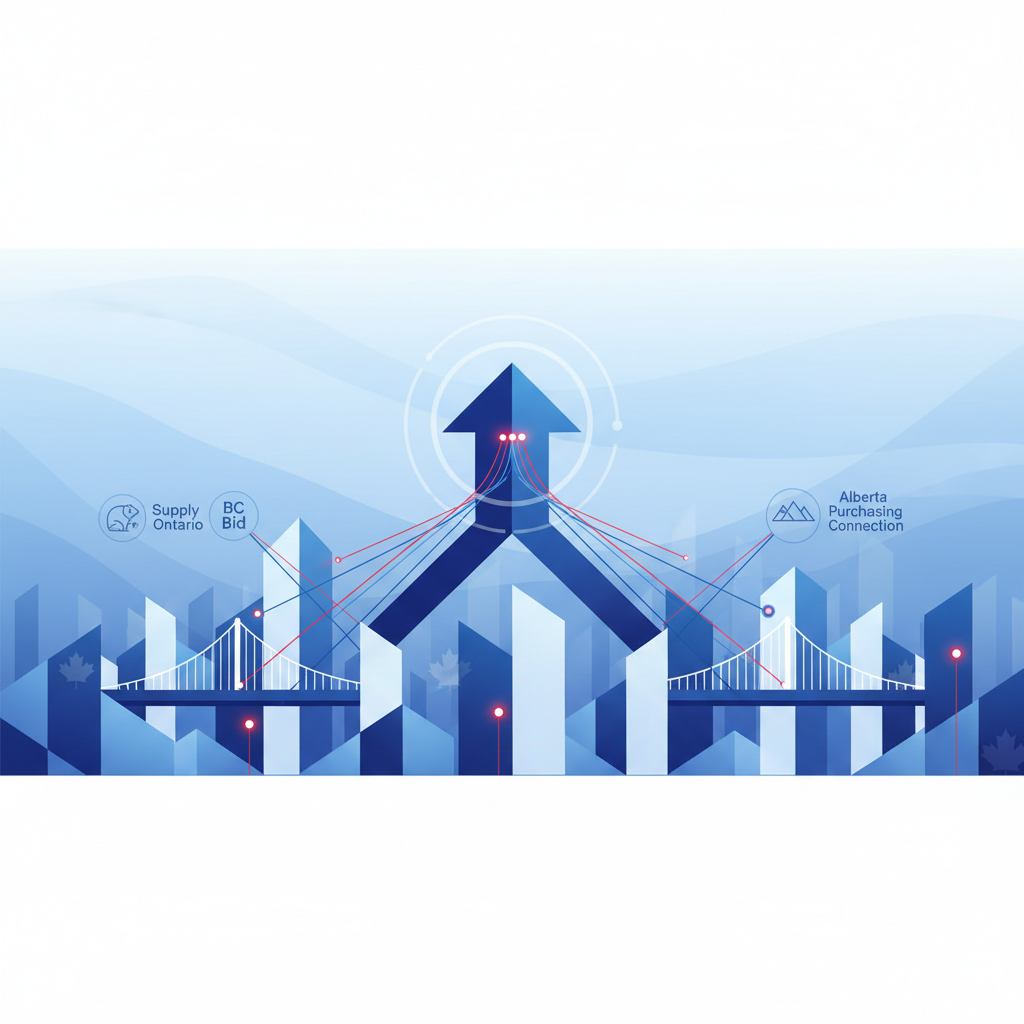
Win $30M+ Provincial Construction Contracts Through Supply Ontario, BC Bid & Alberta Purchasing Connection
Here's the reality: Canadian construction firms leave millions on the table every year because they're not systematically tracking the right provincial procurement portals. While everyone fights over federal Government Contracts through PSPC, the provincial markets—Ontario's Supply Ontario, BC Bid, and Alberta Purchasing Connection—quietly process over $7 billion in annual spend across construction and infrastructure projects[2]. Yet contractors using manual methods to find Government Contracts Canada miss up to 78% of relevant RFPs simply because they're checking the wrong places at the wrong times[1].
The Government RFP Process Guide varies wildly across provinces. Ontario requires open competitive processes for anything above $121,200, BC operates through a network of 700+ public sector organizations, and Alberta centralizes high-value opportunities through its integrated 1GX platform for bidding and payments[1][2]. Understanding how to navigate these three distinct ecosystems is fundamental to building a sustainable Government Procurement strategy that goes beyond opportunistic bidding.
The catch? These aren't unified systems. Supply Ontario handles Vendor of Record arrangements differently than BC's standing offer approach. Alberta's Purchasing Connection requires separate registration protocols. What works for Government Contracting in Toronto won't translate to Vancouver without adjustment. Tools that Simplify Government Bidding Process—like RFP Automation Canada platforms—have become essential for firms serious about competing across multiple provinces without drowning in administrative overhead.
Understanding the Three Provincial Procurement Landscapes
Each province operates its procurement infrastructure with distinct thresholds, submission requirements, and evaluation priorities. This fragmentation creates both challenges and opportunities for construction contractors willing to invest in understanding the nuances.
Supply Ontario: The Gateway to Canada's Largest Provincial Market
Ontario's procurement system centers on Supply Ontario, which manages enterprise-wide vendor arrangements and coordinates with the broader Doing Business portal. The threshold structure matters tremendously here. Contracts between $100,000 and $121,200 can use either invitational or open competitive processes, giving procurement officers discretion. Once you cross $121,200, open competition becomes mandatory[1][5].
What most don't realize: Supply Ontario's Vendor of Record (VOR) arrangements offer contractors a strategic backdoor to long-term revenue streams. These standing offers establish ceiling prices for flexible, recurring work—particularly valuable for construction-related professional services like engineering, environmental assessments, or project management[1]. Getting onto a VOR list means your firm enters the invitational pool for future opportunities without competing in full open tenders every time.
Ontario's recent policy shifts have added complexity. The US Procurement Restriction Policy now excludes American businesses from Ontario public sector procurements, fundamentally changing the competitive landscape and creating expanded opportunities for Canadian firms[4]. This isn't just nationalist posturing—it's a structural advantage you need to highlight in your submissions by documenting Canadian content, local labour, and domestic operations.
BC Bid: Navigating 700+ Organizations Through One Portal
BC Bid underwent significant modernization in 2022, transforming what was once a clunky interface into a more accessible platform for firms of all sizes[1]. The system connects contractors to over 700 public sector organizations across British Columbia, representing that $7+ billion in annual provincial spending[2].
The provincial approach emphasizes pre-market engagement through mechanisms like the Procurement Concierge service. Smart contractors use this resource to pitch innovations during Request for Information (RFI) phases—before formal tenders drop—establishing relationships with buyers and shaping requirements around their capabilities[2]. This front-end work often determines who wins $30M+ contracts long before evaluation committees score technical submissions.
BC's threshold system differs from Ontario's. For Schedule B procurements under $250,000, municipalities and regional entities can pursue direct awards or invited local competitions without full public tenders[2]. Construction firms with established local presence can convert these smaller contracts into relationship-building opportunities that position them for larger institutional work.
Alberta Purchasing Connection: Centralized Access With 1GX Integration
Alberta Purchasing Connection (APC) takes a different architectural approach by integrating procurement, invoicing, and payment functions through the 1GX platform. This centralization means contractors managing the full contract lifecycle—from bid submission through final payment—work within a single ecosystem[2].
Alberta's Procurement Services division posts major construction contracts directly to APC, making systematic monitoring more straightforward than BC's distributed model. The platform requires meticulous attention to submission protocols: downloading complete tender documents, meeting exact closing times and locations, and tracking awards posted after evaluation[2]. Miss any of these procedural elements and your bid gets rejected regardless of technical merit.
The integration with Ariba Discovery provides automatic notification capabilities that address the missed-opportunity problem. Contractors who register properly receive alerts matched to their commodity codes and capabilities, eliminating the manual checking that causes firms to overlook 78% of relevant opportunities[1].
Strategic Registration and Pre-Qualification Tactics
Winning $30M+ contracts starts long before you write a single proposal. The foundation is systematic registration across all three provincial platforms, combined with strategic pre-qualification that gets your firm into the pools where large opportunities get distributed.
Start with complete profile creation on each platform. Supply Ontario's Doing Business portal, BC Bid's vendor registration, and Alberta's APC system all require detailed capability statements, financial information, bonding capacity, and past performance documentation. Incomplete profiles trigger automatic disqualification from many opportunities—procurement officers won't chase missing information when they have 15 other qualified bidders[1].
Here's the thing: pre-qualification separates serious contractors from opportunistic ones. Securing positions in standing offers or supply arrangements provides recurring access to work without competing in full open competitions every time. For construction-adjacent services—geotechnical engineering, environmental monitoring, surveying—these arrangements can generate $30M+ in cumulative revenue across multi-year terms[1].
Document your Canadian content meticulously. Calculate the percentage of labour, materials, and operations sourced domestically. Provincial evaluation criteria increasingly weight local and Indigenous content as scoring factors, not just nice-to-have narrative elements[1]. Firms that treat this as a checkbox rather than a competitive advantage consistently score lower than competitors who embed domestic supply chains into their technical approach.
Register in specialized supplier directories. Indigenous-owned, women-owned, and other diverse supplier certifications unlock set-aside opportunities and preferential evaluation treatment. Business Development Bank of Canada (BDC) procurement programs boost visibility for certified suppliers across all three provinces[1][3]. These aren't token programs—they represent genuine procurement volume reserved for qualified firms.
Monitoring and Opportunity Qualification at Scale
The decentralized nature of provincial procurement creates an information management problem. Ontario Tenders Portal, BC Bid, and APC each publish opportunities on different schedules, with varying lead times and submission windows. Manual monitoring fails at scale.
Platform fragmentation forces a choice: hire dedicated bid pursuit staff to check multiple sources daily, or implement automation that aggregates opportunities across systems. RFP automation tools monitor these provincial portals continuously, flagging opportunities that match your capability profile and filtering out irrelevant solicitations[1].
The 78% miss rate for manual tracking isn't theoretical—it reflects the reality that construction firms focused on project delivery can't dedicate resources to checking six different procurement websites every day[1]. Opportunities appear, close, and award without firms even knowing they existed. This is where AI-powered platforms like Publicus create measurable advantage by aggregating RFPs from various government sources and using qualification algorithms to surface only relevant opportunities.
Notification systems vary by province. BC Bid allows subscription-based alerts for specific categories. APC's Ariba integration provides sophisticated matching based on commodity codes and past bid history. Supply Ontario requires vendors to proactively check the portal unless they're on standing offer lists[1][2]. You need platform-specific monitoring strategies, not a one-size-fits-all approach.
Track post-award data religiously. All three platforms publish awarded contract information showing who won, at what value, and for what scope. This intelligence serves multiple purposes: identifying subcontracting opportunities with prime contractors, understanding evaluation committee preferences, and validating your competitive positioning[1][2]. Firms that treat award data as disposable information rather than competitive intelligence consistently bid on opportunities they have no realistic chance of winning.
Crafting Winning Submissions for Provincial Evaluators
Provincial evaluation committees apply different priorities than federal procurement officers. Understanding these distinctions determines whether your $30M+ construction proposal scores in the competitive range or gets eliminated in technical evaluation.
Fairness, transparency, and value for money dominate provincial evaluation frameworks[1]. This isn't just boilerplate language—it means committees actively look for evidence that your approach treats all stakeholders equitably, provides clear audit trails for public accountability, and delivers measurable economic value beyond lowest price.
Ontario evaluators increasingly apply the Buy Ontario Procurement Directive, which prioritizes suppliers demonstrating Ontario economic benefit. Your submission needs quantified commitments: percentage of workforce from Ontario, value of materials sourced from Ontario suppliers, location of project management offices. Generic Canadian content claims don't cut it—evaluators want provincial specificity[8].
BC's evaluation approach emphasizes innovation presented through pre-market engagement. If you haven't participated in Discovery Days or submitted responses during RFI phases, you're competing against firms that have already shaped requirements around their capabilities[2]. This front-end work isn't optional for $30M+ pursuits—it's table stakes.
Alberta evaluators tend toward structured technical scoring with clear weighting disclosed in solicitation documents. Use this transparency strategically. If past performance carries 30% of total points and your firm has limited Alberta-specific references, partner with local firms who bring provincial credentials. Team composition often matters more than individual firm capabilities when evaluation committees apply local preference factors[1].
Submission protocol compliance eliminates more bidders than weak technical approaches. Download complete tender documents from the official platform—supplemental information posted as addenda won't appear in your initial download. Confirm closing times and whether electronic or physical submission is required. Track bid closing locations for physical submissions, as many municipalities still require paper copies delivered to specific addresses[2]. These aren't minor administrative details—they're pass/fail criteria applied before anyone reads your technical narrative.
Common Pitfalls and How to Avoid Them
Even experienced contractors stumble on provincial procurement nuances. The mistakes follow predictable patterns across all three jurisdictions.
Threshold confusion causes unnecessary work and missed opportunities. Contractors waste resources preparing full competitive bids for opportunities below mandatory competition thresholds, or they pursue direct awards for contracts that legally require open competition. Ontario's $121,200 threshold for mandatory open competition differs from BC's $250,000 Schedule B limit for local procurement[1][2][5]. Know the numbers for each province and each entity type—municipal thresholds differ from provincial ministry requirements.
Incomplete platform registration creates invisible disqualification. Your firm might be highly qualified but filtered out because commodity codes weren't selected properly during vendor registration. APC's Ariba system matches opportunities to vendor profiles algorithmically—if environmental remediation isn't checked in your profile, you'll never see environmental construction tenders regardless of your capabilities[2].
Ignoring Indigenous partnership opportunities means competing on hard mode. All three provinces maintain Indigenous supplier directories and apply preferential evaluation to partnerships demonstrating genuine collaboration, not token subcontracting[1]. Construction firms that proactively build relationships with Indigenous partners before RFPs drop position themselves for set-aside opportunities and evaluation advantages in open competitions.
Late addenda responses sink otherwise compliant bids. Procurement officers issue clarifications and requirement changes through formal addenda up until days before closing. Firms monitoring only at bid posting miss these updates, submitting non-compliant proposals that addressed original requirements rather than amended scope[2]. Continuous monitoring throughout the solicitation period is mandatory, not optional.
The biggest mistake? Treating provincial procurement as secondary to federal opportunities. PSPC gets all the attention, but provincial markets represent enormous volume with often less competition. Contractors who dismiss $30M+ provincial construction contracts as "too complicated" leave market share for competitors willing to learn platform-specific requirements.
Future-Proofing Your Provincial Procurement Strategy
Provincial procurement continues evolving toward greater digital integration and transparent benchmarking. The 2013 Deloitte study commissioned by Canadian public sector councils identified significant gaps compared to international e-government leaders, spurring ongoing modernization efforts[14]. BC Bid's 2022 platform upgrade represents this trend—expect similar improvements to Supply Ontario and APC as provinces compete to attract qualified vendors.
Digital transformation creates advantages for early adopters. As provinces implement more sophisticated e-procurement systems with AI-enhanced matching and automated compliance checking, firms still relying on manual processes will fall further behind. The competitive advantage increasingly comes from technology adoption that scales monitoring and qualification across multiple jurisdictions simultaneously.
Pan-Canadian procurement standards remain aspirational but would fundamentally change the game. Policy recommendations from public sector councils include national performance metrics, standardized cost measurement, and coordinated service delivery across federal, provincial, and municipal levels[14]. If implemented, these changes would reduce the platform fragmentation that currently penalizes smaller contractors unable to maintain dedicated resources for each provincial system.
What matters now: build systematic capabilities for monitoring Supply Ontario, BC Bid, and Alberta Purchasing Connection. Register completely on all platforms. Pursue pre-qualification aggressively. Document Canadian and provincial content meticulously. Track awarded contracts for competitive intelligence. Use automation where it creates measurable time savings on monitoring and qualification.
The $30M+ provincial construction market rewards firms that treat procurement as a strategic discipline requiring dedicated resources and specialized expertise. Your competition is already there. The platforms are accessible. The opportunities are published. What separates winners from perpetual bidders is systematic execution of proven strategies adapted to each provincial context. Start with one platform, master its requirements, then expand. The contracts are waiting for firms willing to do the work.
Sources
- [1] familyservicetoronto.org
- [2] supplyontario.ca
- [3] supplyontario.ca
- [4] supplyontario.ca
- [5] doingbusiness.mgs.gov.on.ca
- [6] newpath.ca
- [7] supplyontario.ca
- [8] ontario.ca
- [9] publicus.ai
- [10] ccc.ca
- [11] ised-isde.canada.ca
- [12] www2.gov.bc.ca
- [13] deltek.com
- [14] iccs-isac.org
- [15] scribd.com
- [16] careers.cognizant.com
- [17] foundersbeta.com