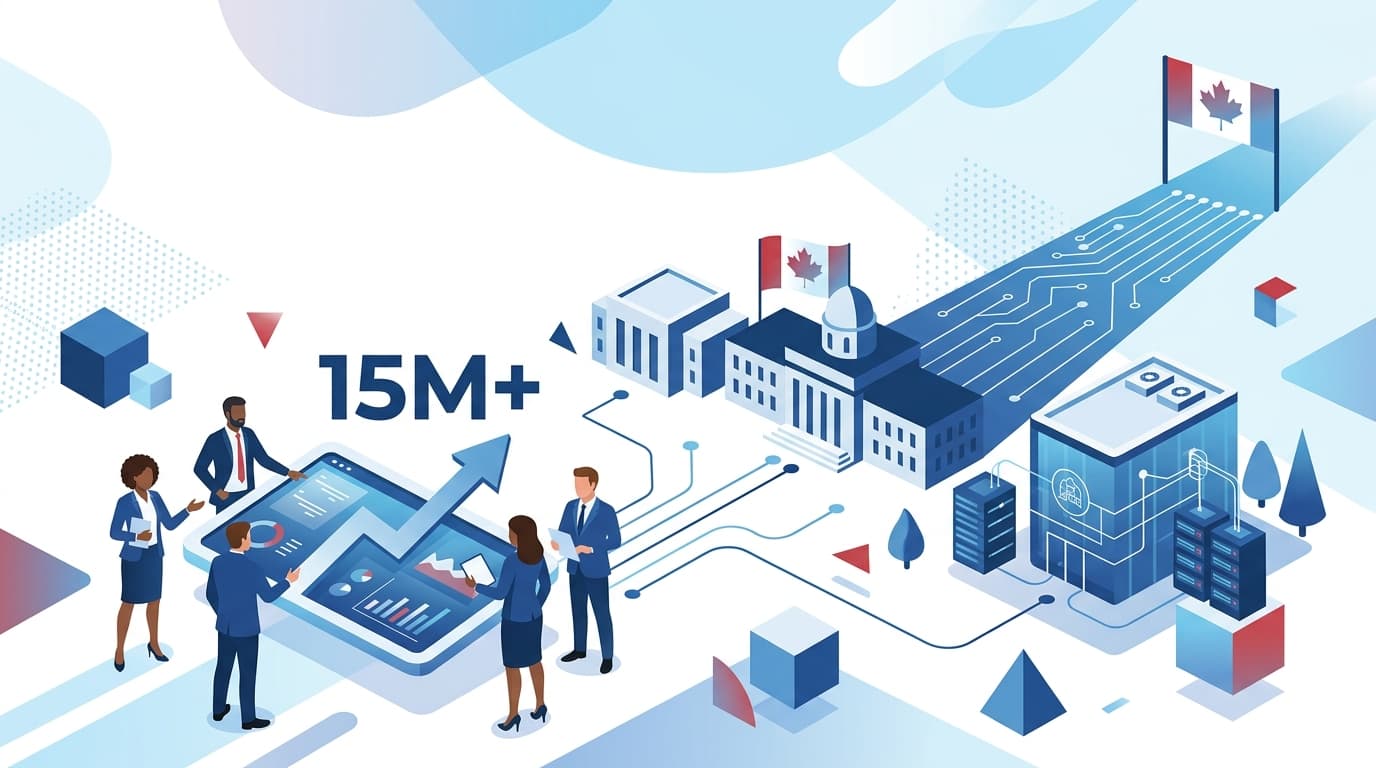
Winning $15M+ Federal Digital Transformation & UX Design Mandates via TBIPS and ProServices
At a Glance
- Massive $15M+ digital transformation and UX mandates are frequently procured through standing task-based vehicles like TBIPS and ProServices by consolidating multi-year requirements.
- Winning requires moving beyond "hourly rates" to pitching integrated, human-centered design (HCD), accessibility-by-default, and measurable service outcomes aligned with the Government of Canada's Digital Ambition.
- Navigating the strict compliance, security, and bilingual requirements of these massive procurements is where many vendors fail, making AI-driven qualification tools essential for modern proposal teams.
This article breaks down exactly how the Canadian federal government buys high-value digital transformation and UX services through standing vehicles, and the specific strategies vendors use to win these massive multi-year mandates.
If you want to know How to Win Government Contracts Canada for massive digital transformation projects, you need to understand the underlying machinery. The landscape of Government Contracts has shifted dramatically over the past few years. Finding and securing Government Procurement deals in the UX and service design space is no longer about throwing a few wireframe designers onto a spreadsheet. As any comprehensive Government RFP Process Guide will tell you, the stakes are incredibly high. You can routinely Find Government Contracts Canada listed for $15 million, $30 million, or more, routed entirely through task-based vehicles like TBIPS and ProServices.
Here's the thing: most vendors look at a Task-Based Informatics Professional Services (TBIPS) arrangement and see low-level staff augmentation. Top-tier integrators and digital boutiques look at it and see the plumbing for enterprise-wide service modernization.
Budget 2021 allocated over $1 billion over seven years for digital service transformation, including $648 million specifically for Employment and Social Development Canada (ESDC) and the Treasury Board of Canada Secretariat (TBS) [4]. That money is flowing right now. And it is heavily dependent on pre-qualified supply arrangements.
The Policy Engine Driving Large Digital Mandates
You cannot win a $15 million mandate without speaking the buyer's policy language. Federal contracting rests on the Financial Administration Act (FAA) and the Treasury Board's policy suite. Specifically, the Directive on the Management of Procurement sets the rules for planning, solicitation, and contract award [3].
When a department wants to spend $15M+ on digital services, it is automatically classified as a high-complexity, high-risk procurement. Most departments cannot authorize this on their own. They require Public Services and Procurement Canada (PSPC) to act as the contracting authority, and they often need Treasury Board approval for both the project and the procurement strategy.
But the real policy driver for UX and transformation firms is the Policy on Service and Digital. This policy legally tasks TBS with providing direction on enterprise-wide digital transition [3]. It requires departments to apply the Government of Canada Digital Standards, which enforce user-centered design, modern architectural patterns, and accessibility.
What most don't realize: the Government of Canada's Digital Ambition 2023–24 explicitly directs departments to enshrine these digital standards into everyday operations [6]. When evaluators score your proposal, they are literally checking your methodology against these Treasury Board directives.
Decoding TBIPS and ProServices for Massive Scale
TBIPS and ProServices are PSPC-managed procurement tools. TBIPS is for informatics professional services (IT architects, UX designers, developers), while ProServices is typically for non-IT professional services, though the lines often blur around business strategy and change management.
Both are supply arrangements. Winning happens in two distinct phases. First, you qualify onto the supply arrangement. Second, you win the actual call-ups or tasks competed among pre-qualified suppliers.
The catch? There is no single public headline stating "TBIPS tasks can be $15M+." Instead, PSPC and client departments consolidate related digital transformation tasks into large, multi-year contracts that cross that threshold. Provided the approvals are in place and trade agreements (like CETA or CPTPP) are respected, TBIPS can scale to accommodate massive project teams over five to seven years [1].
The Reality of the Bidding Process
(Honestly, reading some of these Treasury Board directives is a great cure for insomnia, but the math makes it worth it when a $20M contract drops.)
When a department issues an RFP against TBIPS for a major digital overhaul, they issue it to a selected number of pre-qualified suppliers. For a $15M+ project, the bid period is usually several weeks to a few months. The documentation requires clear, outcome-based statements of work. Evaluators look for alignment with digital standards, transparency, and a deeply documented methodology.
The Playbook: What Actually Wins the Big Bids
Industry commentary from top-tier contractors is consistent. UX modernization and human-centered design (HCD) have moved from "nice to have" to mission-critical delivery status [10].
Departments using TBIPS to staff Agile and UX teams are not buying isolated graphics. They are structuring $15M to $50M total contract value (TCV) mandates around modernizing citizen self-service journeys—think benefits, immigration, and tax portals.
Anchor on a Human-Centered, Research-Driven Methodology
Winning contractors operationalize UX into a named, repeatable method. They don't just say they do research. They show a structured discovery phase lasting 8 to 12 weeks. They highlight user interviews, journey mapping, contextual inquiry, and service blueprinting to find operational friction points [13, 14].
Why does this win? Because TBIPS evaluators increasingly award major technical points for HCD approaches, UX maturity, and proof of iterative learning. If your proposal looks like a generic waterfall software development lifecycle, you will lose to a firm pitching Continuous Discovery and Continuous Delivery.
Leverage Design Systems and Reusable Components
In the US, the Web Design System is a massive accelerator for federal UX [10]. In Canada, GCWeb and GCDesign patterns play the exact same role. Leading vendors do not position themselves as bespoke designers. They position themselves as design-system integrators.
Your proposal needs to show how you will stand up or align to an existing departmental design system. You must explain how you will enforce component reuse across multiple agile teams to drive speed and consistency. Your design tokens must support accessibility and bilingualism by default.
Cross-Functional Governance is Mandatory
Public-sector digital transformation often fails when UX is treated as a downstream design activity rather than a core delivery function [17]. Digital services face unusually high constraints around privacy, records management, identity assurance, bilingualism, and accessibility [15].
Winning teams propose stable, product-oriented squads that bring together UX researchers, business analysts, developers, accessibility specialists, and content designers. Crucially, they show an interdepartmental governance model that explicitly incorporates privacy and security reviews right from the start. Evaluators have seen projects fail because a beautiful interface was completely unbuildable under departmental security policies. They want integrated teams.
Navigating Procurement Constraints with AI
Finding the right opportunities within the noise of federal procurement is a massive drain on resources. This is where modern tools change the game. Publicus is an AI platform designed specifically for government contracting. It aggregates RFPs from various sources and uses AI to qualify opportunities instantly.
Instead of having your senior capture managers spend 15 hours a week manually parsing TBIPS notices to see if your firm meets the mandatory criteria, Publicus handles the initial qualification. It helps save time on proposals by letting your team focus entirely on writing the technical methodology and shaping the service outcomes.
When you are chasing $15M+ digital mandates, leading with outcomes rather than hourly resource categories is the differentiator. You must show evidence that your process reduces user errors, lowers call-center volume, improves task completion, and accelerates implementation [13]. You need a procurement-ready UX evidence package filled with case studies, quantified results, and accessibility audit histories [18].
The Future of Federal Digital Mandates
Accessibility will become non-negotiable. The future of federal digital procurement is moving toward accessible-by-default services and mandatory testing with people with disabilities [18]. Similarly, the government is shifting toward modular procurement and multidisciplinary pods rather than monolithic system integrations.
If your firm can translate UX and digital design into measurable service performance, cost avoidance, and strict compliance, you are perfectly positioned to capture these massive TBIPS and ProServices mandates.
Frequently Asked Questions
Can a single TBIPS call-up really exceed $15 million?
Yes. While there are standard limits for basic call-ups, departments regularly consolidate complex, multi-year digital transformation requirements into large contracts. When the value exceeds PSPC's standard limits or departmental delegations, the procurement simply requires higher-level Treasury Board approval and adherence to international trade agreements before the RFP is issued to pre-qualified TBIPS suppliers.
What is the difference between TBIPS and ProServices for digital transformation?
TBIPS (Task-Based Informatics Professional Services) is specifically designed for IT-related roles, such as UX designers, developers, and system architects. ProServices is generally for non-IT professional services. However, large digital transformation mandates often require change management, business consulting, and organizational design, which may blur the lines, though the core software and UX work is almost exclusively routed through TBIPS.
How does accessibility impact proposal scoring?
Accessibility is no longer an afterthought; it is a mandatory compliance gate. Proposals for large digital mandates award significant points for demonstrating WCAG compliance strategies, inclusive user research methods, and the inclusion of certified accessibility specialists (like CPACC or WAS) on the proposed project team.
How can our firm save time evaluating massive federal RFPs?
Manually reading 100-page RFP documents to check mandatory compliance matrices is incredibly inefficient. Platforms like Publicus use AI to aggregate and instantly qualify these opportunities against your firm's specific capabilities, allowing your bid team to focus on strategy and writing rather than administrative document parsing.
Sources
- [1] trade.gov
- [2] canada.ca
- [3] tbs-sct.canada.ca
- [4] pbo-dpb.ca
- [5] dig.watch
- [6] publications.gc.ca
- [7] publicsectornetwork.com
- [8] canada.ca
- [9] globalgovernmentforum.com
- [10] itpfed.com
- [11] vtechsolution.com
- [12] excella.com
- [13] digital.gov
- [14] fuselabcreative.com
- [15] flyingbisons.com
- [16] fedtechmagazine.com
- [17] designsociety.org
- [18] section508.gov
- [19] whitehouse.gov
- [20] jatit.org