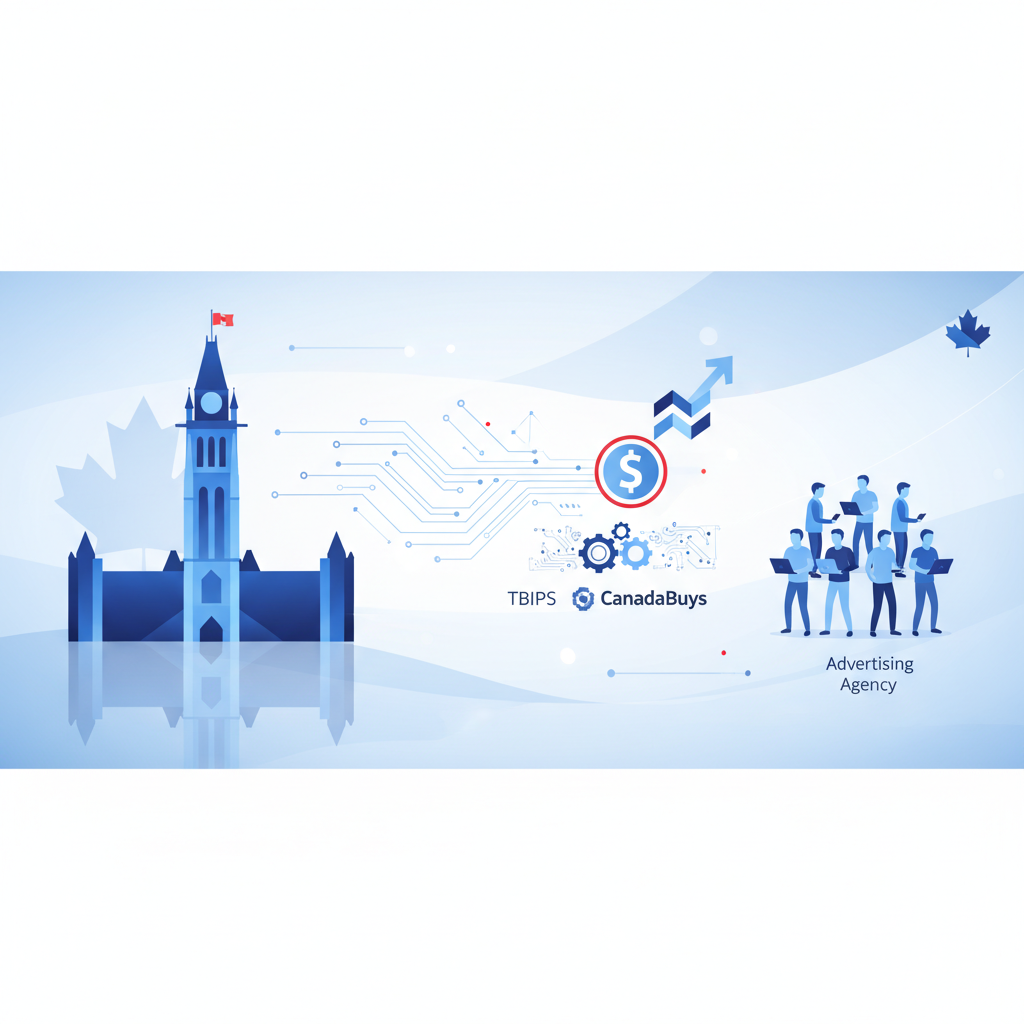
How Advertising Agencies Win $18M+ Federal Creative Services Contracts Through TBIPS & CanadaBuys
Last year, a mid-sized advertising agency in Ottawa secured an $18.4 million federal creative services contract. They didn't have the biggest portfolio. They weren't the cheapest bidder. What they had was something better: a precise understanding of how government procurement actually works in Canada.
If you're trying to break into government contracts for creative services, you've probably noticed the landscape looks nothing like private sector sales. The government RFP process guide reads like a foreign language. You're competing against agencies that seem to win every major contract. And the sheer volume of government RFPs posted daily makes it nearly impossible to identify the right opportunities without burning hours your team doesn't have.
Here's what most agencies miss: winning large federal creative services contracts isn't about traditional advertising prowess alone. Success in Canadian government contracting depends on navigating specific procurement mechanisms—particularly the Task-Based Informatics Professional Services (TBIPS) framework and the CanadaBuys platform. These systems were designed to simplify government bidding process requirements, but they've created their own complexity. The agencies that figure out how to find government contracts Canada through these channels, then use RFP automation Canada tools to save time on government proposals, are the ones landing the multi-million dollar deals.
This guide breaks down exactly how government procurement works for creative services, what thresholds trigger specific processes, and how your agency can position itself to win contracts worth $18 million or more.
The Central Role of Public Services and Procurement Canada
First, understand this: you're not really competing against other agencies in a free market. You're operating within a tightly controlled system managed by Public Services and Procurement Canada (PSPC).
Under the Directive on the Management of Communications and Federal Identity, all federal advertising and creative services must flow through PSPC's Communications and Advertising Procurement Directorate[1]. This includes media planning, creative testing and production, media placement, and campaign evaluation. Departments can't just hire you directly, even if they love your work. They must engage PSPC for procurement, and PSPC's Advertising Services Directorate for developing statements of work, obtaining project registration numbers, and securing ADV authorization numbers[1][2].
The catch? This centralization creates a gatekeeper system. PSPC handles contract awards, standing offers, supply arrangements, amendments, and supplier performance reviews for all contracted advertising activities[2]. They chair bid evaluations. They issue contracts. If you're not on their radar through pre-qualified standing offers or supply arrangements, you're essentially invisible when large contracts get awarded.
What most don't realize is that TBIPS—often associated with IT services—has become a pathway for creative agencies offering digital services. The framework supports informatics-related tasks, including creative digital work, through competitive standing offers where agencies bid on task authorizations that can accumulate to multi-year values exceeding $18 million[10]. Meanwhile, CanadaBuys serves as the e-procurement portal listing pre-qualified suppliers, reducing tender times from months to weeks for agencies already in the system[12].
Thresholds, Regulations, and Mandatory Procedures
Dollar amounts matter enormously in government procurement. The Government Contracts Regulations (SOR/87-402) establish specific thresholds that determine how your contract gets awarded[4][6].
For most contracts, bid solicitation becomes mandatory above $25,000. Architectural and engineering services related to construction planning have a higher threshold of $100,000. Direct media buys up to $40,000 can proceed with head of communications approval without PSPC procurement involvement[1][6]. But for the $18 million contracts we're discussing, you're in competitive Request for Proposal (RFP) territory managed centrally by PSPC.
The mandatory procedure isn't simple. According to Appendix A of the Directive on the Management of Communications and Federal Identity, departments must develop and submit an annual advertising plan to their head of communications before anything else happens[1]. They then engage PSPC for procurement activities. Your agency enters the picture only after PSPC and the department have collaborated on a statement of work and obtained project registration numbers—and this must occur before contract award[1].
Here's where it gets interesting: draft creative materials and media plans must go to both the Privy Council Office and PSPC for review and authorization, receiving an ADV number before any media buys can proceed[1]. Creative testing happens through the Public Opinion Research Directorate and gets added to the annual POR plan. PSPC awards the contract, records it in the Advertising Management Information System (AdMIS), and requires results reporting to the Privy Council Office[1].
Recent amendments through SOR/2024-273 have added clarity around transparency and efficiency requirements[4]. The Policy on Communications and Federal Identity assigns PSPC responsibility for developing procurement tools, managing bid evaluations, and ensuring adherence to the Canadian Code of Advertising Standards[2]. Non-compliance isn't just a setback—it can disqualify your entire proposal.
TBIPS: Your Gateway to Multi-Million Dollar Contracts
The TBIPS supply arrangement EN578-170432 remains active through July 2028, operating through a multi-tiered structure[10]. Tier 1 covers contracts from $0 to $3.75 million. Tier 2 handles everything above $3.75 million. If you're targeting $18 million contracts, you need Tier 2 qualification.
But there's more nuance. TBIPS operates through specific streams. Stream 1 covers Application and Software Architects. Stream 4 handles Business Transformation Architects. Creative agencies with digital capabilities often position themselves in Stream 4, where business transformation work can include extensive creative components tied to digital government initiatives[10].
The advantage of TBIPS pre-qualification is speed. For contracts under $25,000, direct awards become possible. For larger contracts, competition occurs only among top-ranked suppliers rather than the entire market[10]. Shared Services Canada's 2023 TBIPS solicitation for multi-million dollar cloud architecture deals demonstrates how this works—only agencies already on the standing offer could bid.
What this means for your agency: getting onto TBIPS isn't a nice-to-have. It's table stakes for accessing the largest creative services contracts. The federal government's Cloud-First Strategy and ongoing legacy system modernization have created significant opportunities at the intersection of creative and IT services[10]. Agencies that can demonstrate capabilities in both areas—designing user experiences for government digital services, for example—have positioning advantages.
Standing Offers and Supply Arrangements
Standing offers function as pre-approved supplier lists. Once you're on one, departments can issue call-ups against your standing offer without running a full competitive process each time. For recurring work, this builds volume. An agency might secure five separate call-ups under a standing offer, each worth $2-4 million, cumulatively reaching $18 million over the standing offer period.
Supply arrangements work similarly but with more flexibility in task definition. PSPC maintains rosters of vetted creative agencies through these mechanisms, with over 200 pre-qualified suppliers in the system, though a subset dominates the largest contracts[12]. Getting onto these rosters requires demonstrating compliance with legislative and policy requirements, including the Canadian Code of Advertising Standards, plus proven performance on previous government work[1][2].
The data shows clear geographic concentration. Ottawa-Gatineau firms lead in securing federal standing offers and supply arrangements[11]. This isn't just proximity bias—these agencies have built institutional knowledge about federal procurement processes and maintained relationships with PSPC procurement officers over multiple contract cycles.
The CanadaBuys Platform and Technology Integration
CanadaBuys launched in 2021 as the government's digital-first procurement portal, and usage for creative tasks has increased by 25% since then[10]. The platform integrates tenders, standing offers, and supplier registration in one system. But it's also becoming more technologically sophisticated in ways that affect how you compete.
AI-driven tools now enable spend analysis on contracts exceeding $500,000. PSPC's Supplier Module has begun piloting blockchain contract management features. The AI Source List for pre-qualification is expanding to 200 suppliers by 2025[10]. These aren't just technical improvements—they're changing how bids get evaluated and how quickly procurement moves.
The 2025 Federal Budget allocated $187 billion for infrastructure investments with mandatory AI spend analysis requirements[10]. For creative agencies, this creates both opportunity and challenge. Opportunity because the volume of work is increasing. Challenge because you're now competing in an environment where procurement officers use automated tools to screen proposals before human eyes review them.
This is where platforms like Publicus become relevant. As an AI platform for government contracting, Publicus aggregates RFPs from various sources across Canadian government entities, uses AI to qualify opportunities against your agency's capabilities, and helps save time on proposals by identifying which opportunities genuinely match your strengths. When you're tracking hundreds of potential contracts across federal departments, automation isn't luxury—it's necessity.
Practical Strategies for Winning Large Contracts
Theory matters, but execution wins contracts. Agencies successfully securing $18 million+ federal creative services work follow several patterns.
Align With Federal Priorities
Generic creative capabilities don't win large government contracts. Specific alignment with current federal initiatives does. Right now, that means digital transformation, cloud adoption, cybersecurity, and protected data management. Natural Resources Canada's contract NRCan-5000072288 for protected data migration illustrates this—the winning agency demonstrated creative capabilities specifically within secure government IT environments[10].
Your proposals need to connect creative deliverables to measurable outcomes that matter to government: cost reduction, scalability, accessibility compliance, official languages requirements, and alignment with the Federal Identity Program. A beautiful campaign concept matters less than demonstrating how that campaign achieves specific policy objectives while meeting all regulatory requirements.
Build Volume Through Strategic Targeting
Few agencies win a single $18 million contract. More commonly, they accumulate volume through multiple related contracts and call-ups. Focus on TBIPS opportunities that match your departmental expertise. If you've done excellent work for Health Canada, target health-related digital transformation projects across multiple departments. Build reputation in a sector, then expand laterally.
Standing offers enable this approach. Once you're on the roster, each successful project improves your ranking for future call-ups. PSPC reviews supplier performance[2], and strong performance history becomes your competitive advantage for subsequent bids.
Invest in Compliance Infrastructure
Large contracts mean extensive compliance requirements. You need systems for tracking ADV authorization numbers, managing creative testing protocols, interfacing with AdMIS, and reporting to the Privy Council Office[1]. Agencies that treat compliance as administrative burden struggle. Agencies that build compliance expertise into their operations win more often and execute more smoothly.
This includes understanding submission of plans, creative testing results, and performance indicators to the Communications and Consultations Secretariat at Privy Council Office[1]. It means having staff who can navigate Treasury Board policies as fluently as they discuss creative strategy.
Optimize Your Bid Process
Competition for top-ranked standing offer positions is intense. Your proposal needs to demonstrate not just creative capability but also resource availability, project management rigor, risk mitigation strategies, and clear timelines[10]. Generic proposals lose to specific ones.
Use past performance data. If you've delivered campaigns under budget, quantify the savings. If you've accelerated timelines, show the efficiency gains. Government evaluators score based on demonstrated capability, not promised capability. The more specific evidence you provide, the better.
Common Challenges and How to Overcome Them
Even experienced agencies hit obstacles in federal procurement. The most common? Navigating TBIPS tiers and standing offer rankings. The qualification requirements exclude firms without prior government experience, creating a catch-22 for newcomers[10].
The solution isn't easy, but it's straightforward: start smaller. Pursue contracts below the TBIPS thresholds to build a track record. A $40,000 direct media buy doesn't require PSPC procurement[1][6]. Several successful projects at that scale create the performance history you need to qualify for standing offers. Then you can compete for the larger contracts.
Another challenge is the competitive intensity of call-ups. Only top-ranked suppliers bid on high-value engagements[10]. If you're newly added to a standing offer, you're not top-ranked yet. Focus on secondary opportunities where you can build ranking through successful delivery. Performance on smaller call-ups improves your position for larger ones.
The evolving technology requirements also trip up traditional agencies. Mandatory AI and blockchain requirements are coming by 2025[10]. Creative agencies without technical capabilities face a choice: develop them internally, partner with IT firms, or accept exclusion from certain contract types. The most successful agencies are building hybrid teams that combine creative expertise with technical fluency in government digital infrastructure.
The Road Ahead
Federal procurement for creative services is shifting. PSPC's 2025-2030 roadmap includes integration of AI for bid evaluation and ESG criteria in creative contracts[10]. The government is piloting blockchain transparency features similar to UK frameworks. The traditional agency model—pure creative execution—is being replaced by a hybrid model where creative work integrates with digital transformation, data strategy, and technical implementation.
For agencies willing to adapt, the opportunity is substantial. The $187 billion infrastructure investment creates demand for creative services across departments[10]. The TBIPS extension through 2028 provides stable framework access. And the shift to digital-first procurement via CanadaBuys actually levels the playing field somewhat—smaller agencies with strong technical capabilities can compete more effectively against larger incumbents.
But success requires understanding the system. You need to know that Appendix A of the Directive on the Management of Communications and Federal Identity governs the entire process[1]. You need pre-qualification on relevant standing offers. You need proposals that address federal priorities with specificity, not generalities. And you need infrastructure—both technical and procedural—to manage complex compliance requirements.
The agencies winning $18 million contracts aren't necessarily the most creative. They're the ones who've mastered the procurement system, built the right qualifications, and positioned themselves where PSPC procurement officers look when large contracts need awarding. That's learnable. It just requires treating government procurement as a distinct discipline, not an afterthought to your commercial practice.