Tired of procurement pain? Our AI-powered platform automates the painful parts of identifying, qualifying, and responding to Canadian opportunities so you can focus on what you do best: delivering quality goods and services to government.
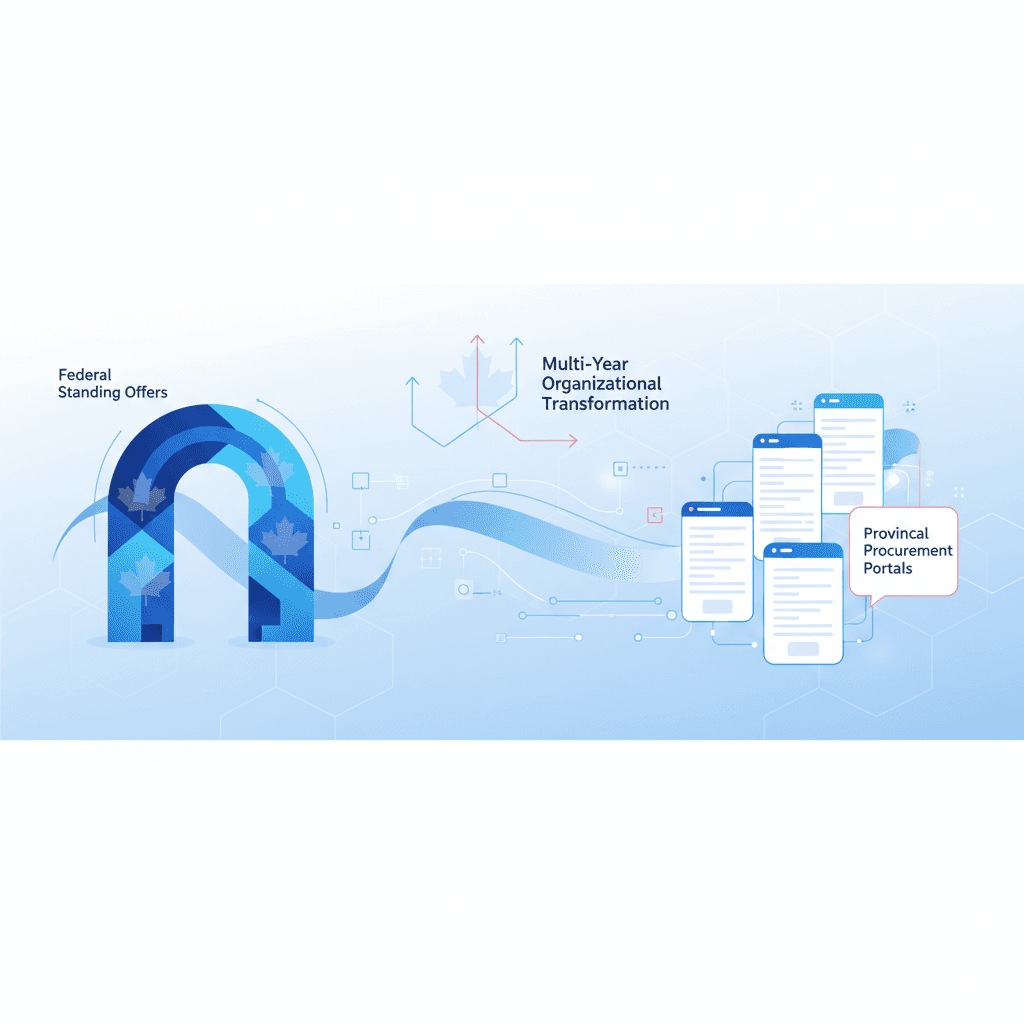
Win Multi-Year Organizational Transformation Contracts Through Federal Standing Offers and Provincial Procurement Portals
A change management consulting firm lands a $900,000 contract with a federal agency in March. In July, the same agency issues another call-up for $400,000. By October, three more departments have contacted the firm directly. Total revenue from that single standing offer qualification: $2.3 million across eighteen months. This isn't unusual. It's how government contracts actually work when you understand the standing offer system.
Most firms hunting for government contracts Canada treat each RFP as a one-time battle. They spend weeks crafting proposals, wait months for decisions, then start over. The government RFP process guide they're following is incomplete. What separates firms earning consistent government procurement revenue from those constantly chasing new opportunities? They've cracked the code on standing offers and supply arrangements—mechanisms that turn a single qualification into recurring contract awards.
Here's the thing: standing offers aren't contracts. They're pre-qualification systems that let authorized government users bypass the full government RFP process for subsequent purchases. When Public Services and Procurement Canada (PSPC) establishes a National Master Standing Offer for organizational transformation services, they're essentially creating a vetted supplier list. Departments can then issue call-ups—actual contracts—without running a new competition each time. For firms trying to win government contracts Canada, this changes everything about how to approach government bidding process work.
The financial implications are substantial. A single standing offer can generate multiple call-ups over several years, and different departments can all tap the same standing offer independently. RFP automation Canada tools like Publicus help identify these opportunities by aggregating postings from federal and provincial procurement portals, using AI to qualify which standing offers match your capabilities before you invest proposal time.
How Federal Standing Offers Actually Work
The mechanics matter because they're different from standard contracts. Standing offers operate under the Financial Administration Act and Treasury Board Contracting Policy, but they don't obligate the government to buy anything. Think of them as framework agreements. PSPC issues a Request for Standing Offer (RFSO)—not an RFP—for specific goods or services. Suppliers respond with their qualifications, pricing, and delivery terms. PSPC then establishes multiple standing offers, often organized by region or capability tier.
The real contracting happens later. When a department needs change management training or digital transformation consulting, an authorized user can issue a call-up directly to any qualified supplier on the standing offer list. For call-ups under $25,000, there's almost no process—they can use form PWGSC 942-03, send an email, or even phone the supplier. The call-up specifies the standing offer agreement number, delivery requirements, and payment method, and that's when the actual contract forms.
What most don't realize: multiple standing offers exist simultaneously for the same service category. PSPC doesn't pick one winner. They establish several—sometimes dozens—to give departments choice. For organizational transformation services, you might see standing offers covering change management training, business process reengineering, strategic planning facilitation, and workforce capacity building. A supplier can hold multiple standing offers across different service categories.
The call-up threshold of $25,000 for simplified processing is critical. Below that amount, authorized users have significant discretion in supplier selection from the standing offer list. Above $25,000, additional considerations may apply, but the process remains far simpler than issuing a new competitive solicitation. This is where the simplify government bidding process advantage becomes tangible—departments save months of procurement overhead, and suppliers get faster contract awards.
Who Can Issue Call-Ups and What Triggers Competition
Not every government employee can issue call-ups. Authorization typically extends to federal departments, agencies, Crown corporations, and participants in the Canadian Collaborative Procurement Initiative. Each standing offer specifies which entities can use it. Some are restricted to specific departments; National Master Standing Offers are available government-wide.
The catch? Even with a standing offer in place, certain thresholds trigger additional requirements. The Federal Contractors Program requires suppliers to sign the Agreement to Implement Employment Equity (AIEE) for standing offers or call-ups valued at $1 million or more, including taxes. This applies to provincially regulated firms with 100 or more permanent employees. The obligation doesn't just activate at award—it continues beyond the contract life. Firms entering the standing offer system need legal and HR infrastructure to maintain compliance, or they'll lose eligibility for larger call-ups.
PSPC also runs semi-annual opportunities for new suppliers to qualify or existing suppliers to update their standing offers. This creates regular entry points rather than forcing firms to wait years for the next RFSO cycle. It's a deliberate policy choice to reduce barriers for small and medium enterprises trying to break into government contracting.
Finding the Right Standing Offers for Transformation Services
Organizational transformation is a broad category. The government doesn't issue one massive standing offer covering everything from executive coaching to enterprise architecture. Services are broken into specific Goods and Services Identification Numbers (GSINs). GSIN U009A, for example, covers instructor-led change management training, including materials, tools, and methodologies for workforce capacity building. Different GSINs exist for strategic planning, process optimization, digital transformation consulting, and organizational design.
Finding active standing offers requires monitoring multiple channels. PSPC publishes active standing offers on its website, organized by commodity and GSIN. But here's where most firms waste time: manually checking these listings daily or weekly, trying to match their capabilities against government classifications. Publicus aggregates these opportunities from various government procurement sources and uses AI to qualify which standing offers align with your business profile, cutting research time from hours to minutes.
Provincial procurement portals operate differently. BC Bid, Merx (used by multiple provinces), Alberta Purchasing Connection, and Ontario's Buy and Sell platform each have their own standing offer equivalents, though terminology varies. Some provinces call them "vendor of record" programs or "standing arrangement" systems. The principles are similar—pre-qualify once, compete for call-ups multiple times—but the procedural details differ by jurisdiction.
The strategic question becomes: which standing offers should you pursue? A firm with five senior consultants can't effectively service a standing offer requiring nationwide delivery within 48 hours. Geographic scope, capacity requirements, mandatory qualifications, and pricing models all factor into the decision. RFSOs specify whether suppliers must offer services in both official languages, provide bilingual materials, or maintain specific security clearances. Reading the full RFSO before investing proposal effort is non-negotiable.
The RFSO Response: What Actually Gets Evaluated
Standing offer responses look different from typical RFP proposals. PSPC evaluates your capability to deliver if called upon, not your approach to a specific project. You're proposing flexible models adaptable to varying client needs—different class sizes, delivery formats, regional coverage, timeline options. The evaluation criteria typically include:
Demonstrated experience delivering similar services to large organizations, with preference often given to public sector experience
Qualifications and certifications of personnel who would deliver services (not just CVs, but evidence of specific methodologies or frameworks they're trained in)
Quality of proposed materials, tools, and methodologies—many RFSOs require sample materials as part of the technical evaluation
Pricing structure and reasonableness across different service scenarios
Capacity to deliver within required timeframes and geographic areas
Financial proposals for standing offers require careful structuring. You're not bidding a fixed price for a defined scope. Instead, you're establishing rate cards, per-participant pricing, or other pricing mechanisms that will apply across multiple call-ups. Government evaluators assess whether your pricing is competitive and represents value for money, often comparing responses across all bidders to establish a reasonable price range.
PSPC incorporates standard acquisition clauses into RFSOs by title, number, and date. These aren't suggestions. Clauses covering intellectual property, liability, insurance, security requirements, and payment terms are mandatory and non-negotiable. Templates are available on the PSPC website, and suppliers should review relevant clauses before pricing their standing offer response—some requirements have cost implications.
Provincial Procurement Portals: Different Rules, Same Opportunity
Provincial governments collectively spend billions on services annually, and many have established portal systems that function similarly to federal standing offers. The terminology shifts—vendor of record programs, standing arrangement lists, preferred supplier agreements—but the underlying value proposition remains: qualify once, compete for recurring contracts.
British Columbia's BC Bid system hosts standing arrangements across numerous service categories. Alberta's Purchasing Connection features vendor lists for professional services including change management and organizational development. Ontario's procurement approach varies by ministry, with some using centralized panels while others issue ministry-specific standing offers. Quebec's SEAO system operates primarily in French, which creates both a barrier and an opportunity—firms with bilingual capacity face less competition.
Provincial portals often have lower thresholds for simplified call-ups compared to federal standing offers. Some provincial agencies can issue direct awards up to $100,000 to vendors on standing arrangement lists without competitive quotes. This variability means firms need to understand the specific rules governing each portal rather than assuming federal procedures apply universally.
The strategic advantage of provincial portals for organizational transformation work is sector specificity. Provincial governments hire consultants for healthcare system transformation, education ministry reorganization, and municipal infrastructure program management—specialized areas where federal demand may be limited. A firm with deep expertise in healthcare change management might find more relevant opportunities through provincial portals than federal standing offers.
Multi-Jurisdictional Strategy: Managing Complexity
Pursuing standing offers across multiple jurisdictions creates operational challenges. Each requires separate qualification, compliance with different procurement policies, tracking of renewal dates, and monitoring for call-up opportunities. A firm could theoretically hold federal standing offers through PSPC, vendor of record status in five provinces, and municipal standing arrangements in major cities—representing dozens of separate agreements to maintain.
This is where technology becomes necessary rather than optional. Manually tracking opportunities across federal and provincial procurement portals consumes staff time that should go toward proposal development and service delivery. Publicus addresses this by aggregating government contracts and RFPs from multiple sources into a single interface, helping firms save time on government proposals by identifying relevant call-ups against standing offers they already hold or new RFSO opportunities aligned with their capabilities.
The compliance dimension also scales with jurisdictional breadth. Federal employment equity requirements differ from provincial diversity procurement policies. Insurance requirements vary. Audit and record-keeping obligations multiply. Firms expanding from federal to provincial standing offers need administrative systems to track obligations by jurisdiction and ensure nothing lapses that would disqualify them from call-ups.
After You're Qualified: Maximizing Call-Up Success
Getting on a standing offer list is the beginning, not the end. The Office of the Procurement Ombud has identified vendor performance management as a foundational change needed in federal procurement, noting movement toward government-wide systems to track supplier performance. What you deliver on initial call-ups directly affects your likelihood of receiving subsequent awards.
Authorized users selecting from standing offer lists have discretion. If three qualified suppliers are available and one has a track record of excellent delivery while another has generated complaints, the choice is obvious. Performance reputation spreads within government. A successful engagement with one department often leads to referrals to others. The opposite is also true—poor performance on a call-up can effectively end your standing offer revenue stream even while you technically remain qualified.
Proactive relationship management matters more in the standing offer context than traditional competitive contracts. Since departments can issue call-ups directly without competition, staying visible to potential users is valuable. This doesn't mean aggressive sales tactics—government procurement ethics prohibit certain activities—but rather professional communication about capabilities, updates on your team's qualifications, and responsiveness when inquiries arrive.
Some firms treat standing offers passively, waiting for call-ups to arrive. Others actively monitor which departments are authorized users of standing offers they hold, understand those departments' strategic priorities, and position their services accordingly. The procurement rules require fair treatment of all standing offer holders, but they don't prevent departments from selecting suppliers whose capabilities best match their current needs.
Renewal and Refresh Cycles
Standing offers don't last forever. PSPC typically establishes them for defined periods—often two to three years—with options to extend. Semi-annual refresh opportunities allow new suppliers to qualify or existing suppliers to update pricing, add personnel, or expand geographic coverage. Missing these windows means waiting months for the next cycle.
The refresh process is usually simpler than initial qualification. Existing standing offer holders submit updated information rather than full responses. But complacency is risky. Market conditions change, new competitors enter, and government priorities evolve. A supplier who qualified three years ago with specific personnel and methodologies may find their standing offer non-renewed if they haven't kept pace with changing requirements.
Calendar management for standing offer renewals across multiple jurisdictions requires systematic tracking. Federal refresh cycles don't align with provincial ones. A standing offer expiring without renewal leaves you disqualified from new call-ups until you re-qualify, potentially losing months of revenue opportunity. Firms serious about government contracting treat standing offer renewal with the same priority as new business development.
The Emerging Procurement Landscape
Federal procurement is undergoing significant modernization. The Office of the Procurement Ombud has called for statutory codification of procurement rules and evolution beyond traditional contracting models to better support complex, multi-year initiatives. These changes will likely expand standing offer use for transformation services rather than contract it.
Why? Standing offers align with government efficiency objectives. They reduce procurement cycle times, lower administrative costs, and create supplier relationships that support longer-term initiatives. For organizational transformation work—which often unfolds in phases over years rather than discrete projects—standing offers provide flexibility that traditional fixed-scope contracts don't.
Provincial governments are watching federal procurement modernization and often adopt similar approaches with local variations. As technology platforms improve and procurement professionals share best practices across jurisdictions, expect greater standardization in how standing offers function. This should reduce some of the jurisdictional complexity that currently complicates multi-government strategies.
The integration of artificial intelligence into procurement processes is already happening on both sides. Government buyers are exploring AI tools to analyze supplier performance data and match requirements to qualified vendors. Suppliers using platforms like Publicus to identify and qualify opportunities faster gain competitive advantage in response times and hit rates. The firms that will thrive in the evolving standing offer environment are those that combine deep transformation expertise with sophisticated approach to opportunity intelligence and proposal automation.
Practical Entry Strategy
For firms new to government contracting, standing offers might seem complex. Start narrow. Identify one or two federal standing offers or provincial vendor of record programs that closely match your core capabilities. Study recent RFSOs in those categories to understand evaluation criteria and pricing expectations. Talk to firms that currently hold similar standing offers if possible—the government contracting community is more collaborative than competitive on procedural questions.
Build your track record deliberately. Government evaluators assess past performance, and "no previous government work" weakens responses. Consider targeting smaller direct awards initially to establish reference projects, then pursue standing offer qualification once you can demonstrate relevant public sector delivery experience. The path from zero government revenue to significant standing offer income typically takes 18 to 36 months of deliberate positioning.
Use available resources systematically. PSPC publishes acquisition guides and templates. The Office of Small and Medium Enterprises offers support programs. Provincial procurement offices often have supplier orientation sessions. And platforms like Publicus simplify the overwhelming task of monitoring opportunities across multiple sources, letting you focus energy on qualification and delivery rather than manual research.
The standing offer system rewards firms that approach government contracting as a long-term business channel rather than opportunistic project hunting. Qualification takes effort. Compliance requires infrastructure. But the payoff—recurring revenue from multiple call-ups, reduced business development costs, longer planning horizons—makes standing offers one of the most valuable mechanisms available for firms providing organizational transformation services to Canadian governments.
Sources
Share
Stop wasting time on RFPs — focus on what matters.
Start receiving relevant RFPs and comprehensive proposal support today.