Tired of procurement pain? Our AI-powered platform automates the painful parts of identifying, qualifying, and responding to Canadian opportunities so you can focus on what you do best: delivering quality goods and services to government.
Secure Predictable Revenue: Government Electrical Contracting Opportunities
ELECTRICAL CONTRACTING, GOVERNMENT PROCUREMENT
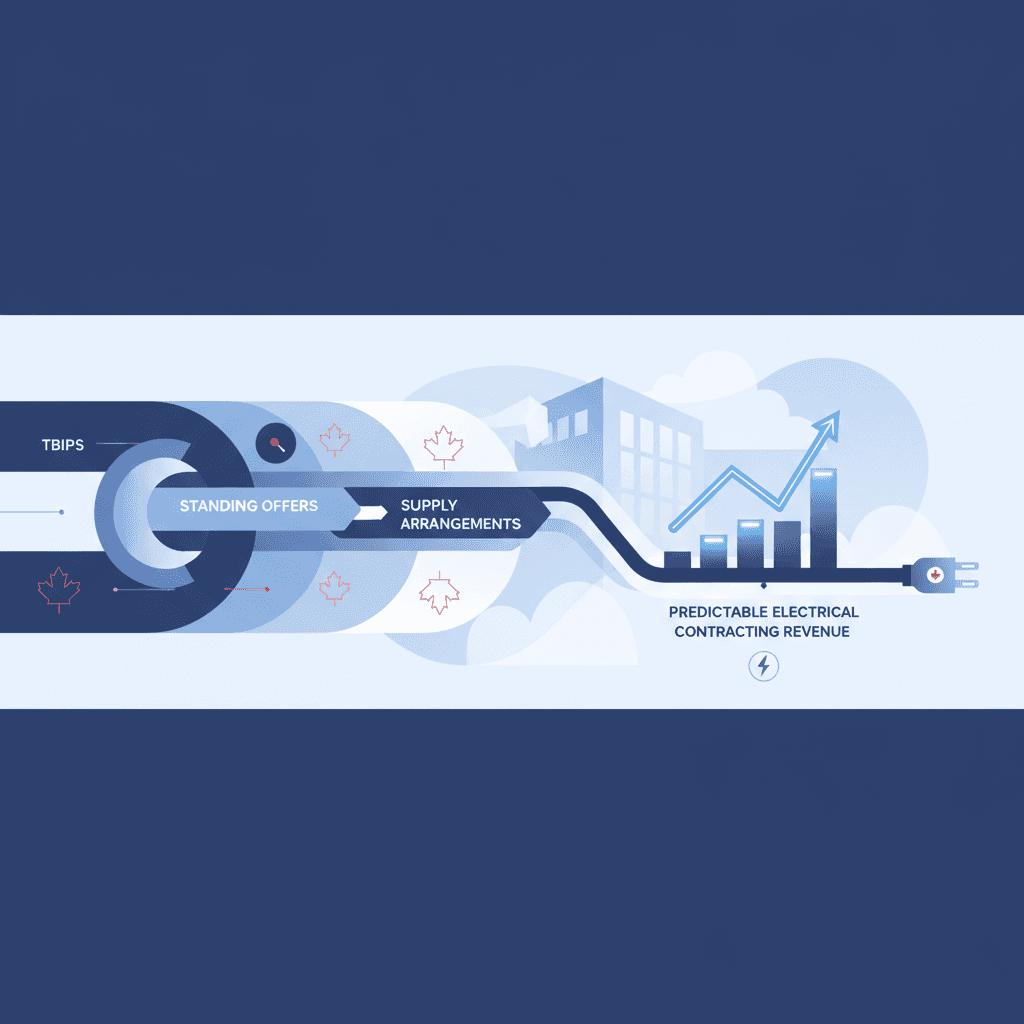
Turn TBIPS, Standing Offers & Supply Arrangements Into Predictable Electrical Contracting Revenue
Here's a sentence that probably confused you: "Use TBIPS for electrical contracting." If you've spent any time navigating Canadian Government Procurement, you know TBIPS—Task-Based Informatics Professional Services—has absolutely nothing to do with wiring buildings or installing electrical panels. It's an IT services framework, plain and simple. Yet the question behind the confusion matters: Can electrical contractors tap into the same structured, repeatable revenue model that IT consultants use with Government Contracts through supply arrangements and standing offers?
The short answer is yes, but you need the right mechanisms. While TBIPS itself won't help you win Government RFPs for electrical work, the federal government does maintain similar procurement vehicles specifically for construction and trades services. Understanding how to position your electrical contracting business within these frameworks—and how tools like RFP Automation Canada platforms can Save Time on Government Proposals—makes the difference between chasing one-off bids and building predictable contract revenue.
This Canadian Government Contracting Guide breaks down exactly how electrical contractors can Find Government Contracts Canada, navigate the Government RFP Process Guide requirements, and ultimately learn How to Win Government Contracts Canada by treating federal procurement as a systematic revenue channel rather than a lottery. The catch? You need to stop thinking like a project-based contractor and start thinking like a pre-qualified service provider.
Understanding the Procurement Landscape for Electrical Services
TBIPS operates under Public Services and Procurement Canada (PSPC) as a supply arrangement method specifically for informatics work above the Canadian Free Trade Agreement threshold, previously pegged at $100,000. Since 2018, standing offers under TBIPS were discontinued in favor of task-based supply arrangements across two tiers: Tier 1 covers contracts from $100,000 to $3.75 million, while Tier 2 handles anything above that ceiling.[3][4]
Electrical contracting follows completely separate channels. PSPC manages procurement for construction trades through different standing offers and supply arrangements available via CanadaBuys, the central portal where federal opportunities get posted. What most don't realize: the structural logic mirrors TBIPS closely enough that IT contractors' strategies translate surprisingly well to trades.
Think of it this way. A standing offer pre-qualifies your company to receive "call-ups" for specific work without running a full competitive process every single time. A supply arrangement does something similar but typically involves multiple pre-qualified suppliers competing for individual task authorizations. Both mechanisms exist to Simplify Government Bidding Process for departments while creating recurring opportunities for qualified contractors.[7]
Why Traditional Bidding Kills Predictability
Open competitive RFPs create chaos for electrical contractors. You spend 40 hours crafting a proposal—representing 2-5% of the potential contract value in pure labor costs—only to compete against 30 other firms with no insight into evaluation weighting.[1] Win rate? Maybe 10% if you're experienced, worse if you're new to federal work.
The federal government issues these open calls when contract values exceed trade agreement thresholds or when no standing offer exists for the required service. For electrical work, that might mean anything from rewiring a federal building to installing backup power systems at a military base. Each bid starts from zero: new evaluation, new competitor pool, new compliance gauntlet.
Standing offers flip this model. Once you hold a standing offer for electrical services, departments can issue call-ups directly to pre-qualified firms—sometimes just three to five suppliers—for work under specific dollar limits. Your win rate jumps to 20-30% or higher because the field narrows dramatically.[1] Even better, many call-ups under $25,000 get awarded directly without further competition, assuming you've confirmed resource availability.[6]
The Pre-Qualification Foundation
Getting onto a standing offer or supply arrangement requires passing through a Request for Supply Arrangement (RFSA) process. For construction-related services, PSPC typically runs these quarterly, with submission deadlines falling on the last business day of March, June, September, and December.[1][3] The next window matters more than the current calendar—you need to plan 60-90 days ahead because assembly takes time.
What goes into an RFSA submission for electrical contractors? Start with mandatory requirements that mirror TBIPS structure even though the technical content differs completely. You'll need verifiable evidence of past performance on comparable federal projects, current liability insurance maintained throughout contract duration without reducing coverage limits, and often security clearances for personnel who'll access government facilities.[3][4]
Security Clearance Requirements
Here's where electrical contractors hit an unexpected wall. Many federal facilities require Designated Organization Screening (DOS) clearance before your team can even enter the building, let alone perform work. TBIPS made this mandatory—no clearance, no supply arrangement award, period.[1][6] The same principle applies to construction trades working on sensitive sites.
You can request clearance sponsorship before submitting your RFSA bid, but processing takes weeks or months depending on the required level. Protected B clearance, common for work inside government offices, involves background checks and references. The good news? Once your key personnel hold clearances, you've built a competitive moat. Smaller competitors often can't or won't invest in this upfront cost, shrinking your competitor pool on future call-ups.
Insurance and Bonding Thresholds
PSPC mandates specific insurance coverage for standing offer holders, and the requirements escalate with contract value. For higher-tier work, you need commercial general liability typically starting at $2 million, maintained continuously throughout the supply arrangement period.[4] Performance bonds and labor and material payment bonds come into play on larger construction call-ups, usually above $150,000.
Many electrical contractors already carry this insurance for private commercial work. The difference? Government contracts require certificates delivered within 10 working days of award, with precise language matching the contract terms. Miss this deadline or let coverage lapse, and you risk default provisions that can suspend your standing offer entirely.[3][4] A fourth default terminates the arrangement, forcing you to wait a full year before reapplying as a "new bidder."
Building Your Revenue Flywheel
Once you hold a standing offer or supply arrangement qualification, the predictability model kicks in. Departments monitor their facilities, identify electrical needs, and issue call-ups to pre-qualified suppliers rather than posting open competitions. Your job shifts from hunting RFPs to maintaining relationships and monitoring call-up activity.
The hybrid flywheel approach that works in IT services translates directly here. Use initial small tasks—maybe a $15,000 lighting upgrade or electrical safety assessment—to demonstrate capability and build trust with the departmental facilities team. Before that task ends, document additional needs you've observed: outdated panels, insufficient capacity for new equipment, or maintenance backlogs. Position yourself to handle the next phase through a follow-on call-up under the same standing offer, avoiding new procurement entirely.[1]
Targeting Tier 1 Opportunities
Tier 1 contracts under $3.75 million represent the sweet spot for most electrical contractors. Why? Departments can award these directly or through PSPC without Treasury Board involvement, streamlining approvals and shortening sales cycles.[3][4] The decentralization means you're dealing with facilities directors and regional procurement officers who issue repeat call-ups to known performers rather than running formal evaluations each time.
The math matters here. If PSPC invites 15 pre-qualified suppliers to bid on a Tier 1 electrical call-up, your odds improve roughly 70% compared to open RFPs where 30-50 firms might respond.[1][3] Concentrate your business development energy on departments where you've already won once. A $120,000 panel upgrade contract seeds relationships that generate three or four follow-on call-ups over 24 months, each one requiring less proposal effort than the initial win.
Managing the CPSS Profile
The Centralized Professional Services System (CPSS) functions as the government's database for tracking supplier qualifications, resource availability, and past performance. While originally built for professional services like TBIPS, similar systems track construction and trades contractors across 120+ factors including current workload, regional presence, and security clearance status.[1][3]
Keep your CPSS profile current. Departments use these systems to identify which pre-qualified suppliers can actually handle a new call-up based on available resources. If your profile shows full capacity or outdated clearances, you won't even get the invitation to bid. Treat this as infrastructure investment—assign someone to audit it monthly, update completed projects, and refresh resource availability. It's unglamorous work that directly impacts your deal flow.
Operational Realities and Cash Flow
Government contracts pay slowly. Expect 30-60 days or longer from invoice submission to payment, even on small call-ups. This reality kills many contractors who bid government work with the same cash flow assumptions they use for private commercial projects.[2] You need working capital reserves or a line of credit sized to cover at least two months of operational expenses plus material costs for active government contracts.
The standing offer model helps because smaller, recurring call-ups create steadier cash flow than one massive project with milestone payments spaced 90 days apart. A mix of three $40,000 call-ups with staggered completion dates smooths out the payment gaps better than a single $120,000 project, even though the total revenue matches.
Supply Chain Considerations
Federal contracts typically prohibit time extension claims based on material delivery delays unless you can prove the delay was genuinely unforeseeable. Standard electrical supply chain disruptions—the kind that plague private projects too—won't earn you relief. This forces a more conservative approach to vendor relationships and inventory management.[2]
Successful contractors negotiate priority access terms with key suppliers for government project materials, sometimes pre-purchasing long-lead items once a call-up award is confirmed. Yes, this ties up capital. But a single default due to late completion can suspend your standing offer, cutting off the entire revenue stream. The cost of buffer inventory beats the cost of default every time.
Common Pitfalls and How to Avoid Them
Resource validation failures sink more proposals than technical deficiencies. When you respond to a call-up, you're often required to name specific personnel and confirm their availability for the proposed schedule. If the department contacts those individuals and discovers they're already committed elsewhere or lack current clearances, your proposal gets tossed for non-compliance.[1][3]
Build a living database tracking your team's availability by week, not month. Include clearance expiration dates, training certifications, and current project commitments. Before submitting any proposal, verify resource availability as if you've already won—because optimistic assumptions about "we'll figure it out later" create compliance failures that damage your reputation with procurement officers who control future call-ups.
Pricing Competitiveness
Government evaluation increasingly emphasizes technical merit over lowest price, but financial proposals still matter. The challenge for electrical contractors: balancing competitive labor rates against the very real compliance costs that government contracts impose. Your bid needs to recover costs for security clearances, insurance premiums, detailed documentation, and slower payment cycles that private work doesn't require.[3]
Use historical data from SAP Ariba or similar platforms to benchmark rates by region. A rate structure that works in the National Capital Region often prices you out of opportunities in Atlantic Canada or vice versa. The best performers calibrate by department and region, maintaining two or three rate models they can deploy based on the specific call-up characteristics rather than using one universal pricing approach.
Technology as a Force Multiplier
AI platforms designed for government contracting—like Publicus—aggregate RFPs and call-ups from CanadaBuys and other sources into a single feed, then use qualification algorithms to flag opportunities matching your capabilities and standing offer scope. This matters because monitoring procurement manually consumes 5-10 hours weekly for someone who knows what they're doing, more for teams still learning the landscape.
Automation saves time on the front end by filtering out irrelevant opportunities, letting you focus business development energy on winnable call-ups from departments where you've already established credibility. On the back end, these platforms help structure compliant proposals faster by pulling template language, organizing requirements, and flagging mandatory criteria before you submit.
The real value isn't replacing human judgment—you still need to decide which opportunities warrant pursuit and how to position your technical approach. Rather, it's collapsing the administrative overhead that buries small and mid-size contractors who can't afford dedicated procurement staff. When a call-up drops with a five-day response window, speed matters. Tools that shave two days off proposal development time convert opportunities you'd otherwise miss into submitted bids.
Looking Ahead: Market Trends
Federal infrastructure investment continues climbing, particularly around green energy retrofits, EV charging infrastructure, and smart building systems—all areas where electrical contractors play central roles. These aren't one-time capital projects. They create ongoing maintenance and upgrade needs that fit perfectly within standing offer frameworks for recurring call-ups.[2][3]
PSPC is consolidating client needs through National Master Standing Offers (NMSO) that aggregate demand across multiple departments and regions, offering better volume and pricing predictability for both government and suppliers.[9] For electrical contractors, this means fewer but larger standing offer vehicles where qualification opens doors to broader geographic and departmental scope than legacy regional arrangements.
The contractors who win in this environment treat government business as a distinct practice with dedicated resources, not an opportunistic side channel. That means someone owns the procurement monitoring, relationship management, and proposal coordination full-time—or at least dedicated part-time if you're a smaller operation. Treating each RFP as a one-off transaction guarantees unpredictable results. Treating standing offers as customer success relationships, where you proactively identify needs and position solutions before formal call-ups issue, builds the predictable revenue model the title promises.
Start with qualification on one or two relevant standing offers. Deliver obsessively on your first call-up. Document everything. Build relationships with facilities directors. Use those initial wins to generate follow-on work before the current task ends. That's the flywheel. It doesn't require magic or insider connections—just systematic execution of the pre-qualification and relationship model that IT firms have used successfully for years under frameworks like TBIPS, now applied to the electrical contracting context where the opportunity is just as real but far less crowded.
Sources
Share
Stop wasting time on RFPs — focus on what matters.
Start receiving relevant RFPs and comprehensive proposal support today.