Tired of procurement pain? Our AI-powered platform automates the painful parts of identifying, qualifying, and responding to Canadian opportunities so you can focus on what you do best: delivering quality goods and services to government.
How MSPs Win Multi-Year Government IT Contracts in Canada
MANAGED SERVICES, GOVERNMENT CONTRACTING
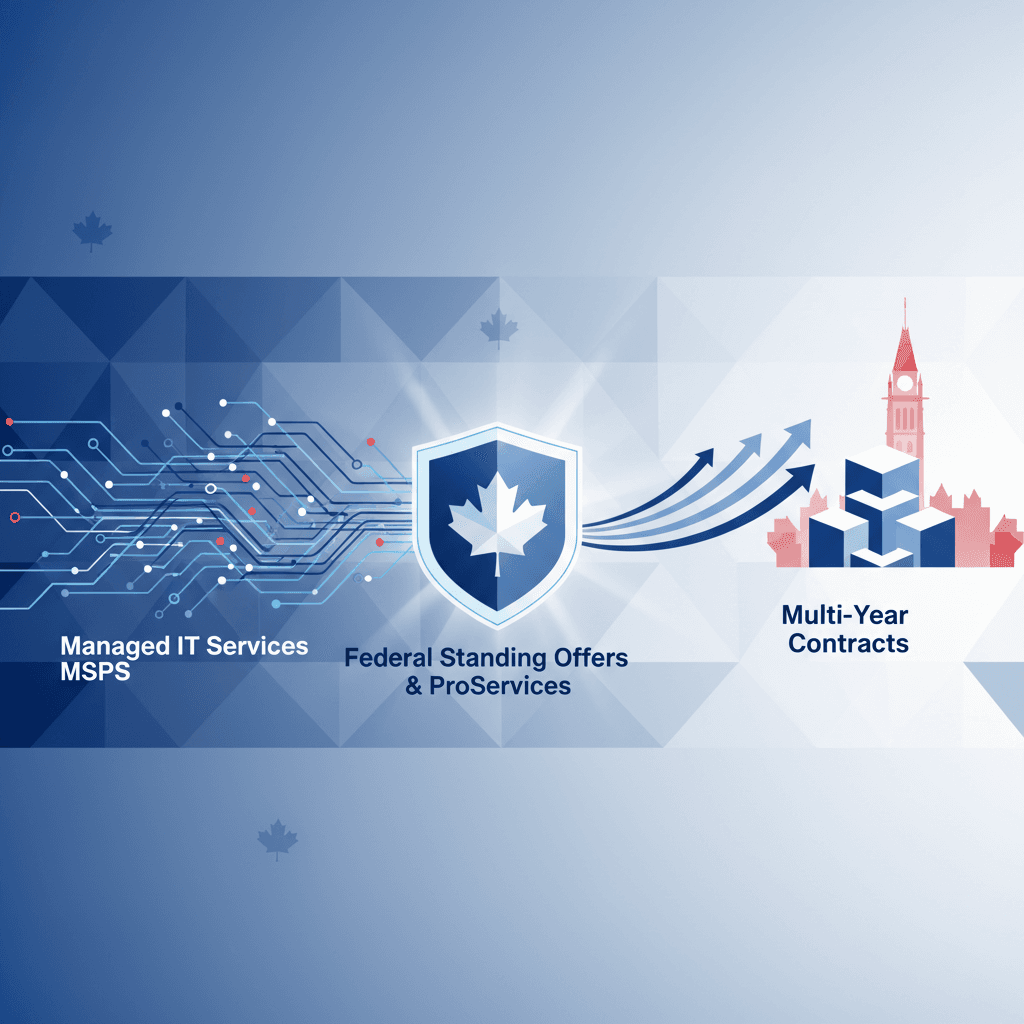
How MSPs Win Multi-Year Managed IT Services Contracts Through Federal Standing Offers & ProServices
A managed service provider in Toronto spent three months preparing a detailed proposal for a federal IT contract, only to discover their submission was rejected because they hadn't pre-qualified through the right standing offer vehicle. Meanwhile, their competitor—with half the technical capacity—won a three-year, $2.8 million contract simply because they understood how government procurement actually works in Canada.
If your MSP wants to break into government contracts, you need to understand that winning federal managed IT services work isn't about having the best technology or the lowest price. It's about navigating the specific mechanisms that Canadian government procurement uses: standing offers, supply arrangements, and vehicles like TBIPS and SBIPS. These aren't just bureaucratic hurdles—they're the actual pathways to predictable, multi-year revenue streams that can transform your business.
Government contracts represent a massive opportunity for Canadian MSPs. Federal departments need ongoing support for networks, cybersecurity, help desk services, and infrastructure management. But the government procurement process is fundamentally different from commercial sales. You can't just respond to a Request for Proposal (RFP) and hope for the best. Understanding the government RFP process guide starts with knowing how standing offers work, what thresholds trigger different procurement methods, and how to position your firm before opportunities even hit the market.
Here's the thing: Public Services and Procurement Canada (PSPC) doesn't run a new competition every time a department needs IT support. That would be impossibly slow. Instead, they maintain pre-qualified supplier lists through standing offers—essentially pre-approved rosters where government buyers can issue "call-ups" for specific work without running full competitions. For MSPs trying to figure out how to win government contracts Canada, getting onto the right standing offers is step one. Tools like Publicus help simplify the government bidding process by aggregating RFPs from various sources and using AI to qualify opportunities, helping you find government contracts Canada that match your capabilities and save time on government proposals.
Understanding Federal Standing Offers and Supply Arrangements
Standing offers aren't contracts. That's the first thing to understand. A standing offer is a pre-qualified list of suppliers who've proven they meet mandatory criteria—technical capabilities, security clearances, financial stability, and compliance requirements. The government has no obligation to buy anything just because you're on the list. But when a department needs services covered by that standing offer, they can issue a call-up directly to qualified suppliers without running a full open competition.
PSPC manages several standing offer mechanisms for IT professional services. The two most relevant for MSPs are Task-Based Informatics Professional Services (TBIPS) and Solutions-Based Informatics Professional Services (SBIPS). TBIPS covers discrete IT tasks and staff augmentation up to $3.75 million—think project-based work or supplementing government IT teams. SBIPS handles comprehensive solutions where the government wants a complete managed service rather than just bodies in chairs.
The catch? You need to qualify first. Standing offers follow a three-phase lifecycle: planning (where PSPC defines mandatory criteria like technical specs, security requirements, and financial stability), solicitation (the Request for Standing Offers or RFSO), and evaluation. Only suppliers who meet all mandatory requirements during the RFSO process get added to the standing offer list. Miss one mandatory criterion, and your entire submission gets tossed, regardless of how strong the rest of your proposal is.
National Master Standing Offers (NMSO) cover nationwide IT services, which means once you're qualified, any federal department across Canada can potentially issue call-ups to your firm. For smaller requirements, there are commodity-specific standing offers. For example, commercially available IT training services operate under GSIN U009E, with call-ups authorized for requirements below $25,000 including taxes. These smaller standing offers are managed through BuyandSell.gc.ca, where departments can issue call-ups via forms, email, phone, or even vendor websites.
What most don't realize: PSPC recently launched an AI Source List in 2025 that pre-qualifies 145 suppliers for AI-related IT contracts up to $9 million, based on expertise in modeling and machine learning. If your MSP has AI capabilities—whether that's implementing AI tools for clients or using AI in your service delivery—this represents a significant new opportunity in government contracting.
The Multi-Year Contract Advantage
Government departments love predictability. They don't want to re-procure help desk services every year or renegotiate network monitoring contracts annually. Multi-year contracts reduce administrative burden and provide service continuity. For MSPs, multi-year agreements through standing offers mean predictable revenue, better resource planning, and the ability to invest in relationship-building with government clients.
Standing offers enable multi-year call-ups for recurring IT needs without new competitions. Once you're on the standing offer and a department issues a call-up to your firm, that call-up becomes a binding contract—potentially spanning multiple years depending on how the department structures it. The standing offer itself might be valid for five years, with individual call-ups extending two to three years with renewal options.
The financial thresholds matter here. TBIPS covers work up to $3.75 million, but that's per task or project. For comprehensive managed services—ongoing support, monitoring, security, backup, and infrastructure management—SBIPS provides the vehicle for larger, longer-term engagements. These aren't quick staff augmentation gigs. They're genuine managed service relationships where your firm becomes the IT department for a federal agency or program.
Pricing structures for multi-year government contracts differ from commercial MSP agreements. Flat-rate or per-user models work, but you need annual increase clauses tied to inflation or industry benchmarks. Government procurement evaluates on "best value"—a combination of technical points, price, and compliance. For larger deals, Industrial and Technological Benefits programs or Indigenous participation can factor into scoring. Your pricing needs to be competitive but sustainable over multiple years, with clear mechanisms for scope adjustments as client needs evolve.
Building Winning Service Level Agreements and Proposals
Government evaluators scrutinize SLAs differently than commercial buyers. Vague promises about "reliable service" or "fast response times" won't cut it. You need specific, measurable commitments that align with federal requirements for uptime, security, and accountability.
Start with response times tied to severity levels. Critical issues—system down, security breach, complete service outage—should have response times around 30 minutes with resolution targets based on the specific scenario. High-priority issues might be 2-hour response, 4-hour resolution target. Medium and low priority can extend to 4 hours and next business day respectively. The key is defining what constitutes each priority level with specific examples relevant to the department's operations.
Uptime guarantees need to be realistic but competitive. Most federal IT SLAs target 99.5% to 99.9% uptime for critical systems, with defined maintenance windows that don't count against availability metrics. Include your monitoring methodology—how you track uptime, what constitutes an outage, and how you report on performance. Government clients want transparency and documentation.
Cybersecurity is non-negotiable in federal contracts. Your proposal must address NIST-aligned data protection standards (Canada follows NIST frameworks extensively), breach notification protocols (typically within 24 hours), vulnerability management processes, and annual security certifications. The average cost of a data breach is $4.88 million—government departments are acutely aware of this risk. Demonstrate that you have robust security practices, insurance coverage, and incident response procedures.
Backup and disaster recovery specifications need detail. How frequently do you back up data? Where are backups stored? What's the recovery time objective (RTO) and recovery point objective (RPO)? Can you demonstrate successful disaster recovery tests? Government evaluators often include technical staff who will assess whether your DR capabilities meet their operational requirements.
Governance structures matter more in government contracts than commercial deals. Quarterly strategic check-ins, customer-approved run books, clear escalation paths, and defined change management processes show that you understand how to work within government accountability frameworks. Include provisions for continuous improvement—annual reviews, satisfaction surveys, benchmarking against industry standards—that demonstrate you're committed to evolving service quality over multi-year terms.
Common Pitfalls and How to Avoid Them
Scope ambiguity kills more government MSP contracts than pricing issues. When your standing offer call-up doesn't clearly define what's included versus excluded, you end up in disputes over billable work. The solution is painful detail upfront. List specific services included in base pricing (unlimited help desk support for defined issues, proactive monitoring, monthly patching, quarterly reviews). Then explicitly list what requires change orders (new software deployments, hardware procurement, project work beyond maintenance).
Roughly 40% of contract disputes stem from unclear scope definitions. In government contracts, disputes don't just strain relationships—they can result in formal procurement complaints, contract termination, or exclusion from future opportunities. Use examples: "Help desk support includes password resets, account unlocks, printer troubleshooting, and basic application support. Help desk support does not include training sessions, custom script development, or troubleshooting third-party applications not listed in Schedule A."
Scalability clauses protect both parties when departments grow, shrink, or reorganize. Government organizations undergo frequent restructuring. Your contract needs mechanisms for adding or reducing users, locations, or infrastructure without requiring complete re-procurement. Build in proportional pricing adjustments—if the department adds 50 users to a 200-user contract, cost increases proportionally based on your per-user rate. Seventy percent of IT leaders regret signing contracts without adequate flexibility for organizational changes.
Performance accountability requires metrics tied to business impact, not just technical measures. Yes, you need uptime percentages and response times. But also consider metrics like "percentage of incidents resolved on first contact" or "average time to restore service for priority 1 incidents." These operational metrics matter more to government program managers than pure technical specifications. Include termination rights if your performance falls more than 15% off industry benchmarks or contracted SLAs—this demonstrates confidence and accountability.
The Qualification and Registration Process
Before you can bid on standing offer call-ups, you need to be registered and qualified. Registration happens through BuyandSell.gc.ca for most federal procurement opportunities, or through Shared Services Canada's procure-to-pay portal for certain IT commodities. Registration itself is straightforward—basic business information, tax numbers, banking details for payment.
Qualification for specific standing offers is more demanding. When PSPC issues an RFSO—Request for Standing Offers—they define mandatory requirements that suppliers must meet. These typically include demonstrated experience (number of years, size of contracts, relevant client references), technical capabilities (certifications, security clearances for staff, specific technology expertise), financial stability (minimum revenue, bonding capacity, insurance coverage), and compliance commitments (employment equity, green procurement, Indigenous participation if applicable).
The evaluation isn't just pass/fail on mandatory criteria. Competitive criteria determine your ranking on the standing offer list. Higher-ranked suppliers might get first opportunity for call-ups, or departments might be required to solicit quotes from the top three ranked suppliers. Technical capability scores often carry the most weight—60-70% of total points—with price and other factors making up the remainder.
Here's what trips up many MSPs: standing offers have expiry dates and require requalification. A typical standing offer might be valid for five years, but PSPC can update qualification requirements or issue new RFSOs that replace existing standing offers. You need to monitor BuyandSell.gc.ca regularly for RFSO opportunities in your service areas. Missing an RFSO means waiting years for the next qualification opportunity, while your competitors secure multi-year call-ups.
Security clearances deserve special mention. Many federal IT contracts require personnel with security clearances—Reliability Status at minimum, often Secret clearance for more sensitive systems. Obtaining clearances takes time (weeks to months), and you need sponsorship from a government contract to get cleared. This creates a catch-22: you need cleared staff to win contracts, but you need a contract to get staff cleared. The solution is building relationships with departments willing to sponsor your key staff for clearance during the standing offer qualification process, or hiring staff who already hold active clearances from previous government work.
Positioning Your MSP for Success
Standing offers reward specialization and demonstrated capability in government-relevant areas. General "we do everything IT" positioning doesn't win federal contracts. Instead, identify specific areas where your MSP has deep expertise that aligns with government needs.
Cybersecurity and compliance is the most obvious differentiator. Federal departments face increasing cyber threats and strict compliance requirements. If your MSP specializes in security monitoring, threat detection, incident response, and regulatory compliance, you're addressing a critical government pain point. Highlight certifications (CISSP, CISM, relevant vendor security credentials), participation in threat intelligence sharing, and experience with compliance frameworks relevant to government (NIST, ITSG-33, FedRAMP equivalents).
Cloud migration and management represents another high-value specialization. The Government of Canada has a cloud-first policy, but many departments struggle with migration planning, security in cloud environments, and ongoing cloud operations. MSPs with proven cloud expertise—particularly in hybrid environments connecting on-premises systems with cloud services—can differentiate in standing offer competitions.
Legacy system support might sound unsexy, but government IT environments include decades-old systems that still run critical programs. If your MSP has expertise maintaining and integrating legacy systems—older databases, mainframes, or custom applications—this addresses a real government challenge. Many vendors chase shiny new technology; fewer want to support a 20-year-old system that processes pension payments for millions of Canadians.
Indigenous partnership and participation can significantly strengthen your standing offer qualification. The federal government has procurement targets for Indigenous businesses and evaluates Indigenous participation in larger contracts. If your MSP is Indigenous-owned, or you have formal partnerships with Indigenous firms for service delivery, this creates competitive advantages in evaluation scoring and can open doors to set-aside contracts reserved for Indigenous suppliers.
Looking Forward: Opportunities and Trends
The managed services market in government IT is shifting. Traditional "keep the lights on" contracts are evolving toward strategic partnerships where MSPs drive digital transformation, not just maintain existing systems. This creates opportunities for firms that position themselves as advisors and innovators rather than commodity service providers.
The PSPC AI Source List launching in 2025 signals government interest in AI-enabled services. As an MSP, this doesn't necessarily mean you need to develop AI algorithms. It means considering how AI tools enhance your service delivery—automated threat detection, predictive maintenance, intelligent ticketing systems that route issues more effectively. Government departments want to understand how AI improves their operations, and MSPs who can articulate that value proposition will win.
Proactive service models are replacing reactive support in government procurement. Departments no longer want to just call when something breaks. They want MSPs who monitor continuously, identify issues before they cause outages, recommend optimizations, and provide strategic planning for technology evolution. Your standing offer proposals should emphasize proactive monitoring, regular technology assessments, and strategic advisory services as part of core managed services, not add-ons.
Auto-renewing terms with fair exit provisions are becoming standard in multi-year contracts. Government buyers want service continuity but also flexibility if circumstances change. Structure your proposals with initial terms (e.g., three years) that automatically renew for additional periods (one or two years) unless either party provides notice. Include transition assistance at no additional cost if the contract ends—this demonstrates confidence in your service quality and removes a barrier to signing long-term agreements.
Platforms like Publicus are changing how MSPs discover and pursue government opportunities. Rather than manually checking multiple procurement sites daily, AI-powered aggregation and qualification helps MSPs identify relevant opportunities faster and focus effort on bids they're most likely to win. For smaller MSPs especially, this efficiency gain makes government contracting more accessible—you're not competing against larger firms' business development teams, you're using technology to level the playing field.
The path to winning multi-year managed IT services contracts through federal standing offers isn't mysterious. It requires understanding the specific mechanisms PSPC uses, building detailed and compliant service offerings, qualifying for the right standing offers before opportunities arise, and positioning your MSP's unique capabilities in ways that resonate with government evaluators. The firms that succeed treat government contracting as a distinct competency—not just an extension of commercial sales—and invest in understanding procurement processes, building relationships, and delivering the accountability and transparency that government clients require.
Your competitors are already doing this. The question is whether you'll join them or continue watching from the sidelines while multi-year, multi-million dollar contracts go to firms who understand how the system actually works.
Sources
Share
Stop wasting time on RFPs — focus on what matters.
Start receiving relevant RFPs and comprehensive proposal support today.